
The Federal and Policing authorities agree on a rethink of how public safety resources are deployed across the country.
President Bola Tinubu has ordered the immediate withdrawal of police officers assigned to protect Very Important Persons (VIPs) across Nigeria and directed their redeployment to frontline policing duties. He issued the order on November 23, 2025, during a security meeting in Abuja with service chiefs and the Director-General of the Department of State Services.
Under the directive, VIPs who still require protection are to be guarded by armed operatives of the Nigerian Security and Civil Defence Corps rather than the police. With the presidency saying the move was aimed at boosting police presence in communities, particularly in areas with little or no visible security coverage.
This is not the first time such a withdrawal has been announced. Similar directives have been issued twice in recent years, but this time the order comes directly from the president, with steps now being taken toward implementation across the country. Still, this is the federal republic of Nigeria.
The ban
The withdrawal order came at what seemed like a peak and then a plateau in Nigeria’s worsening security situation and the growing strain on the manpower of security forces. Many parts of the country faced some form of armed attack, from banditry to kidnapping, crowned with slow emergency response times, especially outside major cities. At the same time, thousands of trained police officers were tied to personal escort duties for politicians, business figures, and other elites.
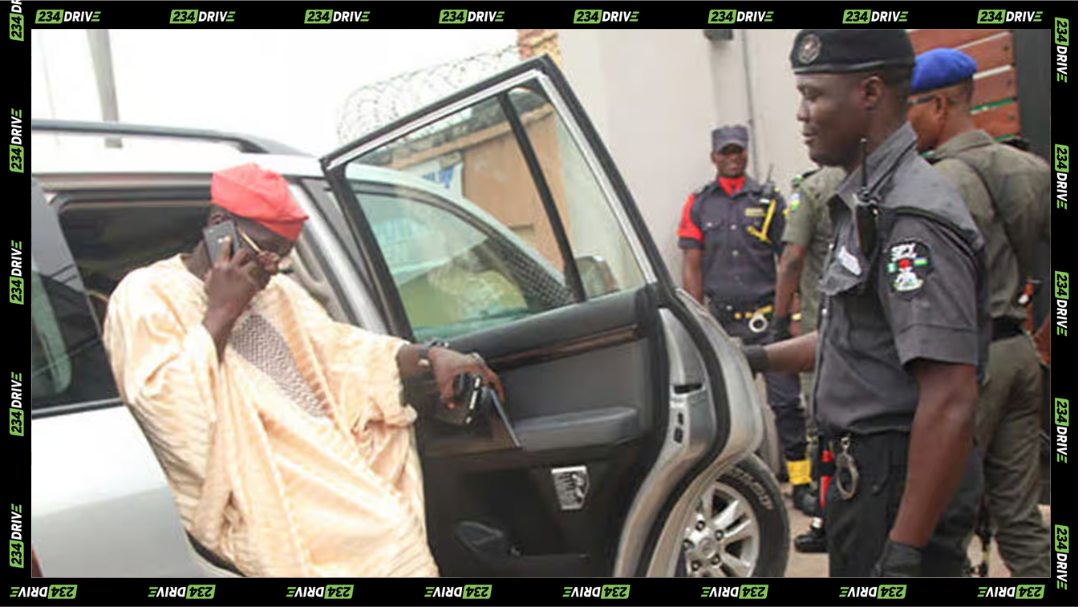
A police officer stands beside a vehicle during a routine escort scene, highlighting long-standing practices now facing renewed scrutiny and possible change. | Source: The Guardian
According to a statement on facebook from presidential spokesperson Bayo Onanuga, many police stations, particularly in rural and remote areas, operate with too few officers to effectively protect residents. The government said redeploying officers from VIP duties back to communities is necessary to strengthen public safety and restore confidence in everyday policing.
Security around VIPs has long been criticised by Nigerians, especially the large convoys common in major cities. Police officers and their vehicles are often used to clear roads ahead, sometimes even blocking intersections. These officers also guard private homes, and escort individuals who sometimes are not legally entitled to such protection, taking resources away from everyday policing and emergency response.
Before the president’s ban
Four months before the presidential directive, the Special Adviser to the President on Policy and Coordination, Hadiza Bala-Usman, publicly revealed that the government was already considering withdrawing police personnel from VIP protection duties.
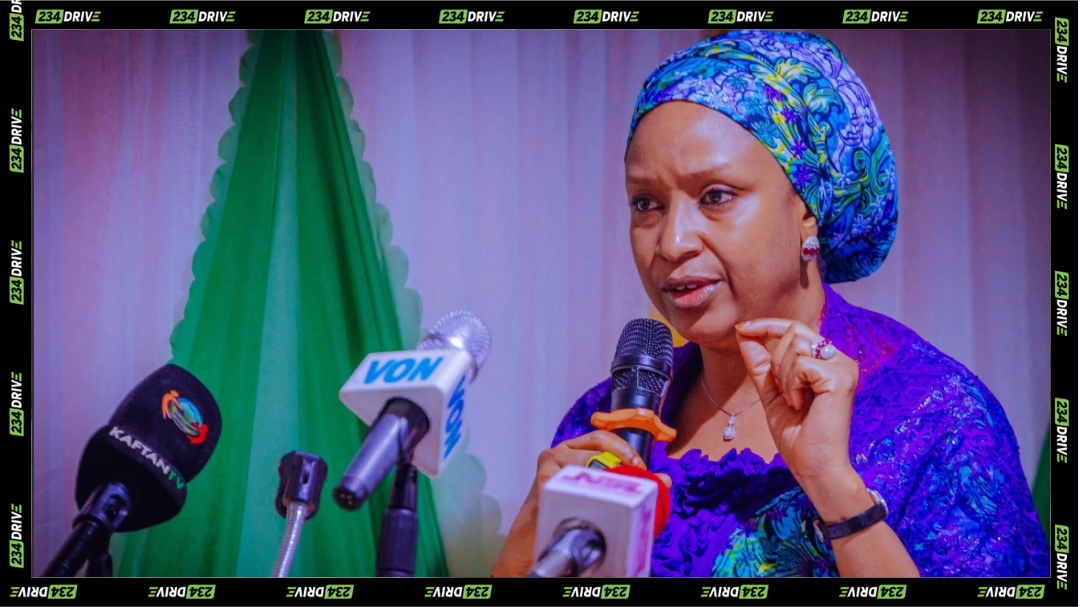
Special Adviser to the President on Policy and Coordination, Hadiza Bala-Usman addresses the media, reinforcing calls for security reforms and a clearer focus on protecting communities rather than individuals. | Source: Instagram
Speaking at a Ministry of Interior retreat in Abuja, she said ‘elite protection’ was weakening national security, calling it wrong to use anti-terrorism-trained officers to guard private individuals while vulnerable communities remain understaffed.
Bala-Usman also disclosed that the government was working to amend the 1986 Private Guard Companies Act to empower licensed private security firms to efficiently take over most VIP escort duties. According to her, VIP protection should not be treated as a public entitlement but as a privately funded service.
Nevertheless, even before her comments, earlier efforts by the police leadership to curb the practice had failed. In June 2023, just months after assuming office, Inspector-General of Police Kayode Egbetokun ordered the withdrawal of Police Mobile Force (MOPOL) operatives from VIP duties, stating that the unit would be reserved strictly for national security operations.
Less than two years later, in April 2025, the IGP issued a similar nationwide directive, again ordering mobile police officers to disengage from VIP protection. Despite both orders, enforcement remained uneven, and a large number of officers continued to serve in private escort roles.
Some VIPs reportedly complained that private security personnel lacked the training, authority, and situational awareness of police officers. These concerns were often used to justify keeping police escorts, even after repeated withdrawal orders. Bala-Usman responded that the answer was not continued police protection but stronger private security systems built with the support of experienced former officers.
The scale of the issue was publicly weighed in a November 2025 report by the European Union Agency for Asylum. The report noted that more than 100,000 police officers were assigned to VIP protection, leaving an effective force of about 271,800 officers for a population of roughly 236.7 million people. That translates to approximately one officer for every 871 citizens, or about 115 officers per 100,000 people.
Even at full strength, Nigeria’s police-to-population ratio remains low, and Nigerians do not need the declaration of an international body to see that the force is overstretched. The agency linked this shortfall to slow emergency response times, weak community presence, and recurring reports of unprofessional conduct, such as extortion and arbitrary arrests.
After the ban
Following the presidential order, the Nigeria Police Force moved to show power and enforcement, deploying special monitoring teams to track compliance and redeploy officers to crime prevention and community policing.
In Lagos, officers were stationed at key checkpoints and high-traffic locations, including the Lekki-Ikoyi Link Bridge and Murtala Muhammed International Airport, to monitor unauthorised police escorts.
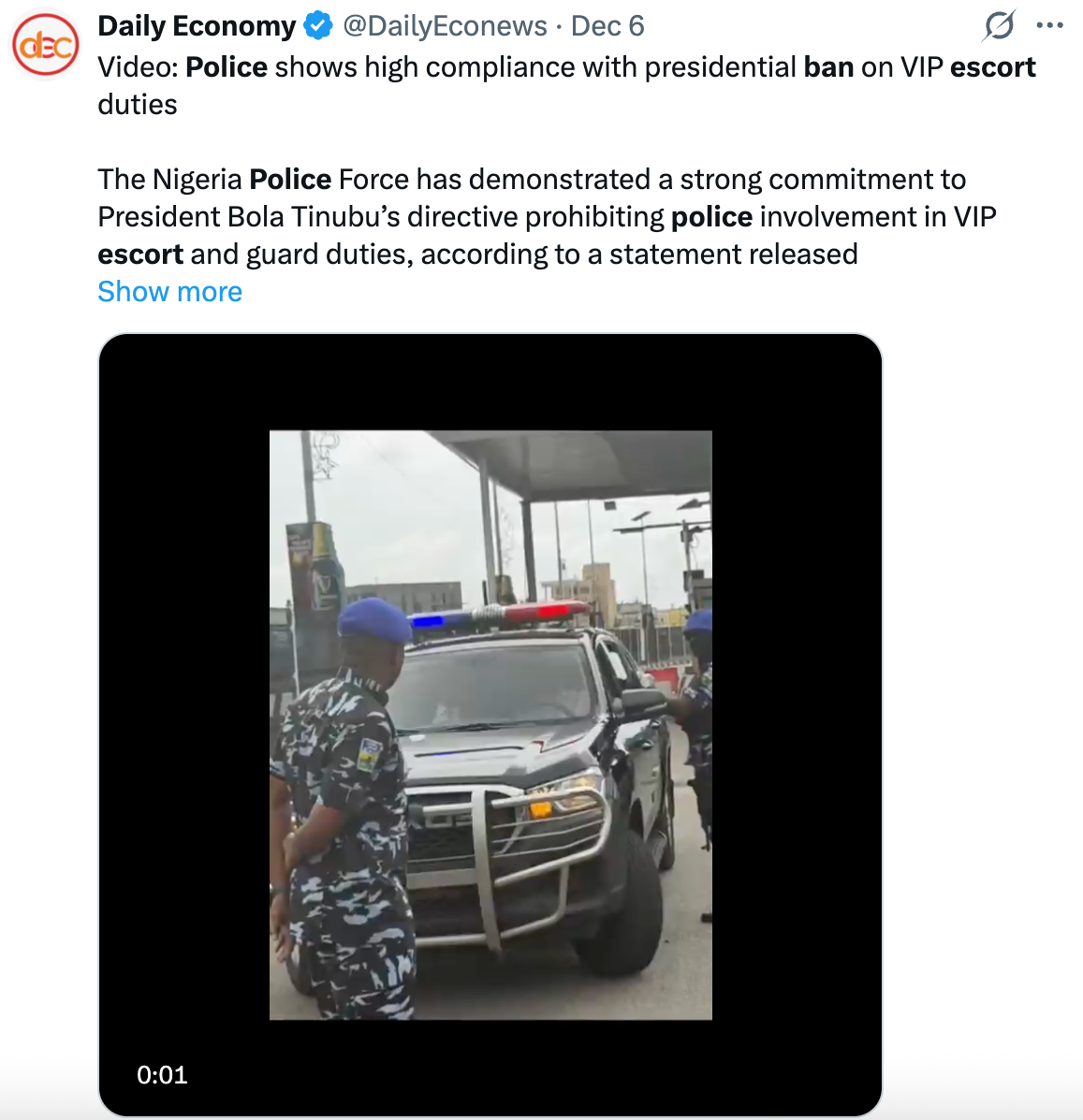
Source: X
On December 5, the police reported satisfactory compliance during the initial exercise, saying no violations were observed and no arrests were made. The Force added that monitoring would continue nationwide and asked for the public to cooperate as officers return to core policing duties.
Separately, the presidency approved the recruitment of 30,000 additional police personnel and announced plans to upgrade police training facilities in partnership with state governments.
However, while official police reports point to broad compliance, it is not possible to independently confirm full nationwide adherence. Some residential estates and private locations are still reported to operate security arrangements that appear to involve police personnel. Although it remains unclear if these deployments are authorised exceptions or cases where the directive is not being fully followed.
Nevertheless, what is clear is that the police will be shuffled out for the Civil Defence Corps, private firms and other paramilitary agencies. Moreover, ministers and senior officials have been instructed to obtain presidential clearance before requesting police escorts, and gaps created by withdrawals are to be filled through inter-agency cooperation.
The withdrawal marks one of the most direct attempts yet to rebalance Nigeria’s security resources away from elite protection and toward public safety. Whether this effort succeeds where previous directives stalled will depend on sustained enforcement and the government’s willingness to resist pressure from powerful interests accustomed to state-funded protection.