
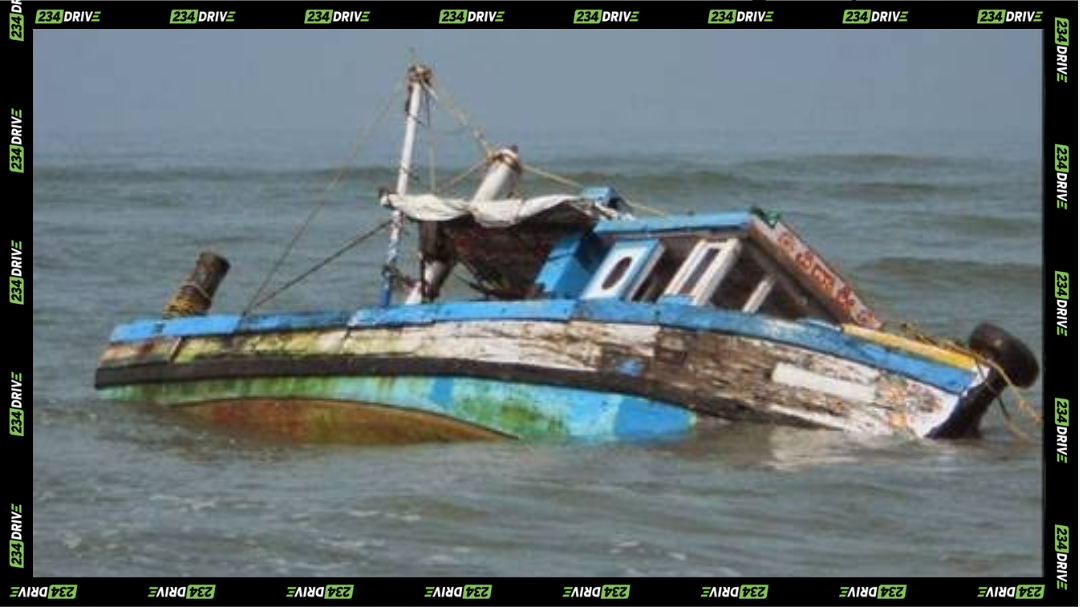
A wooden boat lies partially submerged after an accident, exposing the safety risks of ageing vessels on busy waterways. | Source: ICIR
Nigeria’s Federal Government has intensified its push for tighter waterway safety, following renewed urgency after a boat accident in Lagos left six passengers dead and four rescued along the Nigerdock axis of the Igbologun Water Channel.
The incident occurred at about 8:35 p.m. on Tuesday 6th January, involving a commercial passenger boat travelling along the Ilashe Beach House route. In a joint statement, the Lagos State Waterways Authority (LASWA) and the National Inland Waterways Authority (NIWA) said search-and-rescue teams were activated immediately after a distress alert.
Rescue teams pulled four passengers alive from the water and rushed them to a nearby hospital, while they recovered six others dead. Search operations remain ongoing to account for everyone involved, as preliminary findings suggest the boat may have struck a submerged object.
The Lagos tragedy has reinforced warnings from the Federal Government about the risks posed by unsafe commercial vessels. Earlier this month, the Minister of Marine and Blue Economy, Adegboyega Oyetola, called on state governments to ban wooden boats from commercial water transport nationwide and replace them with fibre-reinforced plastic and aluminium boats.
According to the ministry, many wooden boats in use across Nigeria’s waterways are poorly built, weakly regulated, and prone to failure—especially when overloaded or operated at night. The government argues that modern and luxury boats offer greater stability, durability, and capacity for essential safety equipment, significantly reducing the risk of capsizing or structural collapse.
While the federal government distributed 35,000 life jackets to riverine states in 2025, officials acknowledge that protective equipment alone cannot offset the dangers of unsafe vessels and poor compliance with safety standards.
Recent Boat Accident Incidents
The Lagos crash is the latest in a series of fatal waterway accidents that have kept safety concerns in sharp focus. Authorities say many of these incidents share common factors: night travel, weak enforcement, overcrowding, and unsafe boats.
One of the most devastating cases occurred in Yobe State on 4th January 2026, where a boat accident resulted in the heavy loss of 25 lives and 14 missing, which drew national attention to the state of inland water transport safety. Regulators say that crash, along with others across coastal and riverine states, shows that small, one-off fixes are no longer enough.