

A roadside encounter between police officers and corps members adds to growing concern about harassment during routine stops. | Source: Abisoye Omotosho on X
In recent months, more Nigerians have taken to X (formerly Twitter) and other social platforms to share videos of far-from-pleasant police encounters on the road. Many of the clips involve drivers and passengers—typically young people—in private or ride-hailing cars. What used to be limited to ‘he-said, she-said’ accounts is now increasingly being documented in real time through phone cameras and wearable devices like Meta glasses, making allegations of harassment more credible and harder to wave away.
More People Are Bringing Their Police Encounters Online
For a long time, Nigerians have been talking about police harassment on the road. Complaints about it have circulated for years. But it usually only gets wider attention when a video shows up online—often filmed from a distance, with the person recording trying not to draw attention to themself.
Now, that is starting to change as more people are ready to whip out their phones or small recording devices to capture their side of these stops.
Across a number of these clips, there is a pattern of intimidation, threats, aggressive questioning and indirect attempts to extort money from Nigerians.
One example is detailed in an X post by user @Prezido, wherein a young man was allegedly held back by two police officers while his car was driven away by another. This happened in Asaba, and no further information was given to the general public on this incident. Responses in the comment section suggested that similar incidents had been reported along that stretch of road.

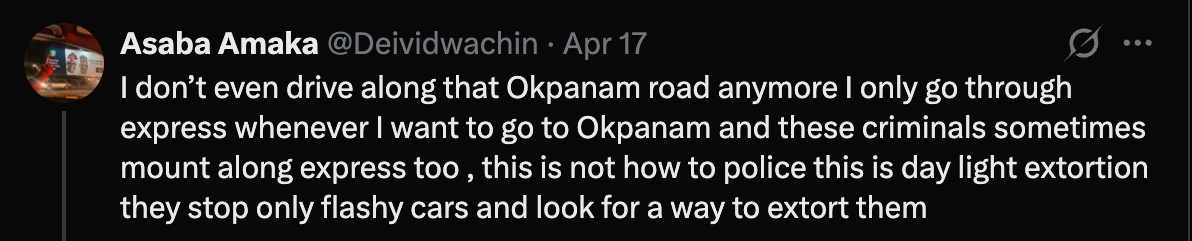
One might expect young Nigerians, who already struggle to afford cars, to find a sense of peace once they are finally behind the wheel. Instead, that seems to put a big target on them for law enforcement officers.
Even family vehicles aren’t immune from suspicion, as online accounts suggest that the Nigerian police do not discriminate in that regard. A recent post by @AbisoyeOmotosho clearly illustrates this. A man and his female partner had been on their way to watch a football match when they were stopped on the road. A male police officer then tried to search his partner, but he declined and asked that a female officer carry out the search instead. The situation escalated from there, with officers verbally abusing his partner before it turned physical and he was slapped.
Even With Complete Papers, Drivers Still Report Harassment
A late-night stop involving popular TikToker Lumber is one more on the growing list of online complaints about how some police officers treat road users in Lagos. According to a post shared on X, Lumber and his friends were stopped during a search and officers reportedly took Submarine Boy’s (a member of the friend group) car papers and asked the young men to follow them to their vehicle for verification.
What should have been a short check then dragged on for hours. Lumber said the tension worsened when one of the officers reportedly tore the papers during the exchange. He then reportedly seized the officer’s phone and insisted that the damaged papers had to be replaced before he would return it. The back-and-forth exchange was said to have lasted from about 1 a.m. until around 4 a.m.
The Official Police Response Stops At ‘We Are Looking Into It’
Following a widely shared incident involving the harassment of two young men on 4 April, the Nigeria Police Force confirmed via X that the officers involved had been identified and would face disciplinary action. But the police did not publicly explain what exact sanctions would follow.
That is where the bigger issue lies. The problem is not only that these incidents keep showing up online. It is that the public is often left with the same kind of follow-up: a promise to investigate, a statement about due diligence and no clear public account of what happens after.
It would be hard to confirm from the available reporting if these incidents are truly rising in a measured statistical sense. But they are clearly becoming more visible, and in recent months there has been no equally clear response from the authorities that matches the scale of what the public’s reports suggest.