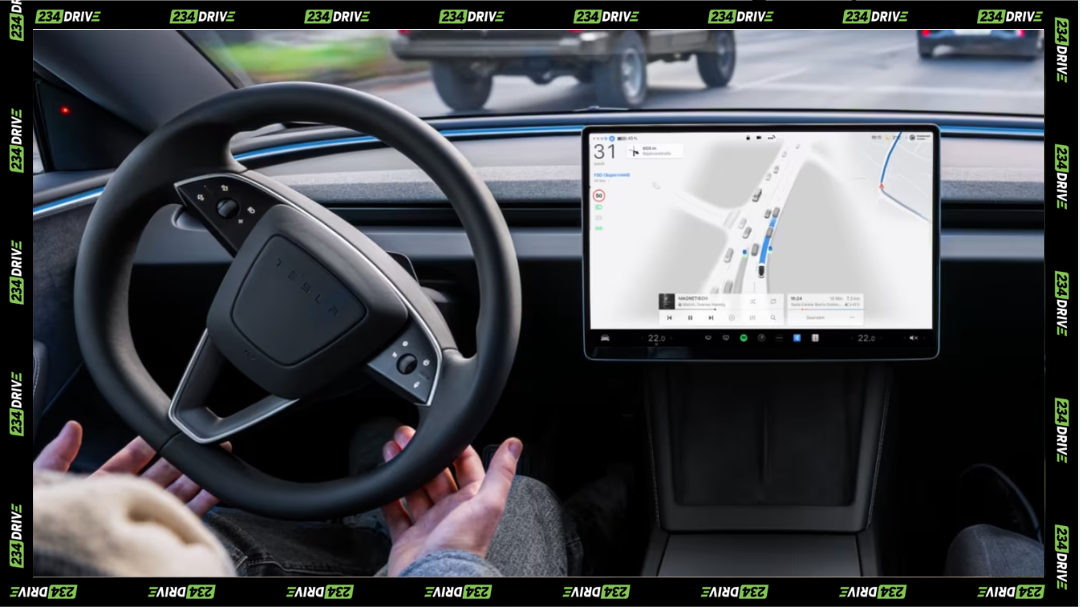
Tesla’s Full Self-Driving interface displayed on the central dashboard, showing live navigation and driving decisions while the system actively operates. | Source: Teslarati
Valentine’s Day is usually about locking in a long-term commitment, but Tesla is taking the opposite route. Tesla CEO Elon Musk said on his social media that the Full Self-Driving (FSD) will move to a monthly-only subscription, ending the outright purchase option. So before you swipe your card, it’s worth pausing to figure out what works best for you—owning it outright now or living with a recurring monthly fee.
Starting after 14th February, Tesla plans to stop selling Full Self-Driving as a one-time purchase. Until now, buyers could either pay $8,000 upfront or subscribe for $99 per month or $999 per year. Going forward, Tesla says FSD will only be available as a monthly subscription. Elon Musk announced the change but did not confirm whether the monthly price will stay the same or change with the structure.
Moreover, It’s still not known how this shift will affect owners who already paid the $8,000 upfront or those on annual plans, as Tesla hasn’t released official details. It’s also worth mentioning what Tesla’s FSD offers actually: despite the name, it isn’t entirely self-driving. Drivers must still stay alert and ready to take control at all times. So by the auto-industry standards, it’s more of a Level 2 driver-assistance system.
Here Are Five Things Tesla’s Full Self-Driving Subscription Actually Offers
If you already have the full subscription, kudos. If you’re still deciding whether it’s worth a recurring fee, here’s a clear breakdown of what Tesla says FSD currently delivers:
- Summon from Parking
One of the coolest features, according to public opinion, is the car’s ability to navigate out of parking spaces and drive to you using the mobile app. It does this with the aid of its camera system to avoid obstacles.
- Always-On 360° Vision
Tesla says its camera-based system maintains constant awareness around the car, supporting blind-spot checks, lane positioning, and the detection of cyclists and motorcycles—covering angles the human eye can’t see all at once.
- Safety Performance Claims
The American carmaker says its FSD (Supervised) system records fewer crashes per mile than the U.S. average, pointing to added safety support that can help reduce common driving errors during everyday use.
- Automatic Lane Changes
On highways, the system can check blind spots and change lanes smoothly without driver prompts while maintaining speed and spacing, with some current FSD users saying the feature has helped them avoid close calls and potential crashes.
- Urban Driving Features
The Tesla can now better handle complex city driving situations such as roundabouts and unprotected turns, following recent software updates, though the description of “human-like intuition” is majorly part of the company’s sales copy.
Is Africa Ready for Subscription-Based Features in Vehicles?
Subscription services are becoming part of everyday life, from gym memberships and streaming platforms to software tools we pay for monthly, and cars are beginning to follow that same direction. What started in the digital space is now extending into vehicle features, and automakers appear to be leaning into it.
Additionally, while Africa’s auto market is growing, it’s doing so unevenly and still has some catching up to do compared with markets in the U.S. and Europe. A gap that means the continent may not be ready yet for subscription-based vehicle features, especially ones tied to advanced software and pricing in foreign currency. Over time, though, these ideas tend to find their way in as markets mature. This isn’t entirely new territory. BMW tested the waters earlier with paid heated-seat features, and the response was mixed at best. Tesla’s move to push Full Self-Driving into a subscription model is facing similar pushback today, suggesting that while the industry is heading in this direction, acceptance is still far from guaranteed.