
In the pantheon of automotive oddities, few cars have endured quite the roller-coaster reputation of the AMC Gremlin. Born on April Fool’s Day 1970—a date that seemed almost prophetic given the mockery it would endure, this truncated little American has evolved from automotive punchline to genuinely sought-after classic. Its journey from joke to jewel tells us something profound about how we judge cars, and how time has a way of revealing hidden virtues.
Let me take you through the story of a car that refused to be forgotten, despite everyone’s best efforts.
Why AMC Built a Car That Looked Unfinished
To understand the Gremlin, you need to understand 1970 America. American Motors Corporation, the scrappy underdog of Detroit’s “Big Four,” found itself in a precarious position. Foreign imports particularly the Volkswagen Beetle and Toyota Corolla were steadily claiming market share with their fuel efficiency and affordability. Meanwhile, AMC had just acquired Jeep, straining finances to their limit.
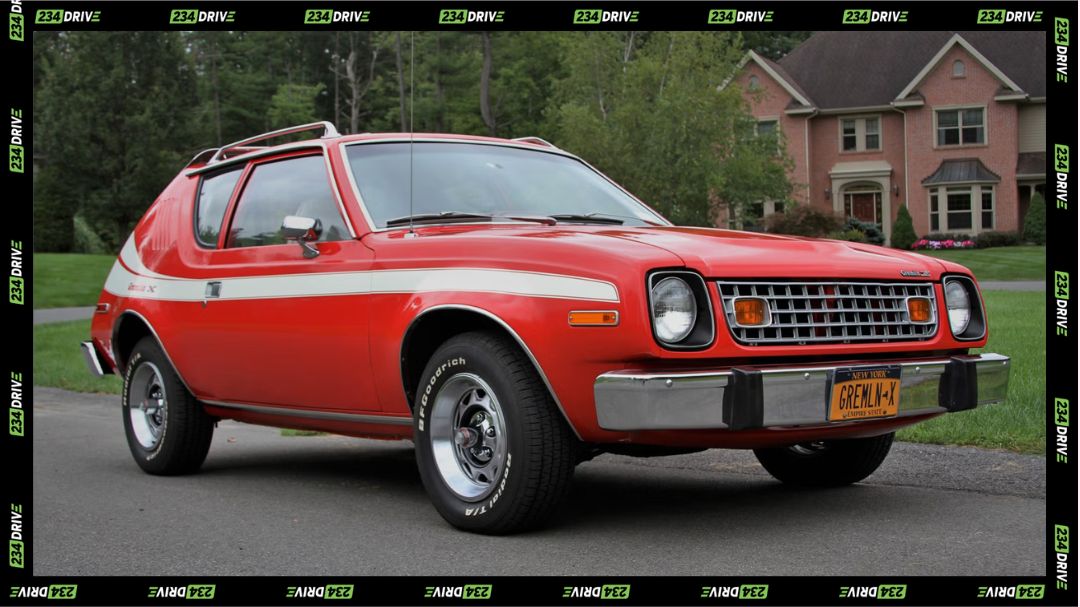
Rather than invest millions in an all-new platform, AMC’s legendary designer Richard Teague sketched a solution on an airline sick bag (truly). Take the existing Hornet platform, chop off the back end, and create America’s first domestic subcompact. The result was unconventional, to put it charitably, a car that looked like someone had simply forgotten to finish designing the rear. But unconventional doesn’t mean unsuccessful.
Priced from just $1,879 for the two-seater model (approximately $15,000 in today’s money), the Gremlin undercut nearly everything on the market. It sold 25,300 units in its truncated debut year, more than doubled to 50,000 in 1971, and absolutely exploded to 171,128 units in 1974 during the OPEC oil embargo. By the time production ended in 1978, over 671,000 Gremlins had found homes, making it AMC’s second-best-selling model ever, trailing only the Hornet from which it was derived.
That’s not the sales record of a failure. That’s the record of a car that understood its moment perfectly.
The Design
The Gremlin’s most distinctive feature—that abrupt, chopped-off rear end—was born out of pragmatism rather than aesthetics. By eliminating a proper boot or hatchback, AMC reduced manufacturing costs and increased body stiffness. The rear window lifted on four-seat models (though was fixed on two-seaters), providing cargo access that was functional if not particularly elegant.
The dimensions tell the story of a car designed to be small and efficient: a 96-inch wheelbase, 161.3 inches in length, 70.6 inches wide, and 51.8 inches tall, weighing between 2,500 and 2,700 pounds depending on configuration. Inside, you found exactly what you’d expect from a budget subcompactSpartan bench seat, minimal instrumentation, and rear legroom that was essentially theoretical. This was transportation, not luxury.
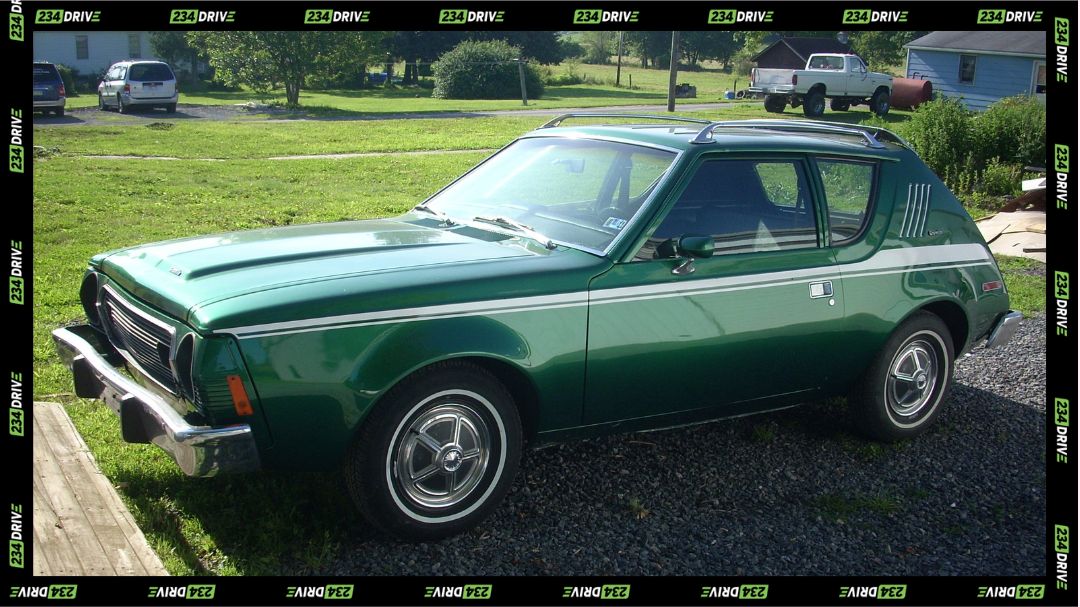
But AMC understood that even budget buyers wanted some personality. Special editions like the Gremlin X added racing stripes and upgraded trim. The collaboration with Levi’s produced models with denim interiors, a gloriously 1970s touch that perfectly captured the era’s aesthetic sensibilities. These weren’t just cars; they were cultural artifacts.
Under the Bonnet
The Gremlin’s engine range reveals AMC’s strategy: proven reliability as standard, with surprising performance available for enthusiasts willing to tick the right boxes.
Base models came with AMC’s trusty 199 cubic inch (3.3-litre) inline-six, producing 128 horsepower and 182 lb-ft of torque. Performance was leisurely about 15.8 seconds to 60 mph and a top speed around 95 mph but fuel economy in the 20-25 mpg range made it economical when petrol prices skyrocketed.
The 258 cubic inch (4.2-litre) inline-six became increasingly common in later models, delivering 110-120 horsepower and approximately 200 lb-ft of torque. Acceleration improved to the 12-14 second range for the sprint to 60 mph, with top speeds nudging 100 mph. Fuel economy dropped slightly to 19-23 mpg, but this engine earned a reputation for bulletproof durability.
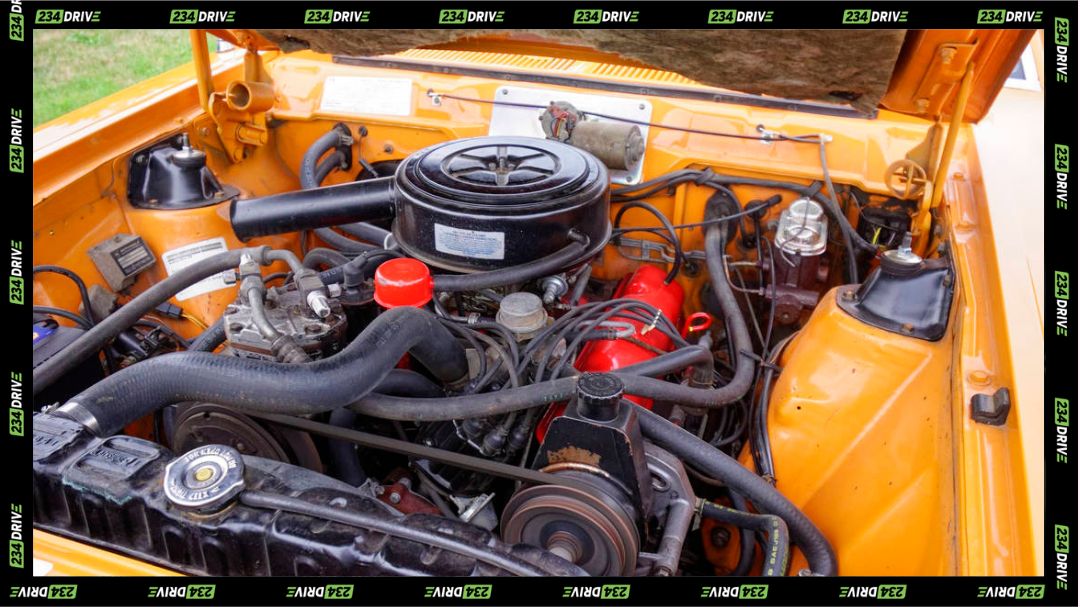
Here’s where things get interesting: From 1971 to 1974, you could order a Gremlin X with V8, featuring AMC’s 304 cubic inch (5.0-litre) unit producing 150 horsepower and 245 lb-ft of torque. Suddenly, this economy car could hit 60 mph in approximately 11 seconds with a top speed over 105 mph. Fuel economy plummeted to 15-20 mpg, but nobody ordering a V8 Gremlin cared about that.
In a 1971 comparison test against five rivals, the Gremlin actually excelled in acceleration, reaching 60 mph in 10.5 seconds quicker than the Ford Pinto and Chevrolet Vega. However, it ranked last overall due to poor fuel economy (19 mpg in testing), inadequate brakes (210 feet from 70 mph), cramped accommodation, and cheap materials. It was fast but flawed.
The final engine option arrived for 1977-78: a 121 cubic inch (2.0-litre) four-cylinder sourced from Audi/Porsche. On paper, this modern engine promised excellent efficiencyEPA ratings of 21 mpg city and 33 mpg motorway. Reality proved less impressive. Road & Track’s 1977 test achieved just 19.5 mpg in real-world driving whilst criticising the engine as noisy, shaky, and underpowered for the Gremlin’s 2,745-pound kerb weight. Only 7,558 buyers chose this option; the inline-six remained the preferred choice.
The Driving Experience
Contemporary reviews paint a consistent picture: The Gremlin delivered basic, predictable transportation with handling characteristics firmly rooted in 1960s engineering. Heavy steering required up to 6.25 turns lock-to-lock. Understeer was the default behaviour. Axle tramp during hard braking unsettled the rear end. The nose-heavy weight distribution didn’t help dynamics.
Braking felt dated compared to imports with disc brakes. The three-speed manual gearbox lacked synchromesh on first gear. The clutch was heavy. Controls felt agricultural. Compared to the more sophisticated Toyota Corolla or even the European Simca 1204, the Gremlin felt a generation behind.
But here’s the crucial point: For buyers who simply needed affordable, reliable transport during a fuel crisis, these shortcomings were acceptable trade-offs. The Gremlin wasn’t competing with sports cars; it was competing with expensive petrol and monthly bus passes.
Reliability
Ask Gremlin owners about reliability, and you’ll get surprisingly positive responses. The simple, proven mechanics, particularly those durable inline-six engines, proved remarkably robust. Many owners report decades of trouble-free motoring with nothing more than routine maintenance: brakes, tyres, spark plugs, and fluids.
However, the Gremlin wasn’t without issues. Rust attacked body panels with particular enthusiasm, especially in regions where roads were salted during winter. The fuel filler neck was prone to leaking from dry rot. Brake fluid leaks occurred. Interior materials rattled and wore quickly. Build quality varied significantly, some units were genuinely shoddily assembled, whilst others lasted indefinitely.
The critical distinction is this: The Gremlin’s flaws were typically fixable issues related to cheap materials and basic engineering, not fundamental design catastrophes. With rust prevention and sensible upgrades, Gremlins remain roadworthy today. That’s more than can be said for many of its contemporaries.
The Verdict Then and Now
Contemporary reviews were decidedly mixed. Road & Track’s 1977 assessment of the four-cylinder model lambasted the integration of a modern engine into an aging chassis, concluding the car felt noisy, shaky, and underwhelming. Regular Car Reviews’ 2019 video on a 1976 model emphasised its cultural role as an underdog cheap, weird, and emblematic of 1970s automotive mediocrity whilst acknowledging better acceleration than Pintos but criticising erratic steering and inconsistent brakes.
Yet MotorTrend’s retrospective argues the Gremlin “wasn’t terrible,” highlighting its sales success and reliability during fuel shortages. CarBuzz contends it doesn’t deserve its negative reputation, praising its iconic styling, affordability, and historical significance. The consensus seems to be: deeply flawed but fundamentally decent.
The Collector Market
Here’s where the story gets fascinating. The Gremlin has transformed from automotive punchline to genuinely desirable classic. Recent auction results demonstrate this evolution dramatically:
- Standard models in good condition fetch $12,000-$16,500
- Well-preserved Gremlin X variants command $20,000-$30,000
- Pristine, low-mileage examples have sold for up to $41,000
Several factors drive this appreciation. Nostalgia for 1970s Americana plays a significant role; people who grew up seeing Gremlins everywhere now have disposable income and want to recapture that era. Rarity matters too; fewer Gremlins survived than Pintos or Vegas, making good examples genuinely scarce.
The customisation potential appeals to enthusiasts as well. V8 engine swaps are popular, as are restomods that maintain the distinctive styling whilst upgrading mechanicals. The Gremlin provides an affordable entry point into classic car ownership without the premium prices commanded by Mustangs or Camaros.
For prospective buyers, verification matters. Build sheets authenticate rare models, particularly Gremlin X 304 V8 variants. Rust inspection is essential—check sills, wheel arches, and boot floors meticulously. Original documentation increases value significantly.
Why the Gremlin Matters
The AMC Gremlin holds a unique place in automotive history, born out of necessity during a time when Americans urgently needed affordable, fuel-efficient transport. While initially criticised for its unconventional styling, cheap materials, and dated engineering, the Gremlin succeeded by delivering on its core promise: economical and durable transportation at a price working families could manage, especially during the 1974 oil crisis. Its existence reflects a moment when American manufacturers were scrambling to adapt to new realities, prioritising function and affordability over sophistication.
Today, the Gremlin has transitioned from a figure of mockery to a collectible icon of 1970s Americana. Its distinctive, chopped-off rear end, once a point of derision, is now seen as bold and memorable. The car is appreciated for its honesty it made no pretense about what it offered and competently delivered on its modest promises. In a modern automotive landscape dominated by homogeneous designs, the Gremlin’s quirky integrity and survival offer a compelling narrative, suggesting that those who dismissed it too quickly are the ones who missed the point.