
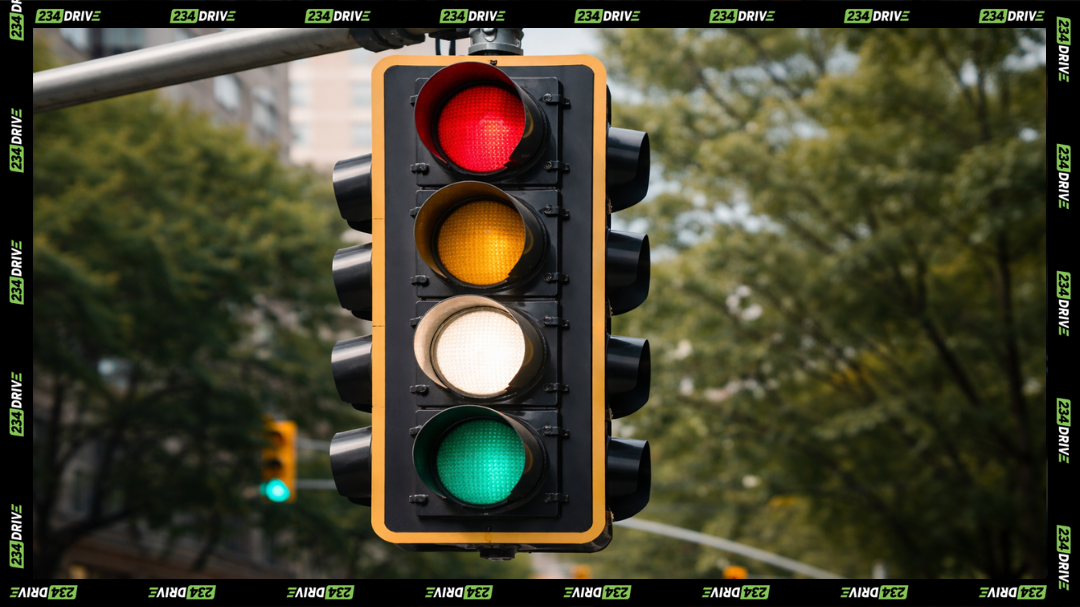
A four-light traffic signal hangs over a city street, with the white light glowing brightly.
A lot of changes might have to be made for this one. From crèche classrooms where children memorise red, yellow and green, the syllabus might need a fourth colour. Driving instructors would adjust their lesson notes. Road safety posters would add one more circle.
Researchers at North Carolina State University have proposed adding a fourth “white” signal to traffic lights. The white phase would activate when enough autonomous vehicles (AVs) approach an intersection, allowing those vehicles to coordinate traffic flow. Simulations show this reduces delays and lowers fuel consumption, especially as the percentage of AVs increases. When human-driven cars dominate, signals revert to the traditional system.
The White Light Lets Autonomous Vehicles Take the Lead at Intersections
The proposal relies on the fact that autonomous vehicles can communicate wirelessly. They already exchange information about speed and position. In this system, they would also share that data with the traffic signal. Instead of a single controller calculating every move, the vehicles help decide the smoothest way to pass through the intersection.
The researchers improved an earlier version of the concept by spreading the decision-making across the vehicles themselves. That makes the system less dependent on one central computer and more tolerant of brief communication delays.
Their simulations found that even a small share of autonomous vehicles can reduce delays. As the number increases, traffic flows more smoothly, and cars spend less time stopping and starting, which lowers fuel consumption.
Autonomous Cars Manage the Flow of Regular Traffic
When enough autonomous vehicles approach, the white light turns on. Those vehicles coordinate their movement and proceed in an organised sequence. Drivers in regular cars do not need to calculate anything new. They simply follow the car in front of them. If it moves, they move. If it stops, they stop. When there are not enough autonomous vehicles nearby, the intersection goes back to the standard signal cycle.
The white phase follows a growing trend of smarter intersections. In India, for example, some cities have tested “decibel lights” that respond to noise levels. When drivers honk excessively and noise crosses a set limit, the red light timer resets, forcing everyone to wait longer. The goal is to discourage unnecessary horn use.
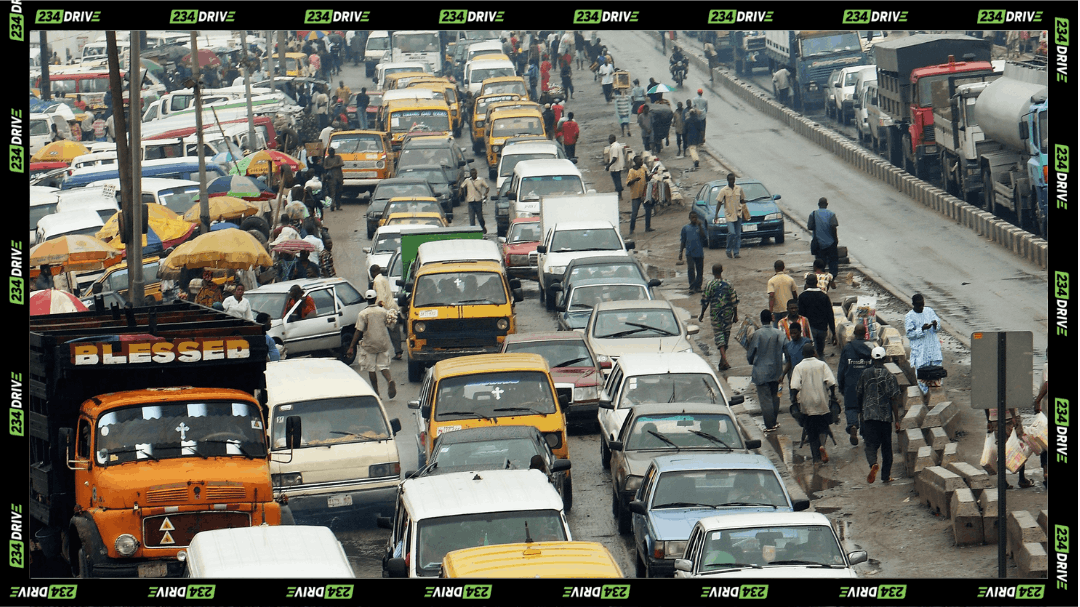
In many African cities, constant honking adds to stress and noise pollution at busy junctions. Noise-responsive signals could help reduce that behaviour. Testing systems like decibel lights alongside limited pilot projects for autonomous coordination in ports or logistics corridors may offer practical ways to improve traffic without overhauling entire road networks at once.