

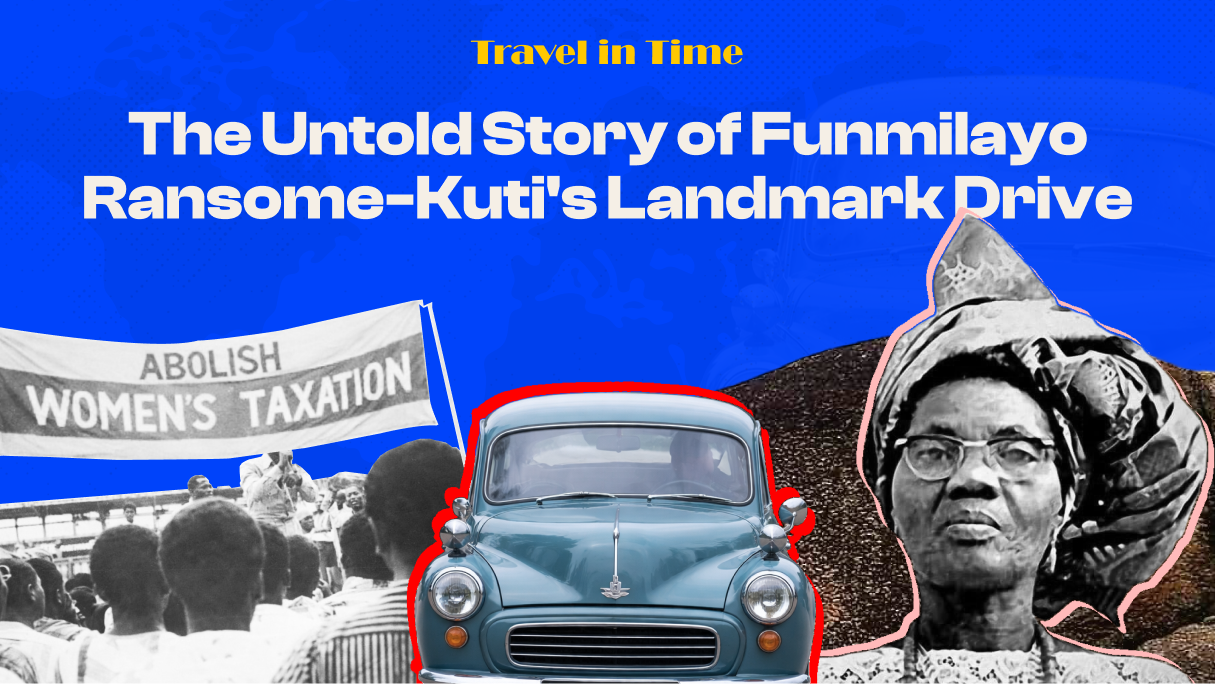
If you went to school in Nigeria, you probably learnt that Funmilayo Ransome-Kuti was the first woman to drive a car in the country. Your Social Studies teacher may have casually dropped it alongside fun facts like Herbert Macaulay being the first person to own a car in the country or Flora Shaw naming Nigeria.
And maybe when you got a little older, the name Funmilayo Ransome-Kuti came up again in relation to Fela Kuti, the Afrobeat legend who also happened to be her third child.Thankfully, recent years have seen Ransome-Kuti being remembered for much more: feminist icon, ‘Lioness of Lisabi’, freedom fighter.
Yet, there is still a lot of obscurity surrounding Ransome-Kuti’s momentous drive. What were the circumstances that led to her driving? What car did she drive? What was the outcome of her drive?
This is the story they didn’t tell you about the first woman to drive a car in Nigeria, and why it was such an important fact to memorise.
The Secondhand Car from England
Between March 1935 and July 1936, Funmilayo Ransome-Kuti (FRK) and her husband Reverend Israel Oludotun Ransome-Kuti arranged to have two secondhand cars shipped from England to Abeokuta through a friend named Solanke—likely their fellow activist friend Ladipo Solanke. The purchase wasn’t flashy or intended to make a statement. It was simply a practical choice that would serve their family.
Israel was a school principal, co-founder of the Nigeria Union of Teachers and the Nigerian Union of Students. He believed in education, unity and progress. Funmilayo had returned from England in 1922 after studying at Wincham Hall School for Girls in Cheshire. She was teaching, running literacy classes for market women and slowly realising just how deeply colonialism had disrupted the lives of ordinary Nigerians, especially women.
The first car never ran properly. Given the couple’s limited means, they’d been forced to buy used cars and the one Solanke sent wasn’t roadworthy, so they ordered a second, replacement car. This time, FRK made sure to tell Solanke to pay more attention to the condition of the brakes, clutch, gear and battery. The frustratingly poor operation of the first car had forced her into a crash course on cars, so she learnt what she could about car components.
Yet, when the second one arrived, it was also in poor condition. The Ransome-Kutis were furious. They felt Solanke had been careless and demanded their money back, but given their humble financial status at the time, the money they had sent him for the cars was probably not enough to buy good quality. It’s not clear whether he refunded it but the friendship survived as the couple maintained close relations with Solanke afterwards. It’s also not clear what models the cars were, but it’s safe to say that they were old and worn out as a mechanic in Nigeria had even labelled one of them ‘fifth hand’. In modern retellings of FRK’s legacy—such as the 2024 film Funmilayo Ransome-Kuti, the second car is often represented as a Morris Minor with the plate number ‘LN 7446’.
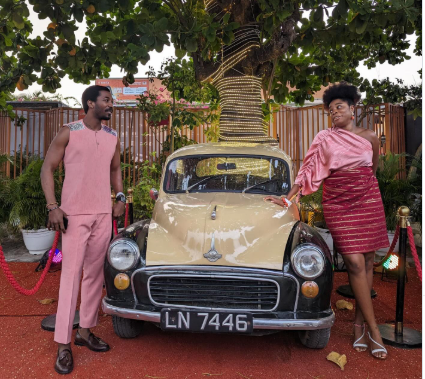
Made Kuti, the great-grandson of Funmilayo Ransome-Kuti, and his wife Inedoye Kuti, at the premiere of ‘Funmilayo Ransome-Kuti’, with a model of Ransome-Kuti’s car. Source: Inside Nollywood via Instagram
Before the cars, the Reverend had been riding a motorised bike while Funmilayo sometimes rode a bicycle, something she’d picked up in England. But after the Reverend had a moderately serious accident on his motorbike, the couple decided a car was safer. They made do with the second car and Funmilayo learned to drive it, making her the first woman in Nigeria to do so.
But here’s what they don’t tell you in school. The reason that fact mattered wasn’t because driving was hard or because women weren’t capable, but because Funmilayo Ransome-Kuti learning to drive was an extension of who she already was. A woman who refused to accept that any space, skill or form of power was off-limits simply because she was female.
The Marriage That Made It Possible
Funmilayo and Israel’s marriage, which began in January 1925, was unusual for its time. It was built on mutual respect, shared ideals and a genuine belief that men and women were equals.
Israel supported his wife’s activism in ways that were almost unheard of in 1930s Nigeria. When she founded the Abeokuta Ladies Club in 1932 and began organising literacy classes for market women, he didn’t object. When she dropped her Christian names Frances and Abigail in favour of her Yoruba name Olufunmilayo, he supported that. When she started challenging colonial tax policies and organising mass protests, he stood behind her.
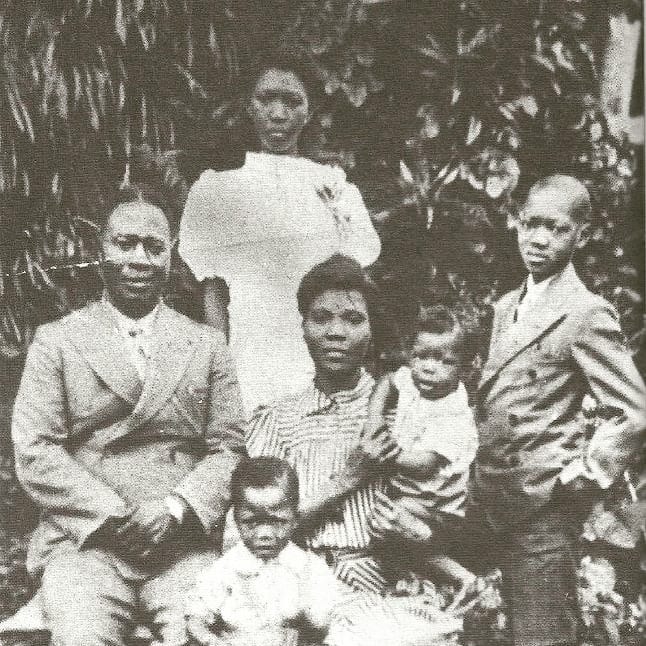
Reverend Israel Oludotun Ransome-Kuti, Funmilayo Ransome-Kuti and their children, Dolu, Olikoye, Fela and Beko. Source: www.picuki
Historian Cheryl Johnson-Odim noted how rare this partnership was. ‘He was an activist himself. He was the founder of the Nigerian Union of Teachers and also very leftist. He supported her, and there are not many men who would have allowed her to be at the forefront to do what she needed to do.’
The car was a symbol of that partnership; something they bought together and that empowered her to move beyond Abeokuta and expand her reach, just like he did.
What the Car Enabled
By the early 1940s, Funmilayo had begun taking her son Fela with her in the car to campaign meetings. In a biography years later, Fela told author Carlos Moore, ‘You know, she was the first woman to drive a car in Nigeria, man … Eventually I got to know what she was doing because she’d take me everywhere with her … And, ohhh-hhh, I liked the way she took on those old politicians, all those dishonest rogues.’
Fela remembered the car taking them everywhere: meetings, demonstrations, confrontations with colonial authorities. It was through this car that Fela got to witness his mother in all her activist glory and thus, the seeds of his own defiance were planted in that passenger seat.
The car gave FRK range. She could travel to other towns, connect with women beyond Abeokuta and attend meetings across the region. When the Abeokuta Ladies Club evolved into the Abeokuta Women’s Union (AWU) in 1946 and later the Nigerian Women’s Union (NWU) in 1949, she mobilised across regions and built a network that eventually grew to 20,000 members.
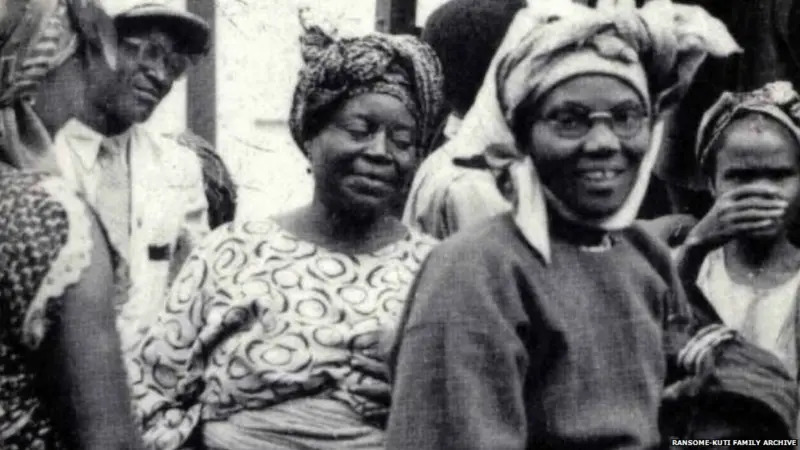
Funmilayo Ransome-Kuti, AKA the Lioness of Lisabi. Source: Ransome Kuti Family Archive
The AWU’s activism was rooted in economic justice. During World War II, British colonial authorities had introduced punishing taxes on market women in Abeokuta. Women as young as 15 were required to pay three shillings annually in income tax even if they were unemployed while men didn’t have to pay until they were 18. Women who couldn’t pay or refused were beaten, arrested, stripped and had their homes ransacked by Sole Native Authority policemen who abused their colonial powers.
FRK organised. In November 1947, she led 10,000 women to the Alake’s palace, singing and dancing in protest. The Alake was the local representative of the British colonial government. The women demanded an end to unfair taxation, arguing that since they had no meaningful representation in local government, they shouldn’t be taxed separately from men. They pointed out that under colonialism, their economic power was declining while their tax burden was increasing.
The protests worked. By April 1948, direct taxation of women ended. Four women received seats on the local council. And on 3 January 1949, Alake Samuel Ademola II was forced to abdicate and driven into exile.
It was one of the most successful women-led anti-colonial movements in African history. Funmilayo didn’t drive to the palace. She marched. But the mobility the car gave her in the years before helped her build the movement that made it possible.
The End of the Road
On 18 February 1977, Funmilayo Ransome-Kuti was at her son Fela’s compound, the Kalakuta Republic, when close to 1,000 armed soldiers stormed the property. They were there because Fela had released an album called Zombie, comparing the Nigerian army to mindless machines. It was the final straw in a long conflict between Fela and the military government.
The soldiers destroyed property, assaulted residents and threw Funmilayo, then 76 years old, out of a second-storey window. She sustained injuries that would eventually claim her life as she was admitted to hospital and remained there until her death on 13 April 1978.
Thousands attended her funeral in Abeokuta. Market women across the city shut down their shops and entire markets to mark her passing. The press called her a ‘progressive revolutionary’ and a ‘Pan-African visionary’.
One year later, Fela took a coffin and travelled nearly 20 kilometres to Dodan Barracks in Lagos (then Nigeria’s Supreme Military Headquarters) and left it at the gate. He detailed the invasion, his mother’s death and the movement of the coffin in his song ‘Coffin for Head of State’.
The Nigerian government never apologised and the soldiers who killed her were never held accountable.
The Woman They Tried to Reduce to a Car
For decades, Funmilayo Ransome-Kuti has been deliberately minimised in Nigerian history. Yes, Funmilayo Ransome-Kuti was the first woman to drive a car in Nigeria. That is true.
But it’s also the least interesting thing about her.
She was the first female student admitted to Abeokuta Grammar School in 1914. She was the only woman in Nigeria’s 1947 delegation to London to protest the Richards Constitution. She founded the Nigerian Women’s Union and the Federation of Nigerian Women’s Societies, which became models for women’s organisations across West Africa, Asia and Europe. She was elected vice-president of the Women’s International Democratic Federation in 1953. She was the first woman appointed to the Western House of Chiefs.
She received the Lenin Peace Prize in 1970 alongside Kwame Nkrumah and Julius Nyerere. She was made a Member of the Order of the Niger in 1965. She was the first African woman to visit China, where she met Mao Zedong and delivered lectures on Nigerian women’s rights. She ran for political office. She was instrumental in the fight for Nigerian independence. She championed Pan-Africanism, socialism and women’s suffrage decades before these ideas became mainstream.
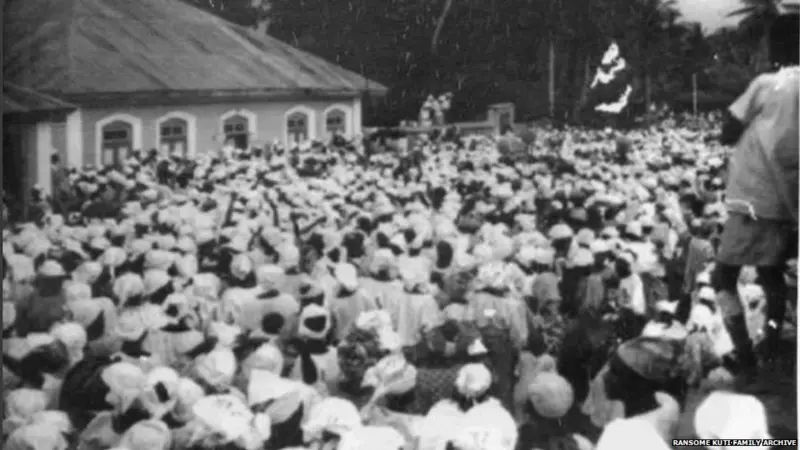
The women of Abeokuta rallying in front of a courthouse to show support for FRK in 1947. Source: Ransome Kuti Family Archive
And yet in Nigerian classrooms, her legacy gets reduced to ‘she was the first woman to drive a car in Nigeria’.
Why?
Because it’s easier to celebrate a woman for doing something novel than to reckon with a woman who challenged every structure of power around her. It’s easier to make her a footnote about motor skills than to teach students that she tonguelashed the Alake into exile. It’s easier to remember her as Fela’s mother than to acknowledge that Fela learned his defiance from her.
Funmilayo Ransome-Kuti wasn’t a woman who happened to drive a car. She was a revolutionary who understood that real freedom required mobility, economic power, political representation and the courage to refuse every limitation placed on her because of her gender.
The car was just one tool in a much larger fight.
