
The global conversation around autonomous mobility has abruptly shifted from theoretical prototypes to mass-market deployment, driven by a landmark unveiling at CES 2026 which took place from 6th-9th January in Las Vegas. In a move that signals the maturity of Chinese automotive technology on the world stage, Afari Technology—the intelligent driving arm backed by automotive giant Geely—has officially launched the G-ASD (Geely Afari Smart Driving) platform. This is not merely another driver-assistance feature; it is an “AI-native” system designed to replace traditional rule-based programming with generative artificial intelligence, effectively giving vehicles a cognitive brain capable of reasoning like a human driver.
At the core of this announcement is the revelation that the system is already far beyond the experimental phase. Geely confirmed that the G-ASD platform has been integrated into over 300,000 vehicles globally, spanning 16 models across its premium Zeekr and Lynk & Co brands. This massive existing fleet serves as a dynamic data engine, enabling the company to leapfrog competitors who are still restricted to small-scale pilot programmes. The launch positions Geely and Afari as frontrunners in the race to deploy a new intelligent driving system that scales from urban commutes to complex highway autonomy without relying on rigid, pre-written code. It also reinforces the company’s dominance in emerging markets where Geely vehicles are increasingly becoming a common sight on the roads.
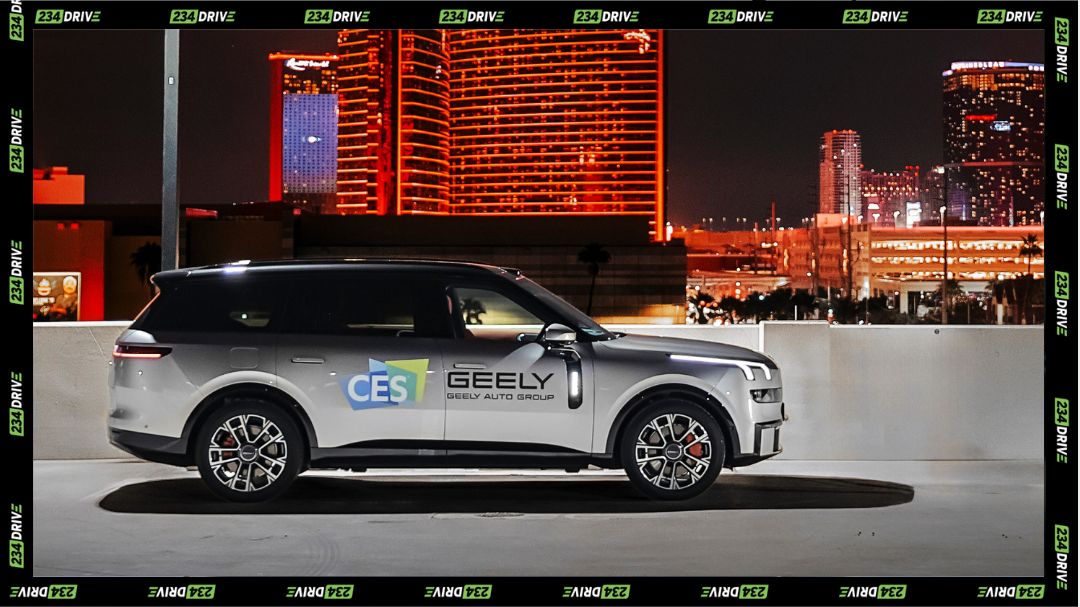
The technical architecture of G-ASD represents a fundamental departure from legacy systems. Afari Technology has introduced the concept of “model penetration” to measure how deeply AI permeates the driving task. Unlike older systems that used AI only for visual perception while leaving decision-making to hard-coded rules, G-ASD utilises an end-to-end model architecture. This involves a sophisticated cocktail of Multimodal Foundation Models, Visual-Language Models (VLM), and Vision-Language-Action (VLA) models. These components allow the vehicle to interpret complex scenes—such as a traffic officer’s hand signals or erratic pedestrian behaviour—and describe them in natural language before executing a manoeuvre.
To support this cognitive load, the system incorporates World Models that simulate potential future scenarios in milliseconds, allowing the car to predict outcomes and react faster than human reflexes. This predictive capability is powered by the “Jieyue Xingchen” general AI foundation model, which boasts 100 billion class parameters. By utilising a generative paradigm and reinforcement learning, the system continuously refines its behaviour based on real-world feedback, creating a feedback loop that ensures the software functions like a human rather than a robot following a flowchart.
The strategic weight of this initiative is bolstered by significant international collaboration. Notably, Mercedes-Benz has acquired a three per cent stake in Afari Technology for approximately ¥1.34 billion (US$192 million), a move that underscores the cross-continental confidence in Afari’s engineering. This partnership infuses the platform with rigorous safety standards, drawing on Volvo’s renowned “safety DNA”—another brand within the Geely portfolio. The system’s training foundation is built upon over 10 billion kilometres of real-world mileage and a million-scale accident dataset, ensuring that the AI prioritises collision avoidance above all else.
In terms of hardware, G-ASD is designed for scalability across different market segments. The configuration ranges from the H7 setup, offering 500 TOPS (Tera Operations Per Second) of computing power for basic urban navigation, to the high-end H9 configuration. The H9 serves as the flagship standard, equipping vehicles with dual Thor chips delivering 1,400 TOPS and a sensor array that includes five LiDAR units for triple 360-degree redundancy. This flexibility allows Geely to roll out next-gen smart vehicle tech to affordable EVs and luxury flagship models simultaneously, without necessitating a complete hardware overhaul for future software upgrades.
The roadmap unveiled at CES 2026 is aggressive and clearly defined. While the current iteration supports L2+ capabilities—such as hands-free highway driving and automated valet parking—Afari is accelerating G-ASD toward L3 conditional autonomy on highways by the latter half of the year. Furthermore, the company targets low-speed L4 capabilities for specific geofenced scenarios, paving the way for robotaxi operations. This progression is contingent on regulatory approvals in key markets like China, Europe, and the US, but the technical groundwork is already being laid through Over-The-Air (OTA) updates that will unlock these features as legislation catches up.
G-ASD is also a cornerstone of Geely’s broader “Full-Domain AI 2.0” strategy, which seeks to unify the intelligence of the chassis, cockpit, and powertrain. This holistic approach introduces the World Action Model (WAM) and a “Smart AI Agent” named Eva. Eva operates as a super-agent, orchestrating vehicle functions and enabling wake-word-free interaction, transforming the car into an intelligent companion. This aligns with a broader industry trend where other major manufacturers also reimagine the cockpit using generative AI to create more intuitive user experiences.
As Geely and Afari drive a new era of autonomous mobility, the implications for the wider industry are profound. The sheer scale of Geely’s deployment provides a competitive moat that rivals like Tesla and Huawei will have to reckon with. It also empowers the group to elevate its diverse portfolio, including Geome electric vehicles, with cutting-edge tech that was previously reserved for premium segments. While challenges regarding data privacy and the ethical decision-making of AI remain pertinent, the G-ASD platform demonstrates that the future of driving is no longer about horsepower or battery range, but about the sophistication of the digital mind behind the wheel. The launch at CES 2026 marks the point where AI-native driving transitioned from a buzzword to a commercially viable, mass-market reality.