
Nigeria is positioning itself at the vanguard of Africa’s transport revolution, moving beyond policy rhetoric to the tangible deployment of electric vehicle (EV) fleets across its most populous states. This significant development underscores a dual-track strategy: leveraging high-impact grassroots distribution to stimulate local economies while simultaneously laying the groundwork for a sophisticated domestic manufacturing hub.
On 28 February 2026, Senator Natasha Akpoti-Uduaghan, representing Kogi Central, orchestrated a landmark distribution of electric vehicles to over 100 beneficiaries who had undergone rigorous technical training. This initiative, executed under an “Operate and Own” model, targeted youths and entrepreneurs across five local government areas, including Adavi and Okene. By providing fully documented, CAC-registered electric tricycles and mini-cars, the programme effectively lowers the barrier to entry for green commercial transport, directly addressing the soaring costs of fossil fuels that have traditionally hampered small-scale logistics.
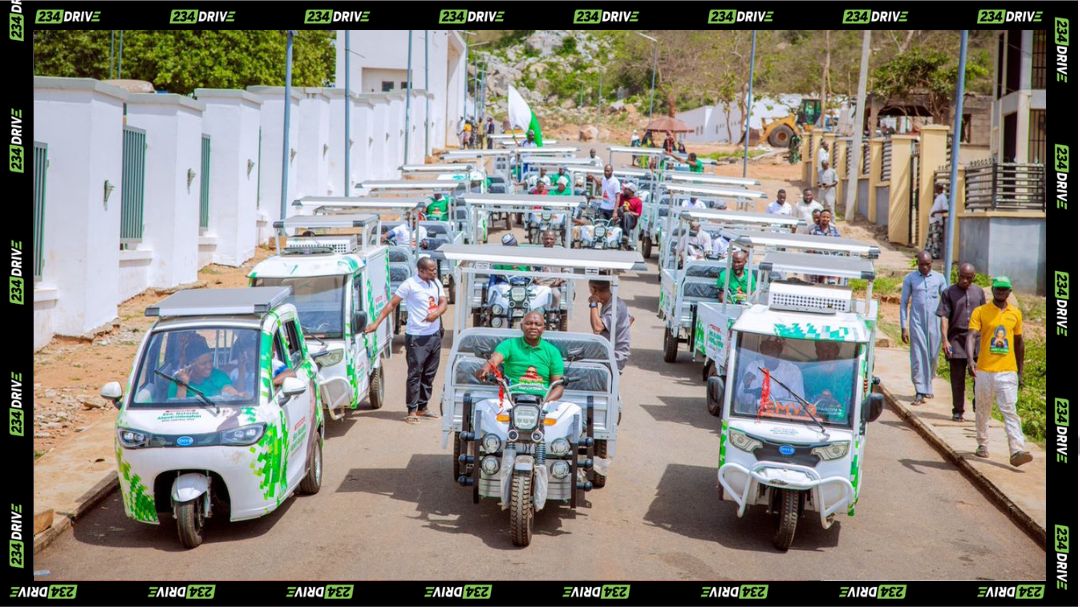
The initiative is underpinned by a robust capacity-building framework. Prior to the handover, the Electric Motor Vehicle Company (EMVC) provided intensive technical instruction to ensure that recipients could handle the maintenance and safe operation of solar-powered units. This focus on skills ensures that the transition to green energy is sustainable, moving away from a culture of simple equipment grants toward one of technological self-sufficiency. For many recipients, like female tricycle operator Blessing Isaac, this represents a shift from financial vulnerability to becoming a pioneer in a zero-emission transport economy.
At the federal level, the strategy scales significantly. On 30 January 2026, the Nigerian government signed a Memorandum of Understanding with South Korea’s Asia Economic Development Committee to establish the nation’s first structured EV plant. This agreement aims to capture a share of the global $800 billion EV market, providing the necessary manufacturing base to support large-scale domestic adoption. The National Automotive Design and Development Council (NADDC) is now coordinating the rollout of nationwide charging infrastructure, a critical step intended to alleviate “range anxiety” and encourage private sector investment in the sector.

The push for electric mobility is further bolstered by state-led initiatives and gender-focused empowerment programmes. The Federal Ministry of Women Affairs recently launched a scheme to deploy 10,000 electric tricycles for women, while in Nasarawa State, Governor Abdullahi Sule distributed 100 electric vehicles to indigent youths. These fragmented but coordinated efforts across the North-East and North-Central regions suggest a national appetite for cleaner mobility that circumvents the logistical challenges of petroleum distribution in rural areas.
Significant investment is also being diverted into the energy infrastructure required to sustain these fleets. The Rural Electrification Agency (REA) has allocated ₦100 billion from its 2026 budget specifically for solar mini-grids and electrification projects that can support EV charging in public institutions and rural hubs. By integrating EV adoption with decentralised renewable energy, Nigeria is attempting to bypass the limitations of its national grid, creating localised energy ecosystems that can power commercial transport independently.
Despite the enthusiasm, the transition faces substantial hurdles. Independent research into EV prospects in Nigeria highlights that while the environmental and economic benefits are clear, the high initial cost of lithium-ion technology and the current scarcity of public charging points remain significant barriers for the average consumer. Critics also point to the potential for over-reliance on imported components, arguing that for Nigeria to truly lead, the focus must remain on the deep localisation of the battery supply chain and power electronics.
The Kogi Central distribution serves as a micro-level proof of concept for what is possible when political will meets technical training. It demonstrates that when the infrastructure and equipment are provided through structured empowerment models, the market is ready to embrace sustainable alternatives. As the Federal Government works to formalise the tax incentives and duty-free policies required for large-scale manufacturing, these grassroots successes provide the necessary momentum to convince investors and the public alike.
This momentum marks a transition from experimental pilot schemes to a serious industrial policy. Nigeria’s ambition to become Africa’s EV manufacturing hub is a high-stakes gamble on a green future, one that requires consistent policy implementation and massive infrastructure investment. Whether this grassroots jubilation can be converted into a nationwide industrial standard depends on the government’s ability to maintain the pace of charging network expansion and ensure that the “Operate and Own” model remains financially viable for the millions of Nigerians currently reliant on traditional internal combustion engines.