
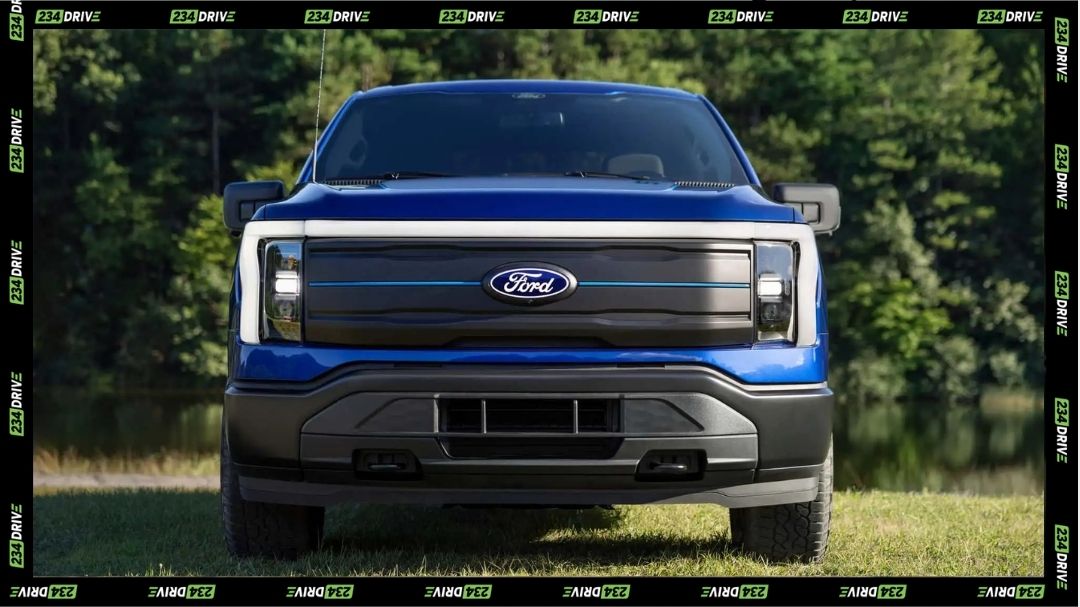
In the automotive world, winning the sales crown is usually a cause for champagne and extended victory laps. It validates billions in R&D, proves the skeptics wrong, and sets the stage for future dominance. But in 2025, the Ford F-150 Lightning achieved a victory that feels distinctly different, more of a “last stand” than a new beginning. With 27,307 units delivered, Ford’s electric workhorse successfully defended its title as America’s best-selling electric pickup, fending off the futuristic Tesla Cybertruck and the surging Chevrolet Silverado EV. Yet, this triumph comes at a moment of profound existential change for the vehicle itself.
The story of the F-150 Lightning in 2025 is not just about sales figures; it is a microcosm of a turbulent year for the entire electric vehicle (EV) industry. It is a tale of a product that won the battle for consumer hearts but found itself on the wrong side of a shifting financial war. As Ford pivots away from pure electrification toward hybrids and extended-range technologies, the Lightning’s performance offers a fascinating glimpse into what American drivers actually want and what automakers can afford to build.
The Numbers Game
Let’s look at the scoreboard. In a year where the broader electric pickup segment contracted by nearly 16%, the F-150 Lightning’s ability to move over 27,000 units is significant. While this represents an 18.5% year-over-year decline, it was enough to keep the Tesla Cybertruck at bay. The Cybertruck, despite its polarising design and massive media footprint, managed only 20,237 deliveries, a sharp 48.1% drop from the previous year.
This statistic is telling. For years, industry analysts predicted that once Tesla entered the pickup market, it would suffocate legacy competition. Instead, 2025 showed that when it comes to trucks, utility and familiarity still carry immense weight. The Lightning looks like a truck, works like a truck, and for thousands of buyers, that was the deciding factor.
However, the competition is far from dormant. General Motors has been quietly building momentum. The Chevrolet Silverado EV saw its sales jump by nearly 52% to 11,275 units, while its luxury sibling, the GMC Hummer EV, climbed roughly 13% to nearly 16,000 units. These gains suggest that while the “early adopter” wave has crashed, a second wave of more pragmatic buyers is slowly emerging—buyers who are less interested in making a statement and more interested in towing capacity and range.
The “EV Winter” of 2025
To understand why Ford is rethinking its strategy despite this sales win, we have to look at the hostile environment of the 2025 market. The year began with optimism but ended in what many are calling an “EV Winter.” The total market share for electric vehicles in the U.S. stagnated at around 7.8%, virtually unchanged from 2024.
The defining moment of the year occurred in the third quarter. Buyers rushed to dealerships to take advantage of the federal $7,500 tax credit before it expired on 30th September. This frenzy drove EV market share to a record 10.5% in Q3, creating a temporary illusion of booming demand. But the hangover was brutal. In the fourth quarter, without the cushion of federal incentives, market share plummeted to 5.8%.
This policy-induced volatility exposed a harsh reality: organic demand for pure EVs, specifically at current price points, is fragile. North America was the only major global region to see a decline in plug-in vehicle sales (down 4%), while the rest of the world continued to grow. For automakers like Ford, who had bet billions on a linear, upward trajectory of adoption, this stagnation was a wake-up call that could not be ignored.
Ford’s Strategic Pivot
The most shocking development of 2025 wasn’t the sales numbers, but Ford’s reaction to them. In December, facing a reality where every electric truck sold was essentially a financial loss, Ford announced a massive strategic pivot accompanied by a $19.5 billion writedown.
This wasn’t just a financial adjustment; it was a philosophical U-turn. The company confirmed the cancellation of “Project T3”, the next-generation, clean-sheet battery-electric truck that was supposed to replace the current Lightning. Along with it, a planned all-electric commercial van was also scrapped.
Why kill the successor to the best-selling electric truck in America? The answer lies in the limitations of current battery technology and consumer “range anxiety.” Ford realized that for a truck to be truly functional for towing and long-haul work, a massive, heavy, and expensive battery is required. This drives up the cost and drives down the efficiency, creating a vehicle that is hard to sell profitably at a price mainstream buyers can afford.
A Bridge to the Future?
Ford isn’t abandoning the electric truck dream; they are just changing the propulsion system. The future of the F-150 Lightning nameplate now lies in Extended-Range Electric Vehicles (EREVs). Unlike a traditional hybrid, where a gas engine drives the wheels, an EREV uses a gas generator solely to recharge the battery, while electric motors still do all the driving.
This solution elegantly solves the towing problem. You get the torque and driving dynamics of an EV, but when the battery drains while towing a boat up a mountain, the gas generator kicks in to keep you moving without a 45-minute charging stop. It acknowledges that the American charging infrastructure and battery technology are not quite ready for the heavy-duty demands of truck owners.
Furthermore, Ford is redirecting its pure-EV efforts toward a new “Universal EV Platform” designed for smaller, more affordable vehicles. The goal is to produce EVs with a target price of around $30,000 by 2027, a direct response to the affordability crisis that has stalled market growth.
The Legacy of the 2025 Lightning
As we look back at 2025, the Ford F-150 Lightning stands as a paradoxical figure. It was the champion of a segment that it effectively outgrew. Its sales victory over the Tesla Cybertruck proved that traditional automakers could build compelling electric vehicles that people want to buy. But its year-over-year decline and subsequent cancellation in its current form proved that “wanting” isn’t enough—the economics have to make sense.
The Lightning didn’t fail; the market conditions required for it to thrive simply didn’t materialise fast enough. In 2026 and beyond, the electric truck market will likely look different, dominated by hybrids and EREVs that offer a compromise between green ambitions and gritty reality. The 2025 sales crown, therefore, is not a sign of what’s to come, but a monument to “Phase One” of the electric revolution: a phase of high hopes, hard lessons, and the realisation that the road to electrification is not a straight line, but a winding path.
The F-150 Lightning is dead. Long live the F-150 Lightning.