
Every morning across Nigeria, millions of drivers perform the same ritual: they turn the key (or push the start button), wait for the engine to hum to life and occasionally glance at the rearview mirror to see what’s coming out of the tailpipe.
For most, a little puff of smoke is just part of the morning. But what happens when that smoke doesn’t stop? Or what if it changes colour? At 234Drive, we know that your exhaust pipe is like a messenger. It’s trying to tell you exactly what is happening deep inside the combustion chamber.
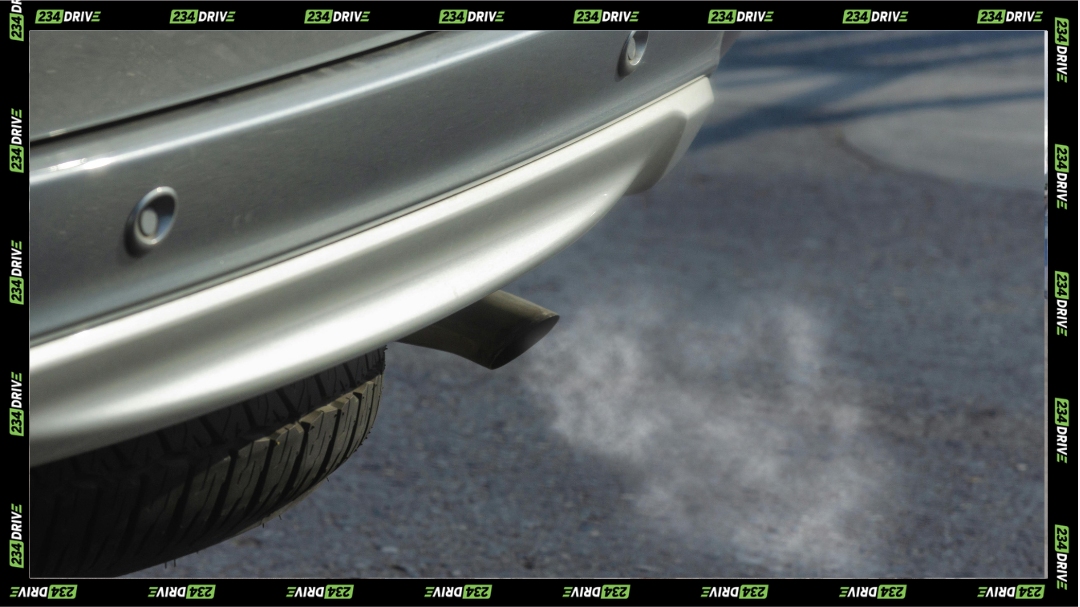
The problem is, these “smoke signals” can be tricky to differentiate. Is it just cold weather, or is your engine about to melt down? Today, we are breaking down the four main colours of exhaust smoke—white, blue, black, and grey—so you can “swing into action” before a minor leak becomes a major engine replacement.
1. White Smoke: The Good vs. The Bad
White smoke is the most common colour you’ll see, and it is also the most misunderstood. It can either be a sign of a perfectly healthy car or a sign of a catastrophic cooling failure.
The “Good” White Smoke (Condensation)
When you start your car first thing in the morning, especially on those rare chilly mornings in Lagos or during the rainy season, you might see a thin mist of white smoke. If you look closely at the tip of the exhaust, you might even see small droplets of water dripping out.
Don’t panic. This is perfectly normal. It’s simply condensation that has built up in the exhaust system overnight. As the hot exhaust gases hit the cold pipes, they create steam. This smoke should be thin and should stop completely once the car reaches its operating temperature (usually after 5 to 10 minutes of driving).
The “Bad” White Smoke (Coolant Leak)
If the white smoke persists long after the car has warmed up, you have a problem. If the smoke is thick, stays in the air longer than steam, and has a strangely sweet smell, your car is “drinking” its coolant.
This is usually caused by a blown head gasket. Think of the gasket as a flat, heavy-duty seal that sits between the engine block and the cylinder head. Its job is to keep the engine oil and the coolant in their separate “lanes.” When the gasket burns or warps (often due to previous overheating), it allows coolant to leak into the combustion chamber.
The Result: Your car will start to overheat rapidly. If you see persistent thick white smoke, stop driving and check your coolant levels immediately.
2. Blue Smoke: The Oil Burner
Blue smoke (which often looks more like a “bluish-white” or “ghostly grey-blue”) is a clear indication that engine oil is being burned along with your fuel.
Under normal circumstances, engine oil should stay in the lower part of the engine to lubricate moving parts, while the “fire” happens in the upper part. When oil enters the combustion chamber, it creates that distinct bluish tint.
Why is this happening?
- Worn Valve Seals: These seals are supposed to protect the engine by preventing oil from dripping down into the cylinders from the top of the engine. When they wear out, oil seeps past them and burns.
- Worn Piston Rings: If the metal rings around your pistons are worn out, they can no longer “scrape” the oil off the cylinder walls effectively. This allows oil to move upward into the combustion zone.
Blue smoke is a serious engine problem. It means you are losing oil, which can lead to “engine knock” or total engine seizure if the oil level gets too low. If your car is blowing blue, it’s time to see a specialist.
3. Black Smoke: The “Heavy Breather”
Black smoke is perhaps the most alarming to see, but it is often the most straightforward to fix. Black smoke is a sign of an unbalanced air-fuel mixture.
For an engine to run efficiently, it needs a precise “recipe” of air and fuel. When you see black smoke, it means the engine is getting too much fuel and not enough air—in technical terms, it’s “running rich.”
The Culprits:
- Dirty Air Filter: Imagine trying to run a race while wearing a heavy mask. That’s your engine with a clogged air filter. It can’t get enough air, so it burns an excess of fuel to keep moving.
- Bad Fuel Injectors: If an injector is “leaking” or stuck open, it’s dumping more petrol into the cylinder than the engine can actually burn.
- Clogged Sensors: Sensors like the MAF (Mass Air Flow) might be giving the brain box wrong information, telling it to pump in more fuel than necessary.
The good news? Black smoke usually means your engine’s “hardware” is still okay, but its “delivery system” needs a tune-up. Fixing this will immediately save you a lot of money on petrol.
4. Grey Smoke: The Turbo Trouble
Grey smoke is the “complicated” one. It is often a combination of the issues that cause blue and white smoke, meaning both coolant and oil might be leaking into the engine at the same time.
While grey smoke can be caused by a failing transmission vacuum modulator (in older cars), it is very common in modern turbocharged cars.
Turbochargers use engine oil for lubrication and often use coolant for cooling. When the seals inside a turbocharger fail, they can leak both fluids directly into the intake system, leading to a thick, confusing grey cloud behind your car. If you drive a “Turbo” model and see grey smoke, the turbo unit is the first place your mechanic should look.
The Healthy Standard: Colourless is King
So, what should you aim for? A healthy, well-maintained engine should follow a simple rule:
- Morning: Startup white smoke + water droplets (Normal).
- Warmed Up: Absolutely no visible smoke.
Once your car is at its proper temperature, the exhaust coming out should be colourless.
It’s Not a Death Sentence!
The most important thing to remember is that none of these smoke colours represent a “death sentence” for your car. Whether it’s a blown gasket or a bad injector, these issues are totally repairable. The key is to “swing into action” the moment you notice the change. Ignoring the smoke signal is what leads to a dead engine on the side of the road.
Conclusion
Your car speaks to you through its exhaust. By paying attention to the colour of the smoke, you can catch problems while they are still small and affordable to fix.
Don’t ignore the signs. Share this guide with your friends and family. Anyone who owns a car or is planning to buy one soon needs to know these colours!