
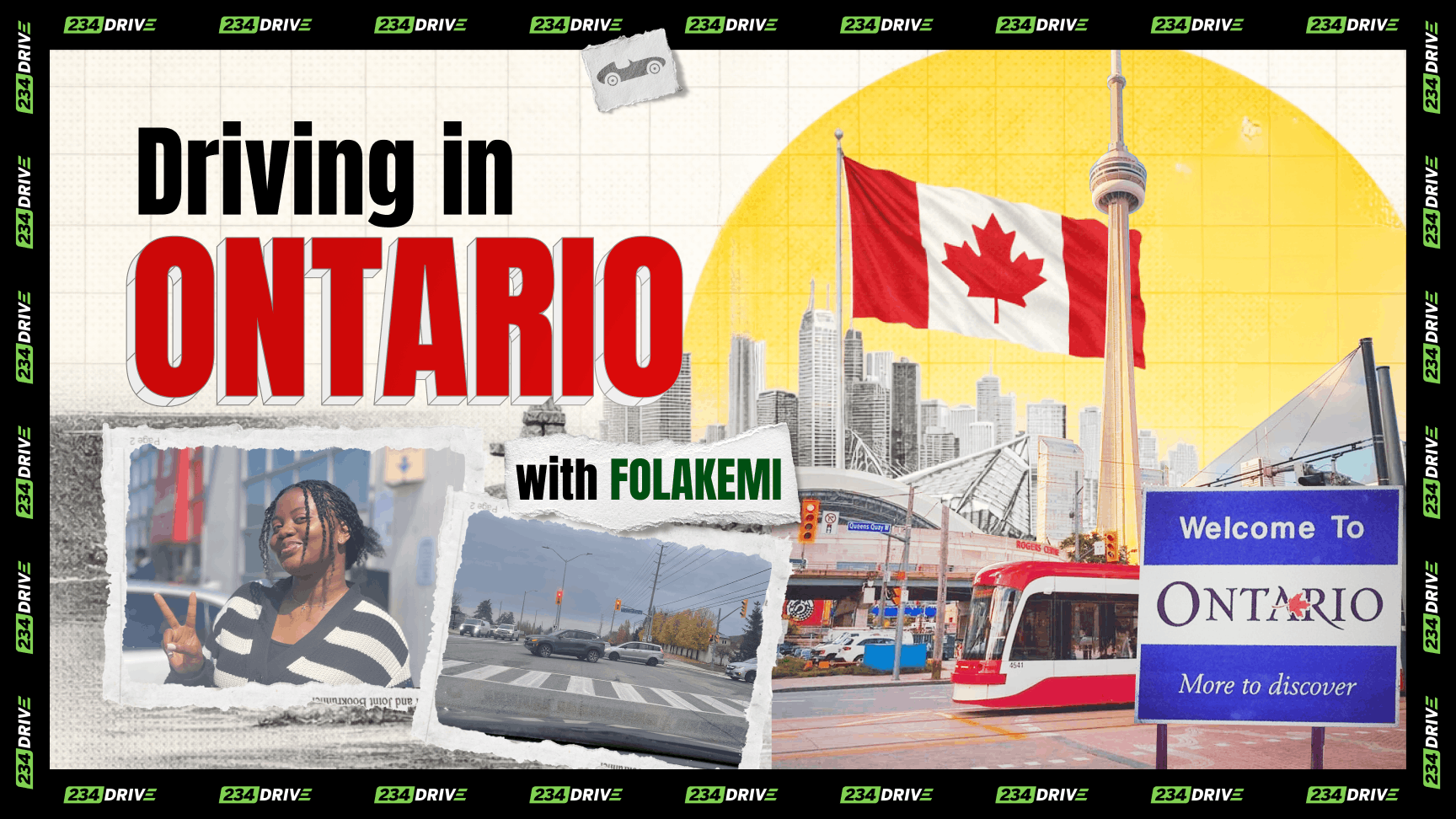
Folakemi, a 25-year-old talent acquisition professional, started her driving journey nearly a decade ago at the once epic Trans Amusement Park in Bodija, Ibadan. For weeks, she and her mum’s driver would drive circles at the park’s spacious parking lot until she mastered the wheel. Years later, she’s navigating the clean buses and well-paved roads of Oakville, Ontario—where 15 minutes is considered a long drive and winter makes public transport unbearable. She’s waging a personal war between sustainability and convenience (electric cars vs petrol). She loves her Toyota Corolla (even though it’s not hers) and has one firm rule: avoid downtown Hamilton’s paid parking at all costs.

Folakemi in Ontario
Describe your first driving experience
My first driving experience was definitely in Ibadan, Oyo State, Nigeria. The first car I drove—I don’t remember the specifications because I’m not into cars—but I think it was either a Toyota or Nissan. Some brand, I’m not sure, but it was a very small car. It was silver, I believe.
How old was I? I think I was probably 15 or 16, probably 16 because I was just learning to drive at that time. So most likely 16. It was at the amusement park around Bodija axis. That was where I used to go and do my driving training. My mum’s driver was teaching me how to drive there. It was a very spacious space, so that’s where I would go and practise.
What are the common ways to get around in your city and what are they like?
My current city is Oakville, Ontario, Canada. Many people get around here with the bus and we have two kinds: one called the GO Bus and then there’s another one that is just the city bus. Each city has its own bus routes and buses. The GO Bus is more provincial and actually sometimes also travels across provinces.
Another common way is Uber. It’s very popular but at the same time, not a lot because of how expensive it can be, especially when you’re travelling a distance. So buses are more affordable. I’d say trains—so the underground trains or normal trains, subway—are pretty common too.
With Uber, it’s very fast to get one and there are different ranges: if you want a huge car, if you want to share with other people, if you want to save money and wait 15 minutes for your ride to arrive, there’s a range of different options. But it can be expensive. It’s easier if you’re going short distances and you can pay like $5, $7. But the longer the distance, the higher the prices, plus taxes.
For the buses, it’s very easy to move around with them and they’re clean and nice. They usually are on schedule, except something is happening. But it depends on the season of the year. In winter, public transport generally isn’t the best because you’re freezing, you’re waiting for the bus. There’s so much happening at the same time and it can be really exhausting and tiring. With the train, it’s manageable because you’re underground. But with the buses, it’s a bit more difficult.
And you have to learn the route. If you don’t know your way, you can miss your way and then you have to spend time waiting for another bus. Depends on the time you’re going out as well. Sometimes during the day, the buses run a bit back-to-back, so if you miss one bus, you may just have to wait maybe 10, 15, 20 minutes for another bus. But if it’s a weekend or it’s late at night or early in the morning, you may have to wait 30, 35 minutes for another bus if you miss the first one.
Fare-wise, the fare is reasonable. A round trip on the city bus is usually about $3 and a few cents. I stay in Oakville, my church is in Hamilton. By drive, it’s like a 30-minutes max drive, usually 25, 27 minutes. But by bus, it takes me like 1 hour 15 minutes to journey from Oakville to Hamilton. A round trip from Oakville to Hamilton and Hamilton back to Oakville takes me about $10 in a day. And I will take two buses going and two buses coming back.
How essential would you say it is to drive there?
I would say it’s very essential, especially because of the weather. Things are nice and sweet during the summer, or even part of the summer. When it starts to get really, really hot, it might also be unbearable. So the weather here can either be extremely cold or extremely hot. I think extremely hot might be bearable, but extremely cold? Yeah, that one is crazy.
If you commute a lot, especially if you’re working or you’re a student going back and forth because you live off campus, it can be tough during winter. Of course, you wouldn’t expect the student to buy a car because of the cost of living. But if you’re working or you just move around a lot, it’s absolutely necessary, I think.
It’s a different thing if you’re moving around the same vicinity. For example, if your church is 5 minutes away from your house or your work is 10 minutes away from your house, maybe you don’t need the car. If grocery stores are all around you, then you don’t really need a car. But if your work is 20, 30 minutes away from your house, your church is another 20, 30 minutes away from your house, it might be helpful.
I think to answer that question, it really depends on what your life looks like and all the places that you go to decide how essential it would be for you to drive. But I think generally, even if you don’t have a car, it’s essential to at least learn how to drive, so that when the time comes for you to have a car, you’re not just learning then.
How difficult was it to get all the requirements you needed to drive in your current city?
It’s a bit different from Nigeria. In Nigeria, you just do driving lessons and then you apply for your licence. Here, you have to first do a written test, and then after the written test, it takes a year between when you do your written test to then get your driver’s licence. But the time is shortened if you have already been driving from a different country and then you go through the licence authentication process, which was what I did. So I was able to do my road test within less than a year of doing my written test.
That written test is called the G1 test. The road test is called the G2 test. And then there is the G test, which is the highest level of driving. To break it down: your G1 is just a knowledge written test; G2 is road tests within residential areas, school zones et al; and then your G (G2 exit) test is the one where you get tested on the highway.
I think it would usually be straightforward, but it was a bit difficult for me because there was a bit of back and forth. There was no clarity in terms of the process for getting licence authentication from my home country. Trust Nigeria to make life hard for you wherever you go.
Generally in this country, it’s easy when you’re from a different country. They tell you pretty much this is what you’re meant to do. When I was leaving Nigeria, I was told I needed to get an extract. So I had paid ₦80,000 to get an extract and I took it to Canada. When I arrived in Canada and I submitted it to the officials, they said absolutely not, we do not receive this. You have to send a letter to the ministry in Ottawa.
So that was a bit of back and forth. And of course, you pay for it. With other countries, they would pay maybe $20, maybe maximum $50 for things like this. But for Nigeria, I had to pay over $150 and then additional charges for all the mailing. So I think the total cost came down to about $200 to $250, which was ridiculous. And this is minus the fee you’re paying for your tests and all of that.
So I would say generally, if you know what to do, it’s straightforward. But if you were being bounced around like me, then yeah, pretty frustrating.
What do you look out for when you’re buying a car?
Personally, I wouldn’t know. I’ve never bought a car before. But if I were to buy a car, honestly it might be the barest minimum. For example, colour of the car. I’m minimalist, so I like colours that are very simple—black. So I will most likely buy a black car. At most, maybe blue or maybe grey, but that’s if there is no black car available.
I don’t like big cars. So you would see me be drawn to smaller cars like the smaller Toyota Corollas, Camrys. I’m not a crazy fan of huge cars at all. I feel like they’re heavier to drive, if that makes sense.
So I would definitely be on the lookout for smaller cars. I would be on the lookout for cars with a lot of innovation—for example, a dashboard that I can use for navigation. I don’t always have to use my phone and Google Maps. Lots of compartments—I love having spare things in the car. Spare outfits, spare everything, tissues, wipes, everything. So lots of compartments.
I’d also like a very easy-to-clean interior. So I most likely will go for cars that are leathered up on the inside instead of cloth-covered seats. Definitely a car that has a good heating system because winter is crazy.
I don’t know all the stuff about mileage and all of that, so I’m not going to say much. But I guess a good car that wouldn’t give me problems in that regard. Also a car that is very easy to find spare parts and replacements. I don’t want to buy a car that I have to go and be shipping spare parts from China or Singapore or something.
Also a car that definitely doesn’t eat up too much gas because fuel is expensive, so I don’t want to have to do too much to fill up my tank. And then finally, I am currently waging a war between electric cars and fuel-functioning cars. I know there’s the entire thing about reducing carbon emission in the environment and I’m all for that. At the same time, I’m not very sure that I’m comfortable with electrical cars yet. Maybe because the only brand that I really know of and I see is Teslas. I used to be a fan of Tesla when it came out, but now I’m not.
So I think the entire idea of having to charge my vehicle—yeah, I’m not sure if I’m there yet. So for now, I probably will be buying a car that would require me to buy gas instead of charging it. I don’t know what that says about me and my commitment to sustainability or the environment.
Did what you were looking for in a car change when you moved?
I didn’t think about buying a car in Nigeria. But if I were considering it, I think definitely it would have changed because I don’t think I had as many. I think the only things that have changed are two major things. First is the entire electric situation. I never considered that in Nigeria, just given the state of the country. But I am currently considering it because there is actually infrastructure here to help that. Number two is the entire heating system. I didn’t even think about it when I was in Nigeria because Nigeria is hot enough. But now, of course, that’s something I highly consider.
What car do you currently drive?
I currently drive a Toyota Corolla. It’s not mine, but I currently drive it. It depends on the time of the day. If I’m driving my sister’s car, one of my sister’s cars would be a Toyota Corolla. If I’m not driving that car, I’m driving my brother-in-law’s car, which is a BMW. When I’m not driving that, I’m driving my first sister’s car, which is a Range Rover. So it really depends on the time of the day and what I’m going to do and whose car is available.
What is the best part of driving in your city?
Two things. Number one is the fact that when I go out for groceries and all of these things, I don’t have to think about how to carry my groceries home. I can just pop them in the car and move. That’s easy.
Number two is again, the weather. I really cannot over-emphasise this. It’s amazing to wake up and see what the weather forecast is like and not be too worried because I’m going to be in the car driving with heat as opposed to walking or trying to commute with public transport.
Plus unlike Nigeria, if a place is 10 minutes away in Canada, that’s considered far. And I might be exaggerating, but yeah, I think you may get the point. Because the roads are good, driving for 10 minutes straight or 15 minutes straight is completely different from driving for 10 minutes in Nigeria. The roads are good. The traffic lights work. And everyone—well, almost everyone— obeys the traffic lights.
If you have only one hour in the city, where do you drive to?
There are so many places to drive to. I think I would be driving to the mall. There are so many stores, so many and I personally like shopping. There are so many things to see, so many malls to go to. Or if you’re not driving to the mall, maybe other places for sightseeing like Niagara Falls or something—although that’s already over an hour drive, so I’m not really sure that’s a wise decision.
Honestly, maybe just a really good food spot. A really great restaurant. Just drive there, one really close by, have some good food and drive back and leave.
Best place to drive at night?
I wouldn’t know. I don’t really drive at night. When I’m driving at night, I’m usually coming back from the grocery store. I like to go to grocery stores in the evening as I find it’s a way of clearing my head.
How does the experience of driving in your hometown compare to that of your current city of residence?
To be fair, I enjoyed driving in Ibadan. I think there was a crazy part of it. I don’t do road rage because I’m almost always blasting music in the car. So I don’t really pay attention, and if I want to vent, I vent to the music with the lyrics.
But I would say Ibadan is kind of calm-ish. So it’s definitely different from Lagos. I don’t think someone is going to get down and slap me or do something random in Ibadan. And also because there isn’t a lot of traffic in Ibadan. I enjoy that. I enjoy the fact that I can move around easily with no fear of being stuck in traffic for two hours. And I can also easily get from point A to point B. If you’re going somewhere in Ibadan, almost everywhere I go is 15 minutes away from wherever it is that I am, honestly.
Now comparing that to my current city, driving 15 minutes in Canada is a bit of a distance. If I’m going to a store and I see 15 minutes, that’s long. That is long. So I think those two things—just the time and how long it takes to get to a place—is a bit interesting.
What is the most difficult city you’ve ever driven in?
In Nigeria, I only used to drive in Ibadan. I never tried driving in Lagos because, you know why. For anyone that doesn’t know why, Lagos is a crazy place and you cannot assume that everybody on the road is sane. So I never attempted driving in Lagos. I only used to drive in Ibadan in Nigeria.
But now in Canada, I have driven in Oakville, Hamilton and Toronto. And I would say the most difficult city I have driven in is probablyHamilton, because Hamilton downtown is a bit interesting. The traffic lights are very interesting and I feel like they’re honestly just there to frustrate you. Best city I’ve driven in? Oakville, for sure.
What is a traffic rule in your current city that you still haven’t gotten used to?
Honestly, I think most of the traffic rules here make sense. The only one that I haven’t gotten used to is…So generally, you can do a right turn when the light is red. The only time you cannot do a right turn when the light is red is when there is a sign that says do not turn right on red. Or if you are in the city of Montreal in Quebec, you can never turn right on red.
Now being in Oakville, I barely see signs that say don’t turn right on red—just a few. But in Hamilton, there are a lot of signs that say don’t turn right on red. So it’s taking some getting used to, to always have to check for the signs because it’s almost like a mental thing. If the light is red, I can still turn right except there’s an oncoming vehicle. But I think I’m getting used to having to actually check for signs that say don’t turn right so I don’t break any traffic laws.
And then the other one is the twin of that rule, which is when the light is red, you cannot turn left. You can only turn left when the light is green and you have to give the oncoming vehicle the right of way. They have the right of way. So you have to wait for oncoming vehicles to pass before you can turn left.
What’s the traffic situation in your city like during rush hour?
I think rush hour in Oakville is pretty much the same everywhere else. It’s basically around 8am—between 7am to 9am—on the weekdays because obviously everyone is going to work. And then rush hour comes back, 4 to 5, 6-ish during the weekdays because again, everyone is coming back from work.
And sometimes there’s rush hour on Sunday evenings because some people go out around that time and are trying to get back home, prepare for the week and all of that.
How do I deal with it? I avoid them. I avoid rush hour. I just try not to be out at that time. And if I am, well, it’s not as bad as being stuck in Lagos traffic for 4, 5 hours. So yeah, it’s really not that bad.
How do you handle aggressive drivers or road rage?
In my city, I haven’t experienced road rage. There aren’t so many aggressive drivers. Just the ones that feel like the speed limits are suggestions and not the law. And for people like that, you stay away. So if you see someone driving crazy, you just switch to a different lane and let them go forward to do whatever they want to do. That is how I handle that.
What was the craziest thing that has happened to you while driving there?
Probably just seeing another car go at a speed that is just insane. Like, are you trying to die? How many lives do you have? Yeah, that’s the craziest thing for me.
What’s the biggest challenge of parking in the city?
Now this one I’m passionate about. Parking in the city is exhausting. But not in this city because I don’t really go anywhere that gives me problems with parking. When I go to the grocery store, there’s a wide parking lot. You can park very much anywhere.
At home, you have your own reservation and spots and all of that, except there are too many cars. So if you have more than two cars and the driveway is filled and the garage is filled, you would have to park on the street. And if you’re parked on the street, you have to either register for parking. I think there’s a maximum of maybe 15 slots in a year. And then after that, you have to do paid parking. So yeah. I don’t think that’s too bad.
But parking in other cities around me—when I drive to other places like Hamilton or Toronto—most of the parking is paid parking. And for places like downtown Hamilton and downtown Toronto, there is really no spot for parking. So if you’re going to a store, for example, there is no guarantee that that store has parking. Especially if it’s a busy grocery store, if it’s a restaurant or some other big-deal store, they probably will have underground parking.
I don’t enjoy underground parking. It just adds a level of stress to driving. So yeah, paid parking is definitely something I don’t enjoy. Why am I paying for parking? Why?
Hamilton and downtown Toronto has a lot of that. And also, if you don’t know where or where not to park, if your car gets towed, well, that’s going to be painful because you’re going to pay heavily for it.
The only place that I have to pay for parking in my city is when I go to the dentist. But I also don’t have to pay for parking. I just give my dentist the ticket and they validate it because I guess it’s included in whatever it is you are paying the dentist. So they don’t make their customers pay for parking, which again is great.