
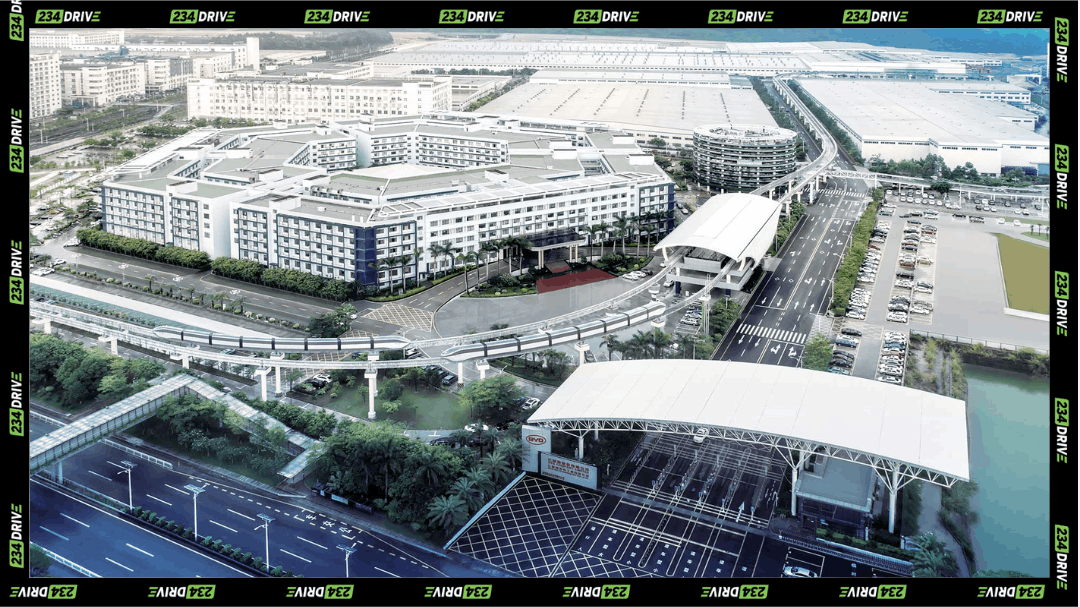
An image of BYD headquarters at Pingshan industrial park |Source: Bydglobal
The newly crowned EV leading brand is now building cars at a speed that sounds almost unreal. At one of its factories in China, a finished vehicle rolls off the line every 60 seconds. That plant alone can produce about 1,280 cars a day—more than 400,000 a year. This kind of output helps explain how BYD moved ahead of Tesla in 2025, delivering around 2.25 million fully electric vehicles worldwide.
How BYD Is Building a Car Every Minute
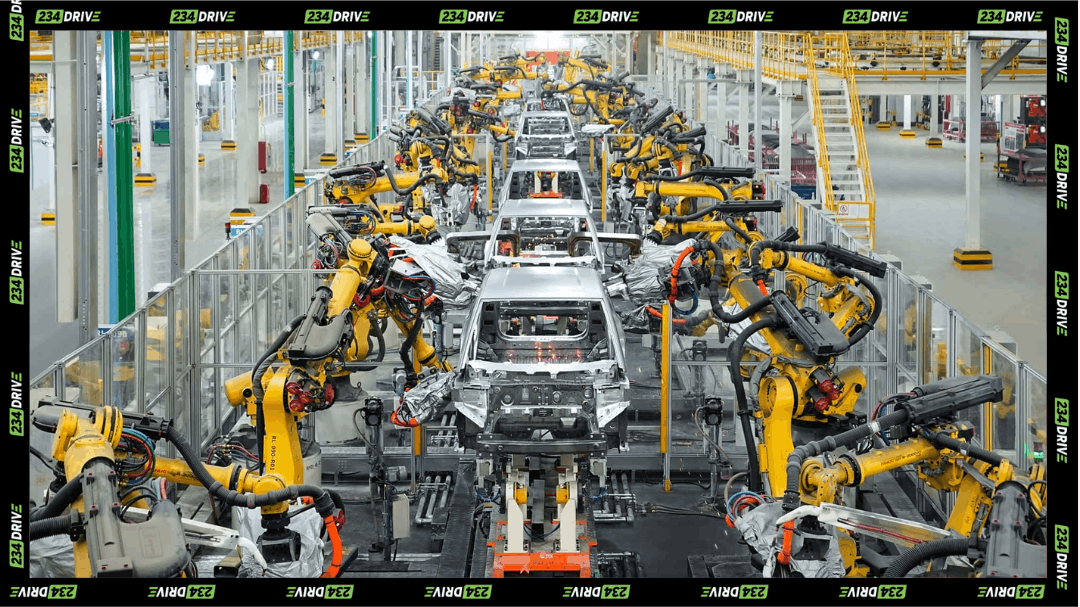
Image Source: InsideEVs
One factory sits in Xiaomo, inside the Shenzhen-Shanwei Cooperation Zone, and only started operating in September 2023. Despite its recent start, the factory functions seamlessly. BYD also makes its premium models there, including cars from its Yangwang and Dynasty lines.
Everything begins in a massive stamping workshop covering about 140,000 square metres. That’s where large metal sheets get pressed into doors, roofs and body panels. From there, the Pieces move to the welding section, where robotic arms—many designed by the Chinese makers themselves—join thousands of parts together with precision.
Next comes painting. Automated systems coat each vehicle before it heads to final assembly. On that line, workers handle the finishing touches—installing interiors, connecting systems and running checks to make sure everything works as it should. Because different sections of the plant operate at the same time, not one after the other, the factory keeps cars moving on a line continuously. A line which a car is expected to pass through in around sixty seconds.
Additionally, the company’s largest factory, located in Xi’an, runs at an even faster pace. That site operates four major assembly lines and produces between 4,000 and 4,400 vehicles daily. When you do the math, that works out to about three cars every minute. In late 2024, the plant crossed a major milestone—more than one million fully built electric vehicles in a single year.
Across all its facilities, BYD produced roughly 4.5 million vehicles in 2025. About half of those were pure EVs, while the rest included plug-in hybrids and commercial models. That level of production helped the company widen its global lead, even as growth in China’s EV market is starting to cool slightly.
What Would This Look Like in Africa?
Now imagine this kind of factory operating on African soil.
Countries like Morocco and South Africa already have established vehicle assembly plants. Morocco has become a strong export hub, supplying cars to Europe. South Africa remains one of the continent’s most experienced automotive production centres. But most of these operations focus on assembling imported parts rather than running fully integrated, high-speed EV plants.
A factory built at BYD’s scale would be different. It would handle everything in one place. That would mean deeper local supply chains, more skilled manufacturing jobs and stronger technical training in automation and robotics.
It could also make electric vehicles more affordable over time by lowering production costs. For a continent where transport demand keeps growing and urban traffic continues to expand, faster and larger-scale EV production could change how people move.
Of course, this would require stable power, strong infrastructure, and clear policy direction. But if those pieces come together, a one-car-per-minute plant or something close in Africa would reshape the continent’s place in the global auto industry.