
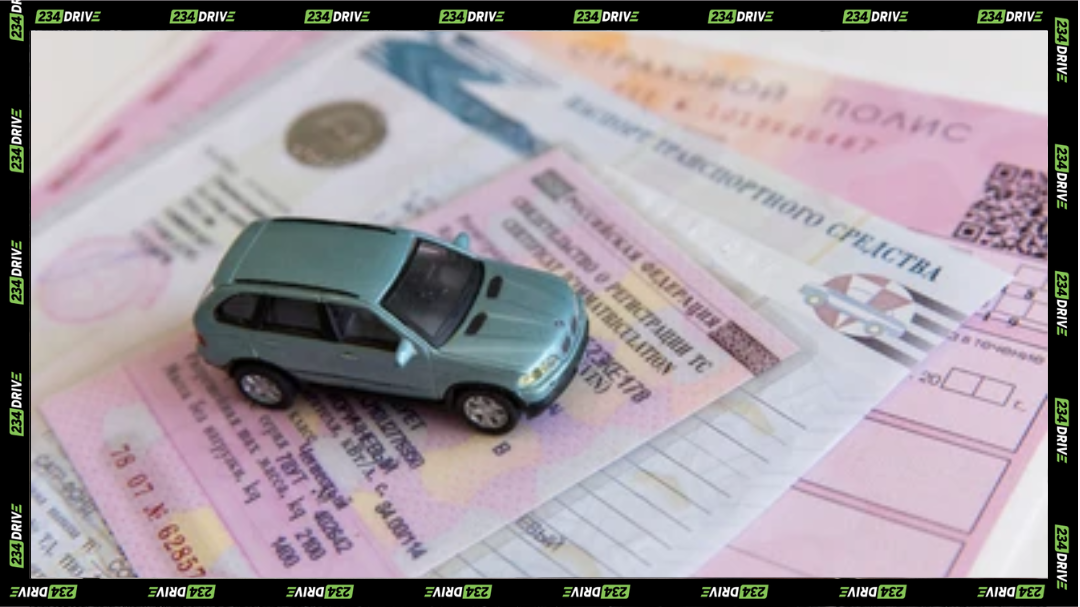
Vehicle documents and a car model highlight how registration rules shape ownership and movement across borders. | Source: Shutterstock
Russia is preparing legislation to allow stolen car registrations, meaning vehicles flagged as stolen in Europe and other “hostile states” could be legally registered and used within the country. The proposal, developed under the direction of Vladimir Putin, would treat such vehicles as valid domestic property irrespective of their status in international databases.
This marks a change in how Russia handles cross-border vehicle ownership tied to ongoing geopolitical tensions.
What Russia’s New Law Does — In Simple Terms
Russia does not currently register vehicles listed in international stolen vehicle databases.. However, the proposed law would allow registration of those same vehicles if they are flagged by countries Russia classifies as hostile. This list includes the 27 EU states, the US, Switzerland, Norway, Canada, Japan, South Korea and Australia.
Russian authorities state that current limited cooperation from these countries makes it difficult to determine the basis for some listings.
Once the new law is implemented, the change would:
- Allow affected vehicles to enter Russia’s formal registration system
- Reduce reliance on foreign verification for ownership disputes
- Provide a legal covering for vehicles already present in the country
German law enforcement groups have noted that cross-border vehicle theft networks already move cars toward regions where recovery is more difficult, with over 30,000 vehicles reported stolen in Germany in 2024.
How Other Countries Handle Stolen Vehicles (Europe)
Approaches vary across countries, but most rely on verification and cooperation. Germany, the United Kingdom, Japan, and Singapore require full documentation before a vehicle can be registered. These systems use shared databases and international coordination to confirm whether a vehicle has been reported stolen.
Switzerland has mechanisms that allow the return of illicit assets, in some cases even without direct foreign court orders. Some countries operate with less consistent enforcement. Belarus has been identified as a transit route for vehicles moving between Russia and the European Union, sometimes involving falsified documentation.
Nevertheless, Russia’s proposal introduces a different model by placing domestic registration rules at the center of the process.
How Other Countries in Africa Handle Stolen Vehicles
Across Africa, how stolen vehicles are handled largely depends on enforcement capacity, border control and documentation systems.
Some countries allow undocumented or irregular vehicle registration largely due to internal instability. In places like Sudan, past ‘legalisation programmes’ have allowed vehicles without full documentation to be registered, often linked to conflict zones and limited state control. These conditions shape how vehicles enter and stay in the system.
Then there are known hubs and transit markets. Egypt stands out with a large informal market where weak verification and document irregularities allow vehicles—some originating from Europe—to circulate and move across borders into nearby countries. This kind of environment supports both local use and regional movement.
A third group includes countries where enforcement exists but remains inconsistent or under-resourced. Chad and the Democratic Republic of Congo are often described as end destinations, where limited checks allow vehicles from neighboring countries to blend into local markets. Nigeria also fits here. It has been flagged in international operations as a destination for stolen vehicles, linked to gaps in VIN tracking and database integration. At the same time, reforms like the National Vehicle Registry aim to strengthen oversight.
In contrast, some African countries apply stricter controls. South Africa does not allow the registration of illegally imported vehicles and enforces seizure and destruction policies, a stance shaped in part by its efforts to tackle domestic car theft and hijacking. Kenya requires proof of lawful export before registration, while Morocco works with European authorities to track and intercept stolen vehicles. Regional systems such as the Southern African Regional Police Chiefs Co-operation Organisation (SARPCCO) also play a role. They require clearance certificates confirming that vehicles are not reported stolen across member states before registration is approved.