
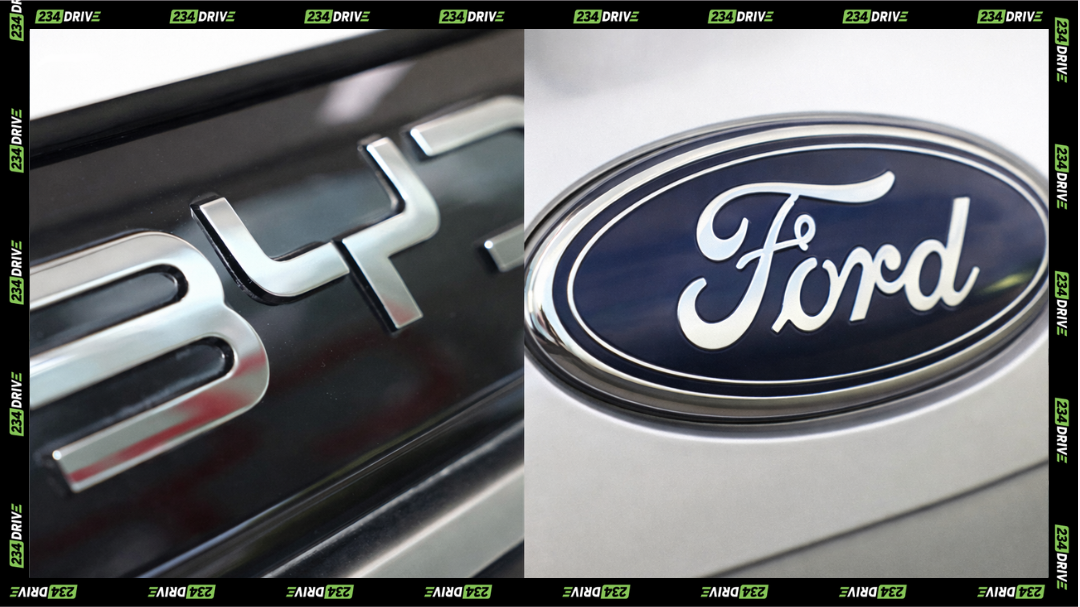
A close-up shot places the BYD badge beside the iconic blue Ford emblem.
China’s BYD has officially passed Ford Motor Company in global vehicle sales for the first time. In 2025, BYD sold 4.6 million vehicles, edging past Ford’s 4.4 million and moving into sixth place worldwide, a change that shows how quickly the Chinese electric vehicle makers are climbing in the global market. And, traditional car brands are now feeling the pressure.
BYD Moves Into the Global Top Six of Vehicle Sales
BYD grew its sales by about 7.7% last year, a much smaller number than the 40% of 2024, while Ford’s global numbers fell by roughly 2%. That gap was enough to change the rankings. A few years ago, this would have sounded unlikely. Today, it reflects how quickly the market is changing currently.
The global leaderboard now looks like this:
- Toyota Motor Corporation – 11.32 million
- Volkswagen Group – 8.98 million
- Hyundai Motor Group – 7.28 million
- General Motors – 6.18 million
- Stellantis – 5.48 million
- BYD – 4.60 million
- Ford – 4.40 million
- Geely Group – 4.12 million
- Honda – 3.52 million
- Nissan – 3.2 million
BYD only sells plug-in hybrids and fully electric vehicles. It stopped making traditional petrol-only cars back in 2022. It also overtook Tesla in EV sales last year, delivering 2.25 million electric vehicles.
Ford’s CEO described Chinese carmakers as a “wild card” in the global industry. His point was simple: Chinese brands combine lower production costs with strong technology, and that makes them tough competitors. As growth slows in China’s local market, more of those vehicles are now heading overseas.
About 25% of BYD’s 2025 sales came from exports—roughly 1.05 million vehicles. The company plans to increase that to 1.3 million this year. It has also built factories in Brazil, Thailand and Hungary to support international demand.
Africa Key to BYD’s Expansion While Western Tariffs Slow Its Reach
Africa is quietly becoming part of BYD’s global story. Demand for affordable electric vehicles, especially for commercial use and fleet operations, continues to grow across parts of the continent. African markets offer room to expand without the same political resistance seen in the West.
The United States and the European Union have imposed tariffs that limit Chinese EV sales in their markets. Those restrictions slow BYD’s growth in key markets. Without them, one could argue that the company might have exported more vehicles—and possibly climbed even higher in the global rankings. For now, BYD is expanding where it can, with expansions in Bahia, Brazil and other countries in South America. And the numbers show that strategy is working.