
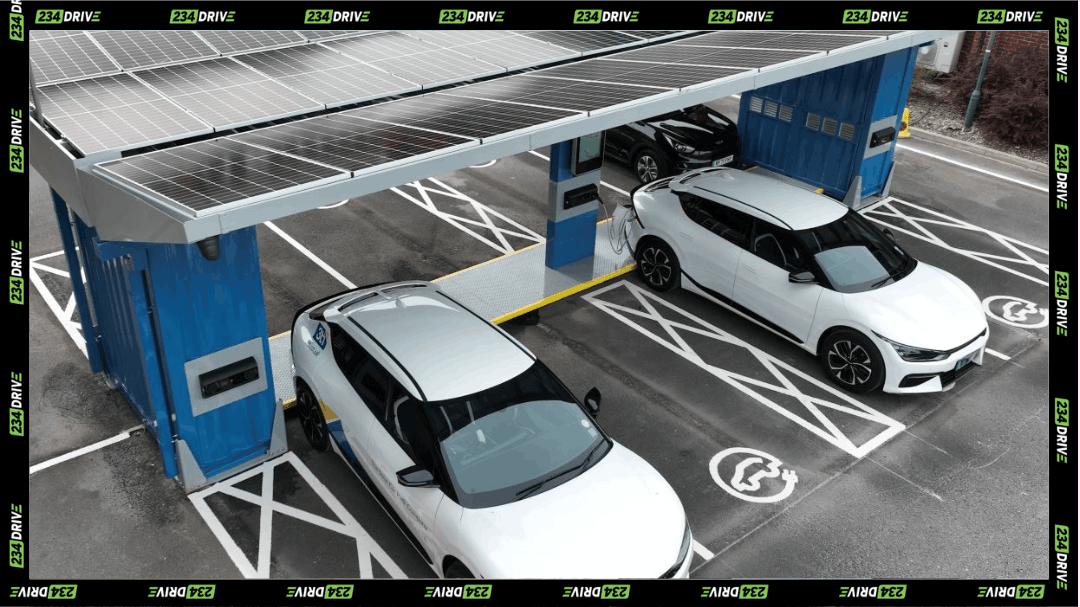
MTN Nigeria and First WATT Renewable Limited are bringing solar power into Nigeria’s EV charging conversation. The two companies have announced a renewable energy infrastructure partnership that will support 60 kW electric vehicle charging stations across eight MTN facilities in Nigeria.
The sites include Ikoyi, Matori, Ojota, Abuja, Port Harcourt, Asaba, Kano and Ibadan. The project also aims to cut MTN’s diesel use while improving energy reliability across some of its most important operations.
Solar, Battery Storage and EV Charging Rollout Across MTN Sites
The project has two main parts, but the mobility angle sits in the EV charging rollout. First WATT will provide renewable energy systems for 60 kW EV charging stations at eight MTN facilities across Nigeria. This means the charging stations will be supported by solar and battery systems, rather than relying heavily on diesel-backed electricity.
The wider project will also bring solar panels and battery storage to selected MTN facilities across Nigeria. According to the announcement, the plan includes about 34 MWp of solar power capacity and 40 MWh of battery storage.
Those systems will support MTN sites such as data centres, switch facilities, cable landing stations, customer service centres and other important network locations. While this part is mainly about MTN’s operations, it also shows how renewable energy can support high-demand infrastructure.
Both companies say the project will help cut diesel use, lower emissions and improve power reliability at selected MTN sites. Based on current estimates, the programme could help avoid about 25,000 tonnes of carbon dioxide equivalent emissions over five years. The final figure will depend on how the systems perform after deployment.
Oluwole Eweje, Chief Executive Officer of WATT Renewable Corporation, said the EV charging part of the project shows how renewable energy can support cleaner mobility in Nigeria.
Tobechukwu Okigbo, Chief Corporate Services and Sustainability Officer at MTN Nigeria, said the project supports MTN’s goal to reduce diesel dependence, improve energy use and increase renewable power across its operations.
How This Fits Into Nigeria’s Solar EV Charging Push
Efforts to make EV adoption easier in Nigeria are starting to move beyond vehicle sales. More attention is now going into the power and charging systems drivers need after buying an EV.
234Drive has highlighted an increase of around 400% in EV adoption since 2020. Although the market is still in its infancy, it is clear that charging access needs to keep up with the growing number of EV buyers.
Different projects are already shaping this early charging map. Abuja has seen activity through NNPC’s first EV charging station and GAC’s EV charging station at Jabi Lake Mall. Lagos has also joined the rollout through charging infrastructure linked to Qoray. Kano adds a stronger solar angle, with Qoray’s fully solar-powered EV battery-swap stations showing how cleaner energy can support charging in places where power supply is not always steady.
The next stage is about making charging feel less like a special arrangement and more like a usable part of everyday movement. Drivers need reachable charging points, steady power and cleaner energy systems capable of keeping chargers active. Solar-backed charging helps answer part of this problem by reducing dependence on diesel and unstable grid supply.