
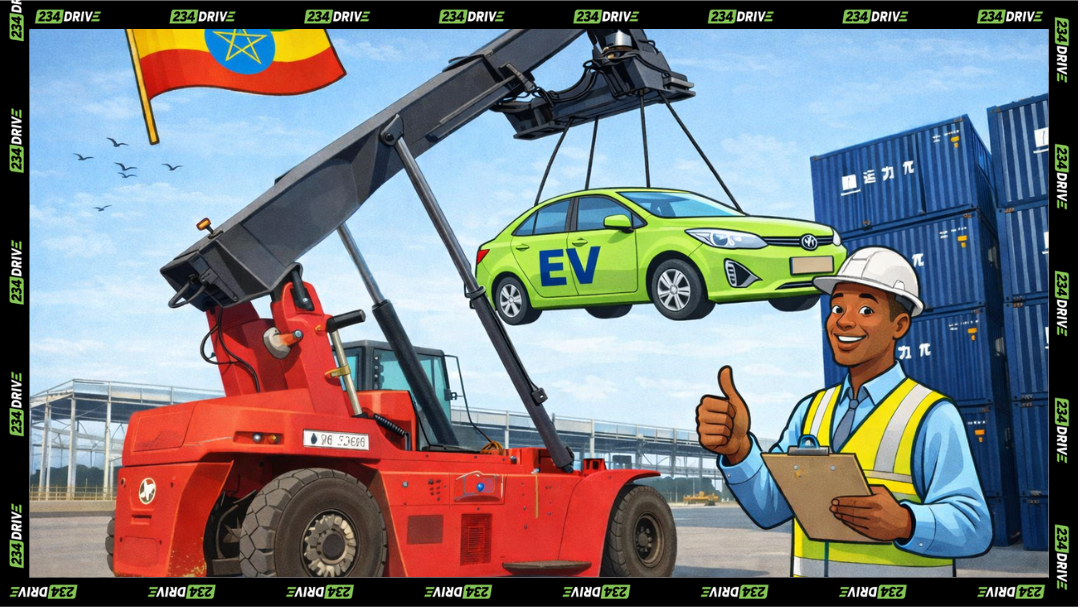
Ethiopia stopped allowing petrol and diesel cars into the country in 2024 and reduced taxes on electric vehicles (EVs). Since then, EVs have grown from less than 1% of cars on the road to nearly 6%, which is above the global average of 4% per country. The government made this move mainly to cut fuel import costs and ease financial pressure. Still, the country’s access to cheap electricity from the Grand Ethiopian Renaissance Dam has helped make the switch possible.
The Ban That Changed Everything
In 2024, the government banned the import of fuel-powered cars. At the same time, it reduced import taxes on electric cars: 15% for fully built EVs, 5% for semi-assembled ones, and 0% for vehicles brought in as parts and assembled locally.
Interestingly, the main motivation for this decision was not climate change. Ethiopia has spent billions of dollars over the years subsidising fuel. After defaulting on its debt in 2023 and receiving a $3.4 billion bailout from the IMF in 2024, the country needed to cut costs, and fuel imports were a big pressure point.
The impact was immediate. As Ethiopia only has around 1.7 million vehicles for a population of 130 million, even small changes show up clearly in percentages.
In Addis Ababa, new electric cars now compete directly with used petrol cars. A BYD Seagull sells for about 3.6 million birr (around $23,000), which undercuts the price some secondhand petrol cars used to go for. Chinese brands like Changan Automobile, as well as Volkswagen and VinFast, are now common in showrooms.
Cheap Electricity Makes It Work
The switch to EVs is mainly due to the fact that Ethiopia produces a lot of its own electricity. The Grand Ethiopian Renaissance Dam, completed in 2025, generates 5,150 megawatts of power. Along with wind and solar projects, the country now has extra power to sell to its neighbours.
Electricity costs about $0.10 per kWh—roughly half of what consumers pay in the US. Some households pay even less because of subsidies. That makes charging an EV much cheaper than buying fuel.
The government says this is about energy independence. Instead of relying on imported fuel, Ethiopia wants to run its transport system on power it produces locally.
There are now 17 EV assembly plants in the country, with a target of 60 by 2030. Addis Ababa has about 500 chargers installed, though officials say the city alone needs at least 1,000. Charging still takes time—most stations need four to six hours for a full charge—but the network is growing.
What This Means for the Rest of Africa
Ethiopia joins a small group of African countries using industrial policy to reshape transport. Only South Africa and Morocco have built large-scale automotive manufacturing industries. Ethiopia has chosen a different path—focusing on EV assembly, tariff reform, and reducing fuel imports rather than full vehicle production.
Governments across Africa are observing the outcome. Adjusting import duties on electric vehicles, aligning transport policy with renewable power generation, and encouraging electric buses and two-wheelers through public procurement are emerging as practical tools.
Power-exporting countries could be well placed to adapt this strategy. Zambia and Mozambique generate significant hydropower and export electricity within Southern Africa, while Ghana has exported power through the West African Power Pool. Redirecting part of that generation toward domestic transport electrification could reduce fuel import bills and support local EV assembly ecosystems.
Infrastructure gaps remain, particularly in charging networks and grid access beyond major cities, yet the broader lesson extends beyond Ethiopia: aligning domestic power generation with transport policy and vehicle import reform can quickly reshape a national fleet. Ethiopia has created a replicable framework, and for countries worldwide seeking energy security, lower import bills, and cleaner urban transport, the approach offers a practical template rather than a theory.