
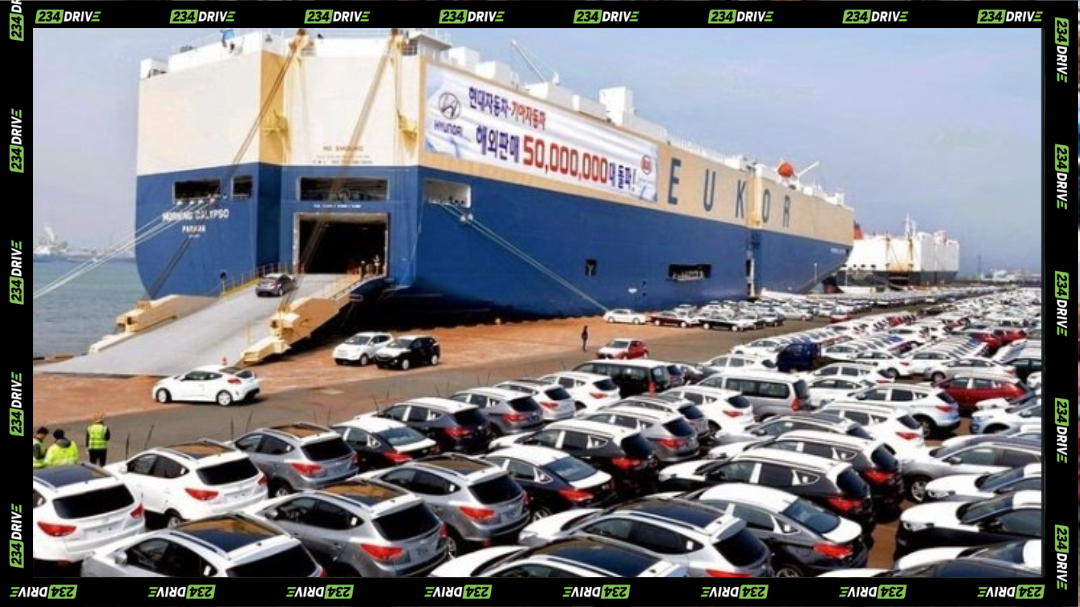
Rows of imported vehicles roll off a cargo ship, highlighting the steady flow of cars entering Nigeria from the port. | Source: Clearing Agent
Even with persistent pressure from a weak naira, high interest rates and costly vehicle financing, Nigerians still imported far more vehicles from the United States in 2025 than the year before, with spending rising by about 81% to $985 million in the first 10 months of the year.
Data from the US Census Bureau and the Bureau of Economic Analysis show that Nigeria spent $442 million more on vehicles and auto parts between January and October 2025 than in the same period in 2024, when imports totalled $543 million.
Passenger Cars Dominate Imports as Trucks, Parts, and Monthly Totals Climb
Passenger cars accounted for most of the rise, with imports climbing to $727 million from $411 million a year earlier. The $316 million increase shows that demand for US-sourced cars remains strong, even as buyers deal with higher prices caused by a weaker currency, shipping fees, and port charges.
Commercial vehicles also saw a clear jump. Imports of trucks, buses, and special-purpose vehicles more than doubled to $63 million, driven by logistics, construction, and industrial operators expanding their fleets despite tight credit conditions. Spending on vehicle parts rose to $195 million from $103 million, suggesting more repairs and upkeep of existing vehicles and continued reliance on imported components.
Monthly figures show momentum remained positive toward the end of the period. Nigeria imported $136 million worth of vehicles and parts from the US in October 2025, up from $116 million in September. Passenger cars dominated October inflows, while trucks, buses, and parts made up the balance. However, the pace of growth moderated compared with 2024, suggesting demand was stabilising after a strong rebound.
Domestic figures point in the same direction. Data from the National Bureau of Statistics show passenger car imports reached ₦1.01 trillion in the first nine months of 2025, up ₦113.15 billion year on year. Analysts link the recovery to improved access to foreign exchange and a steadier currency, even as demand remains heavily import-driven. Local production is also starting to respond; 234Drive reported that Innoson Vehicle Manufacturing confirmed plans in 2025 for a CNG assembly plant in Bayelsa State, with jobs and local vehicle production expected to grow. While import rules can further evolve to support this shift, imports still dominate the market for now.