
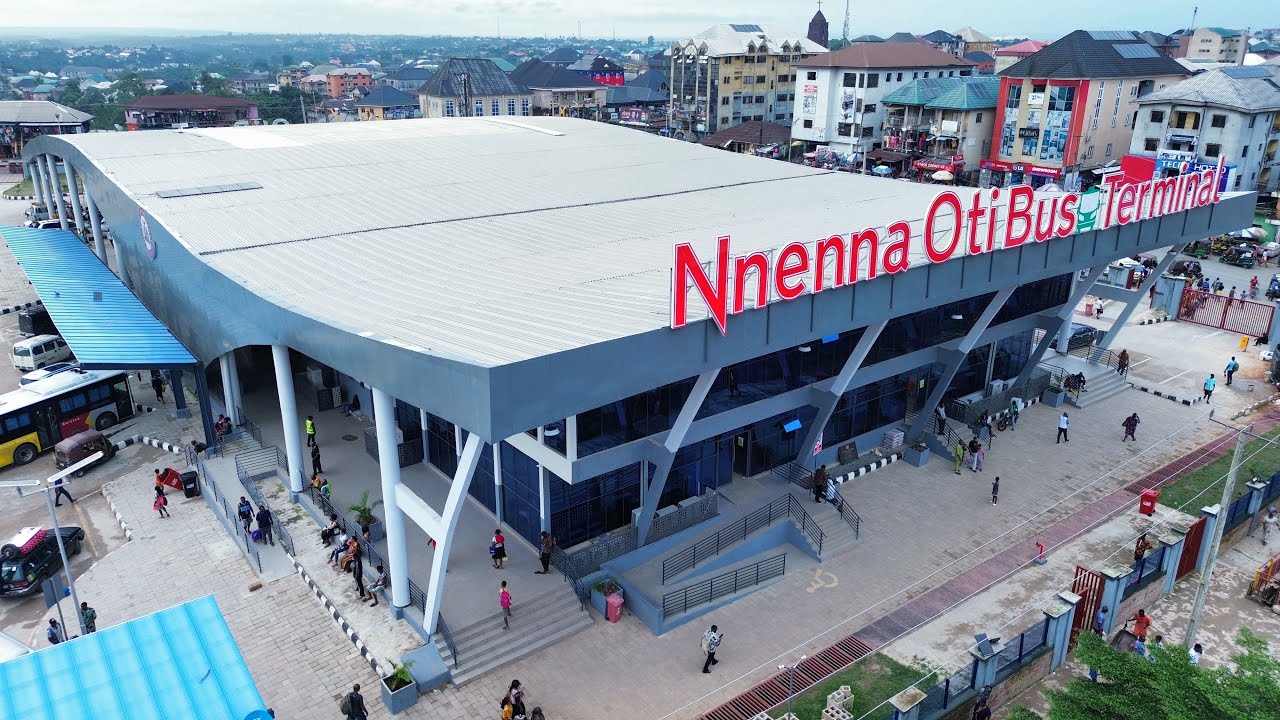
I was scrolling through my feed when I stumbled upon a short video recorded by a Ghanaian travel creator named EfyaKimora (@Efyakimora). She had just arrived in Umuahia, Abia State, and was walking through a newly built, two-storey bus terminal complete with a blue glass facade, working air conditioning, and digital ticketing counters. You could see her shock was genuine and before long, she was openly telling viewers in other African countries, ’Other countries, I hope you are seeing it… make sure you emulate oh!’
The clip has since gone viral. While thousands of people celebrated it as a proud moment for regional infrastructure, it quickly sparked a much deeper debate on the timeline about what public transportation in Nigeria should actually prioritise.
Why It Was Built
Understanding why a project like the Prof. Nnenna Nnannaya Oti Central Bus Terminal exists requires looking at how Umuahia operated before its construction. For decades, the Abia State capital suffered from dozens of informal, scattered motor parks taking over major roads and choke points. Private park operators and unions loaded buses directly on the pavement, creating perpetual gridlock, security risks and arbitrary ticketing for passengers.
The state government built this central terminal to forcibly relocate all roadside motor parks into one controlled perimeter. By centralising intercity and intra-state transit under a single roof, the goal was to clear city traffic, improve tax collection and establish public safety for travellers. It was also designed to anchor a broader urban reform programme that includes new traffic signals, road expansion and a fleet of green electric shuttle buses, commissioned earlier this year with WTO Director-General Ngozi Okonjo-Iweala in attendance.
How It Operates: An Airport Model for Road Transport
The facility itself operates more like a regional airport terminal than a conventional West African motor park. Built by engineering firm Planet Projects, the multi-storey hub has the capacity to handle over 340 buses simultaneously.
Inside, the operation relies on a few key features: climate-controlled lounges, where over 62 industrial air conditioners keep passenger waiting areas cool and shield travellers from the heat; digital ticketing and commercial hubs, where passengers buy tickets at structured counter bays rather than negotiating with touts on the tarmac, alongside 22 retail shops, commercial spaces, restaurants and a motel for long-distance drivers needing overnight rest; and separated arrival and departure flows across two floors to prevent vehicular bottlenecks at the gates. Additionally, the terminal has designated ramps and facilities built specifically for commuters living with disabilities. These accessibility features are especially progressive as public infrastructure is often inaccessible by design.
The Beauty of Dignified Mobility
It is easy to understand why the video resonated with so many people. For decades, taking an intercity bus anywhere in Nigeria has meant enduring a degrading experience. Most commuters are used to informal motor parks built on unpaved dirt, where you wait under broken plastic canopies while loaders shout destinations into the hot air.
The newly commissioned terminal in Umuahia stands in stark contrast to that reality. By consolidating scattered motor parks into a single, clean facility equipped with organised departure bays, seating lounges, and security surveillance, the state government offered something rare in public transit economics: human dignity. When a commuter can buy a ticket at a counter without fighting off touts, it changes how they feel about public movement.
The MVP Critique: Glamour vs. Function
Yet, as the video gathered thousands of views, a sharper critique began to take over the conversation. Transport analysts and regular commentators online started asking whether an elaborate, multi-billion naira building is really the best use of public funds in a country facing severe economic pressures.
X commentator @TheCharlesIsidi raised a valid point grounded in product design. In business, a Minimum Viable Product (MVP) focuses strictly on core functionality.
‘We do not understand the concept of an MVP, all that a bus stop needs is a kiosk with POS to get payments, and a shade at best for people to wait for the bus.’
For public transit, what the average commuter needs on a daily basis is a shaded bus stop, a reliable POS kiosk for ticketing, and paved roads that do not destroy vehicles. Even major private transport operators in Nigeria do not build airport-style lounges because the thin profit margins of road transport cannot support massive overhead costs.
Another X analyst, @bigbrovar, highlighted the heavy opportunity cost. The argument is that the money required to build and power one massive, glossy building in the capital city could easily fund dozens of standardised, safe bus shelters across an entire state.
‘Nigerians are obsessed with glossy outcomes, even when there is no fundamental infrastructure to sustain them.’
The Danger of the White Elephant
The real concern isn’t just the initial cost of construction but also what happens six months down the line. Nigeria’s transport history is littered with ambitious projects that looked incredible during their ribbon-cutting ceremonies, only to devolve into dark, abandoned structures once the government changes or the generator fuel runs out.
Nigeria doesn’t have to imagine what this looks like six months down the line. Abuja is currently living it. In 2024, FCT Minister Nyesom Wike broke ground on three ‘world-class’ bus and taxi terminals at Mabushi, Kugbo, and the Central Business District, a combined project reportedly worth over ₦51 billion. Mabushi and Kugbo were completed and commissioned in June 2025, with President Tinubu himself in attendance. More than a year later, both terminals are still sitting empty. Wike has explained that the buildings are finished but can’t be opened because management contracts for private operators are still awaiting approval from the Federal Executive Council, a bureaucratic bottleneck with no clear end date.
That’s the gap between a ribbon-cutting and a functioning terminal. A building can be architecturally complete and administratively dead at the same time, and from the outside, both states look identical in the viral video: gleaming, modern, ‘finally we have something world-class. It’s only months later, when one terminal is processing thousands of passengers a day and the other is a locked glass shell collecting dust, that the difference between infrastructure and monument becomes visible.
Maintaining a two-storey glass building with dozens of active air conditioners requires consistent revenue and disciplined facility management. If the fares collected at the gate cannot cover basic upkeep, the facility risks becoming another white elephant, a project built for political prestige rather than long-term operational survival.
Finding the Balance in African Transit
So, where does that leave us?
The truth is that both sides of this debate are fairly reasonable. Everyday citizens deserve clean, safe transit spaces that treat them with respect. Expecting commuters to settle for muddy roadside parks forever is not a policy strategy.
At the same time, governments must avoid the temptation of building monuments solely for social media applause. A truly successful transport system is not measured by how impressive a building looks in a travel vlog on day one. It is measured by whether that terminal is still clean, fully powered, and affordable for a market vendor carrying goods two years later. Closing that gap is exactly the problem initiatives like Impact by 234Drive are trying to solve from the other direction, funding voucher systems and standardised shelters instead of single landmark buildings.
If state governments want to build grand terminals, they must ensure those buildings are backed by sustainable maintenance models. Otherwise, we will keep spending billions on temporary glamour while the basic roads outside remain in the dark.