
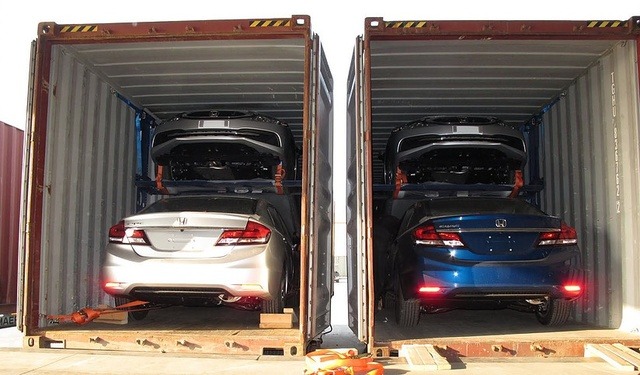
After a voyage of about six weeks across the Atlantic, an imported vehicle arrives in Nigeria in a shipping container. The importer must then pay customs duties and terminal charges before taking delivery. However, workers at a facility in Lagos must still unload the vehicle.
This final stage can expose the vehicle to significant damage. At many offloading sites, workers use wooden planks, manual labour and gravity to remove vehicles from containers. Cars may therefore sustain dents, scratches or mechanical damage, regardless of their value or condition before shipment. Containerised vehicle shipping through Nigerian ports consequently carries substantial risks during the final stage of delivery.
The Three Doors of Air, RoRo and the Container Trap
Vehicle imports into Nigeria from the United States, Canada, Europe and the United Arab Emirates generally arrive through one of three logistics routes, each with a distinct cost and risk profile. Air freight is the fastest option and avoids maritime complications, but transporting a vehicle by air can cost between $40,000 and $100,000, depending on its origin. This makes it commercially unviable for most standard consumer vehicles.
Importers widely regard RoRo (roll-on/roll-off) as the safest maritime option because drivers can drive vehicles directly onto a specialised carrier at the port of origin and off again upon arrival. By contrast, individual buyers and vehicle dealers commonly choose the more contentious option of containerised shipping, securing vehicles inside standard 40-foot metal containers for the ocean voyage.
Container shipping protects vehicles from sea salt and harsh weather during transit. A 40-foot container costs between $7,000 and $9,000 for the voyage and can carry four to five vehicles, reducing the average shipping cost to around $2,000 per vehicle. This lower per-vehicle cost makes container shipping attractive to commercial importers, although damage during offloading can offset the savings.
The Flatbed Scramble and the Ticking Clock
Once the vessel docks at Apapa or Tin Can Island and the Nigeria Customs Service completes its clearing formalities, the real logistical gymnastics begin.
The shipping fee covers the use of the container during transit, but the clearing agent must return it empty to the shipping company’s designated yard by a set deadline. Failure to meet that deadline attracts daily demurrage charges. Because having the shipping line deliver the container directly to a private, secure workshop or residence incurs punishing haulage and demurrage fees, clearing agents rely on a standard workaround.
They hire a flatbed truck to hoist the container from the port terminal and haul it to an open-air offloading lot, often located in chaotic hubs around Amuwo Odofin, Maza-Maza or the outskirts of Lagos. Once the flatbed truck parks at the lot, the clock starts ticking for the container to be unsealed and hauled back to the port.
Inside the Offloading Site and the Role of Offloaders
At the offloading lot, a specialised group of frontline workers takes over. Local operators simply call these men ‘offloaders’. They control the physical infrastructure of the final delivery stage, owning the wooden ramps, makeshift blocks, jacks and other tools they need to extract four tightly packed cars from a dark, elevated steel box.
Clearing agents negotiate a fixed fee per car with the offloaders before the crew begins work. Because commercial container offloading lots lack modern hydraulic loading docks or professional overhead gantry cranes, offloaders rely on traditional, high-risk methods. They stack mismatched wooden planks and logs at the base of the container doors to build a steep, improvised ramp.
If a car’s battery is dead, which is common after a six-week voyage, or if the keys go missing during port inspections, the challenge increases. Rather than troubleshoot the electrical system, the crew may use physical force. Workers may drag, winch or manoeuvre cars down the ramp, relying on braking and steering to prevent them from slipping off the sides.
The Damage Caused in the Final Fifty Feet
Regular importers at Lagos ports know that these rudimentary extraction methods frequently damage vehicles. The most common problems affect vehicle lighting, bodywork, suspension and mechanical components.
Workers may damage headlights, taillights and body panels while manoeuvring large sedans and SUVs through the container’s narrow steel doorway. Suspension systems and shock absorbers can also suffer severe impact damage when vehicles roll off makeshift ramps and drop abruptly onto hard concrete.
A particularly expensive hazard is a cracked oil sump. If a vehicle bottoms out on the concrete edge of the lot or strikes a jagged wooden block, its aluminium oil pan may fracture and immediately release the engine oil. Prolonged port handling may also expose vehicles to component theft, with importers reporting missing wing mirrors, car stereos and catalytic converters.
As a result, owners may need to carry out bodywork and mechanical repairs on vehicles that were in good condition when they bought them abroad before they can drive them in Nigeria.
Union Gridlock and Barriers to Modern Equipment
Given the frequency of these costly mishaps, an obvious question arises: why do clearing agents continue using wooden planks? Why can’t an individual agent or a consortium of importers invest in modern, hydraulic car-unloading ramps, mobile cranes or specialised container tilting trailers?
Veteran clearing agents at Lagos ports attribute the continued use of manual offloading methods to powerful local unions and organised associations of port offloaders. According to the agents, these groups maintain tight control over manual labour within designated logistics zones.
If an independent clearing agent attempts to introduce mechanised, modern offloading equipment that eliminates the need for manual labour, they face immediate resistance, punitive fines or outright operational blockades from local union enfranchisements. It mirrors a broader structural pattern across Nigerian commerce where informal syndicates fiercely protect labour-intensive, archaic methods to safeguard daily wages, effectively locking out technological upgrades.
For Nigerian car buyers, containerised shipping will continue to carry significant risks unless operators modernise offloading facilities and remove barriers to mechanised handling. A vehicle may arrive safely at the port only for workers to damage it while removing it from the container.