
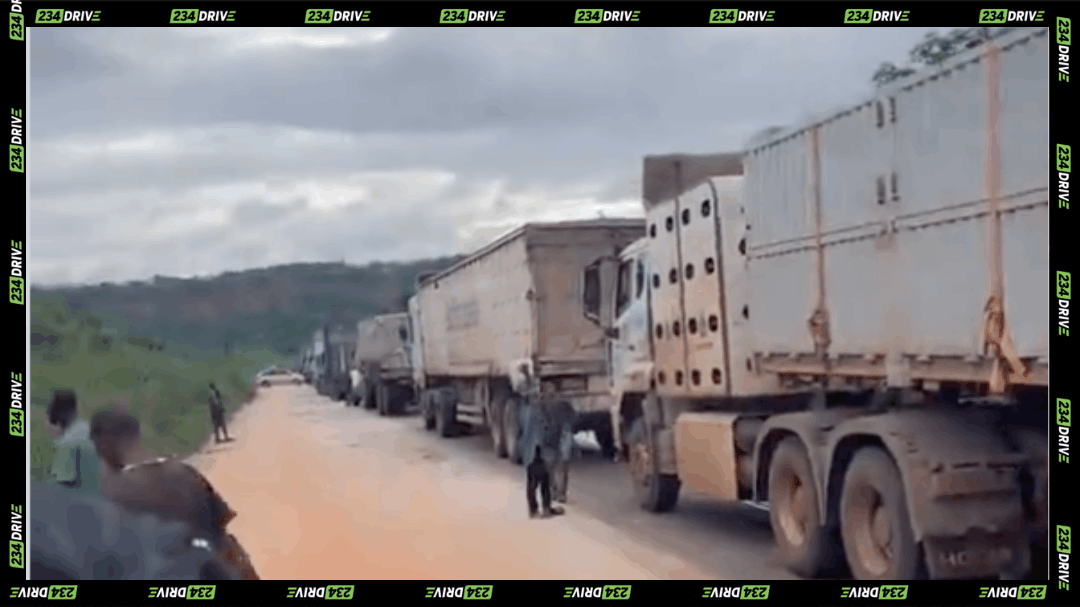
A bus carrying live catfish lost its entire stock after getting stuck for hours in traffic on the Agbor–Benin Expressway.
A post by X user @ChuksErics shows a video recording by a passenger who filmed the incident and blamed the loss on the gridlock and poor state of the road.
Damaged Agbor–Benin Road Leaves Travellers Stranded for Days
Traffic on the Agbor–Benin section of the Benin–Asaba Expressway reportedly remained at a standstill for three days, leaving motorists and passengers stranded. Floodwater covered parts of the road, while failed sections and deep potholes restricted movement. Some travellers reportedly spent nights inside their vehicles as the queue stretched along the highway.
The road forms part of the 125-kilometre Benin–Asaba corridor connecting Edo and Delta states. It also serves as an important route between Nigeria’s South-South, South-East and parts of the South-West. In March 2025, the Federal Government launched its reconstruction under a privately funded concession awarded to Africa Plus Partners, with a stated completion period of 30 months.
However, motorists say the road has continued to deteriorate. Increasing reports of deepening potholes and damaged sections, along with congestion, have made movement increasingly difficult. Residents said one section that motorists still used in 2019 became virtually impassable by 2023, forcing drivers onto longer and riskier alternatives.
The Minister of Works, David Umahi, previously said the 25-year concession limits how quickly the government can terminate the agreement or appoint another contractor without facing legal and financial consequences. He said the ministry had asked the concessionaire to improve its performance.
Umahi also announced plans to inspect the road with independent engineers, state officials and the concessionaire. He also alleged that the company removed more than 30 kilometres of asphalt without completing the expected repairs.
Agromobility Is Essential to Every Nation and Problems Faced Must Be Addressed
The loss on the Agbor–Benin Expressway shows what farmers and food traders risk when movement breaks down. Agricultural produce must still leave the farm, pass through rural and major roads, and reach buyers in good condition.
Poor roads and long delays make that journey slower and more expensive, while perishable goods face a greater risk of spoilage. A report by the Food and Agriculture Organization of the United Nations (FAO) also identifies stronger rural and national transport networks as important for improving market access and reducing post-harvest losses.
Other markets use specialised systems to move live fish safely. The FAO recommends clean, well-oxygenated water, controlled temperatures, suitable loading levels and gradual acclimatisation after arrival. In India, the Live Fish Carrier System moves table fish from ponds to retail markets. The country is also testing drone transport with containers that regulate water quality, oxygen and temperature.
This is where agromobility becomes important. It connects farms to roads, suitable vehicles, storage facilities and buyers instead of treating each part separately.
In Ghana, Mathias Charles Yabe’s AkoFresh offers a glimpse of how that connection could work. Its solar-powered cold rooms and refrigerated transport aim to protect produce while helping farmers move it towards the market.