
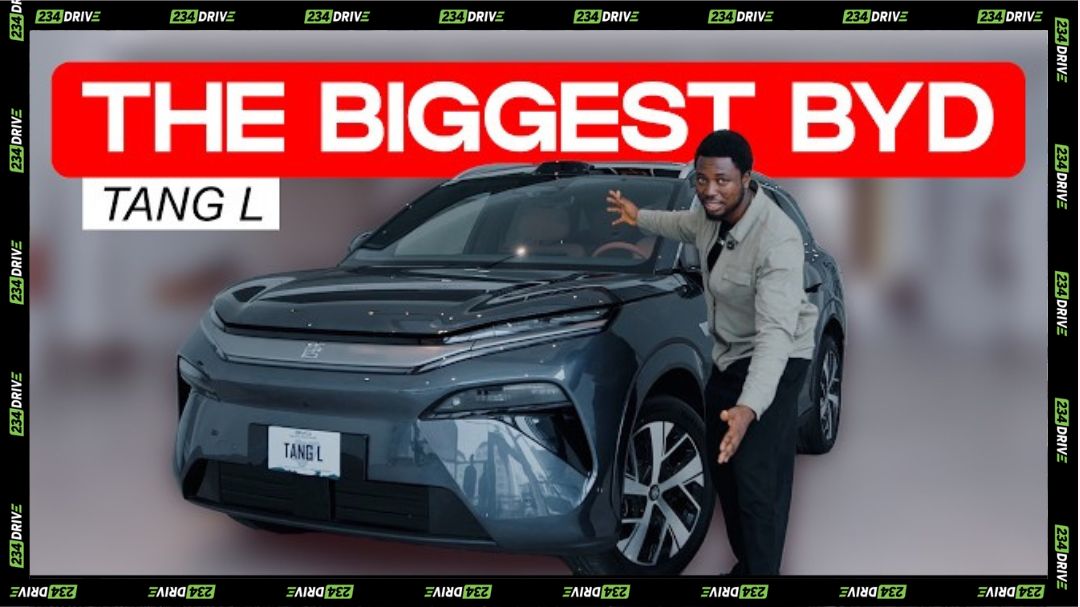
For years, the conversation around autonomous driving in Nigeria was dismissed as a technical impossibility due to chaotic lane markings and unpredictable traffic. However, the arrival of the 2026 BYD Tang L suggests that the era of “intelligent driving” has officially reached West Africa. With a system that successfully navigates Lagos traffic without driver intervention, the Tang L is more than just a luxury SUV; it is a proof of concept for the future of African mobility.
There has been a rapid proliferation of Build Your Dreams (BYD) vehicles on Nigerian roads. What began as a rare sight has become a daily occurrence, signalling a silent shift toward electrification. The Tang L, the “Large” flagship of the lineup is the strongest argument yet that EVs are ready for the Nigerian norm.
Intelligent Mobility: The “God’s Eye” and Lidar
The most striking feature of the Tang L is the DiPilot intelligent driving system, or what BYD calls “God’s Eye” technology. Unlike previous iterations of cruise control, this system utilises a Lidar sensor mounted above the windscreen in conjunction with 12 external cameras.
On the road, the vehicle demonstrates a sophisticated ability to read Nigerian traffic patterns. It identifies pedestrian crossings, maintains lane integrity, and manages braking and acceleration with a smoothness that rivals a human driver. This is supported by the Cloud Suspension system, which actively scans the road surface ahead to adjust the damping, effectively neutralising the impact of potholes and uneven road surfaces common in urban centres.
Design and Executive Comfort
The “L” in Tang L signifies its status as a full-sized, three-row luxury SUV. Despite its dimensions, the design is athletic rather than bulky, featuring a hidden D-pillar and an illuminated red BYD logo. A standout design detail is the rear LED light bar, which incorporates “Chinese Knot” patterns, an aesthetic touch that creates a distinct visual signature at night.
Inside, the cabin is an immersive experience in “burnt orange” Napa leather. BYD has moved away from the minimalist sterility of some EV competitors, opting for a luxury-first approach:
- Adaptive Cockpit: A 12.8-inch rotating central screen acts as the command centre for the vehicle’s God’s Eye systems and infotainment.
- Climate-Controlled Storage: A wireless charging pad includes a dedicated cooling vent to prevent smartphones from overheating during fast charginga critical feature in the Nigerian heat.
- Executive Seating: All seats, including the rear, are heated and cooled, while the front seats feature a multi-point massage function.
The 13-Day Commute: Breaking Range Anxiety
For the Nigerian buyer, the primary concern remains the charging infrastructure and range. The Tang L addresses this with a 100 kWh battery providing 670 km of range on a full charge.
To put this in perspective for a Lagos professional: a daily return commute from the Mainland (Ikeja) to Victoria Island is approximately 40 km. In a Tang L, a single charge would theoretically last 13 days, nearly two full weeks of urban driving before needing to visit a charger.
While a standard home power supply may take up to 48 hours to charge such a massive battery, a dedicated wall kit can complete the task in 13 hours. This makes the Tang L a viable “plug-in-on-Sunday” vehicle for the modern executive.
Performance and Value
The Tang L is not merely efficient; it is formidable. The dual-motor setup produces 670 horsepower, allowing the SUV to sprint with a level of responsiveness that traditional internal combustion engines in this size bracket cannot match. For those seeking even more power, an all-wheel-drive version producing 1,00 horsepower is available, though it sacrifices roughly 50 km of range for the added performance.
The BYD Tang L enters the Nigerian market at N83 million. To bolster consumer confidence in this new technology, BYD Nigeria provides a 6-year warranty on the body and an 8-year warranty on the battery.
As the mobility landscape shifts, the Tang L stands as a reminder that the transition to EVs is no longer about “if,” but “when.” In a country where fuel costs and maintenance for traditional V8 SUVs are skyrocketing, a self-driving, long-range electric alternative at this price point is a difficult proposition to ignore.