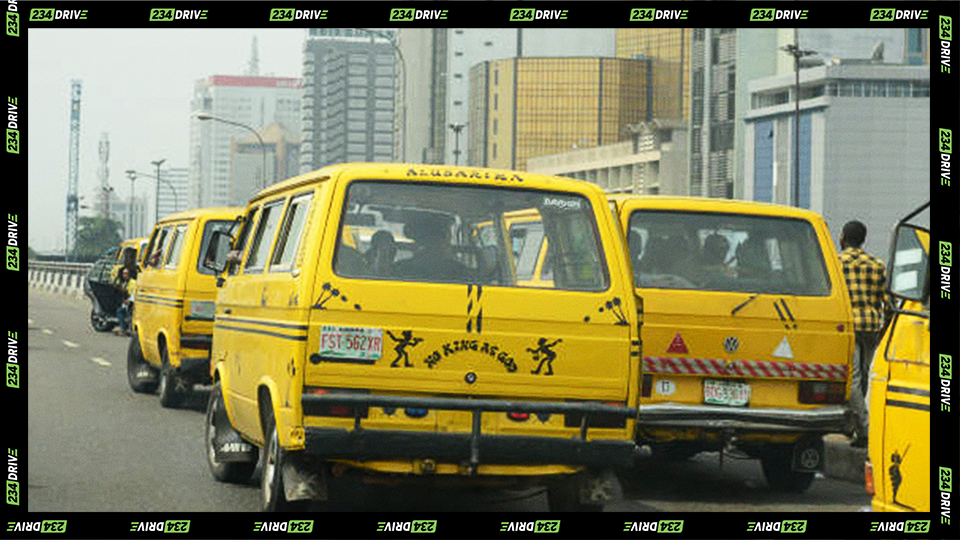

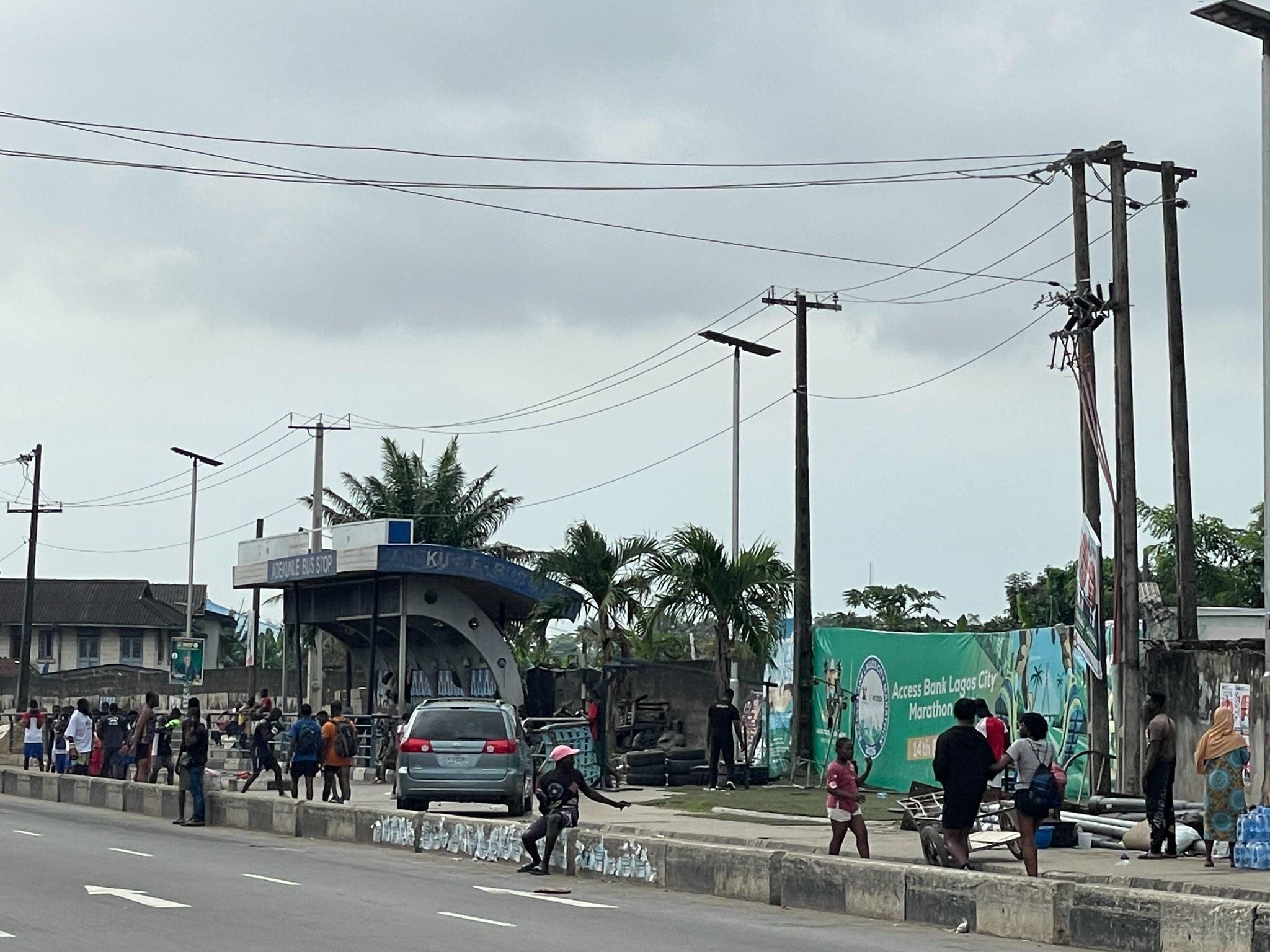
On any given Saturday morning, if you drive through Yaba along Murtala Muhammed Way, you will witness a familiar weekend ritual. Dozens of people are working out and jogging along the edge of the road. Drive along Airport Road, Third Mainland Bridge and the newly opened stretches of the Lagos Coastal Road on the Island, and you’ll see the same as well. The outer lanes of these expressways have been turned into makeshift fitness corridors every weekend.
The practice is neither new nor confined to these locations. Years ago, the monthly environmental sanitation exercise created a regular window for roadside workouts, with vehicle movement restricted for several hours. Residents used the temporarily empty roads for group fitness sessions, football matches and occasional runs. Although those closures have ended, the habit has persisted. To an outsider, it may look like an inspiring display of community health and discipline, but it also points to a more frustrating reality that Lagosians continue to exercise on the road because the city offers too few dedicated, accessible alternatives.
It is easy to assume this habit belongs to one specific district or a few congested neighbourhoods, but the pattern repeats itself across the entire metropolis.
Wherever the state or federal government lays down a wide, continuous stretch of concrete or asphalt, morning exercisers appear almost immediately. On the Island, runners take to the outer edges of the Lekki-Epe Expressway corridor and the smooth, newly constructed stretches of the Coastal Road. On the Mainland, similar crowds occupy the road shoulders along Airport Road, the Third Mainland Bridge approaches and major arterial routes through Yaba and Surulere.
This pattern cuts across neighbourhoods, regardless of income level or geography. From sprawling suburban districts to dense commercial hubs, residents have turned the edges of major transport corridors into their default exercise grounds. As this practice becomes this widespread in a city of more than twenty million people, it is no longer an isolated local habit. It becomes a clear indication of an urban environment that leaves residents with few safe, accessible places to move.
The immediate question is why residents take their workouts and football games onto major roads rather than using spaces within their own communities. Inner neighbourhood streets across Lagos were rarely designed for exercise or recreation, and decades of poor maintenance have left little safe, usable space for group activities.
One of the most serious obstacles is the neighbourhood drainage system. Many inner streets have deep storm gutters running directly alongside residential property lines, while the heavy concrete slabs meant to cover them are often broken, sunken or missing entirely. These hazards make any energetic activity, whether a fitness drill or a game of football, needlessly dangerous.
Physical space is equally limited. Residential roads are lined with cars because many apartment blocks lack adequate parking, while the remaining shoulders are occupied by wooden kiosks, mechanics’ toolboxes, private generator cages and piles of building sand. There is rarely enough uninterrupted space for fitness groups to set up equipment or for footballers to organise even a small-sided game.
Major road corridors offer what these neighbourhood streets do not: broad, continuous stretches of relatively level ground. Runners use the edges, but they are only one part of the scene. Fitness groups turn sections of asphalt into open-air gyms, while footballers mark out informal pitches wherever traffic is light enough. The appeal is not simply visibility or safety in numbers but the rare availability of enough space to exercise and play.
The LASPARK Paradox
The issue in Lagos is more nuanced than simply claiming the state has no public parks at all.
The Lagos State Parks and Gardens Agency (LASPARK) manages dozens of parks and landscaped gardens across the state. The agency maintains public facilities such as Ndubuisi Kanu Park in Alausa, Peace Park in Ojota and Jibowu Recreational Park, alongside managed green patches in parts of Victoria Island and Lekki. The problem is that the existence of a park somewhere in the state does not automatically solve the daily exercise needs of an ordinary resident.
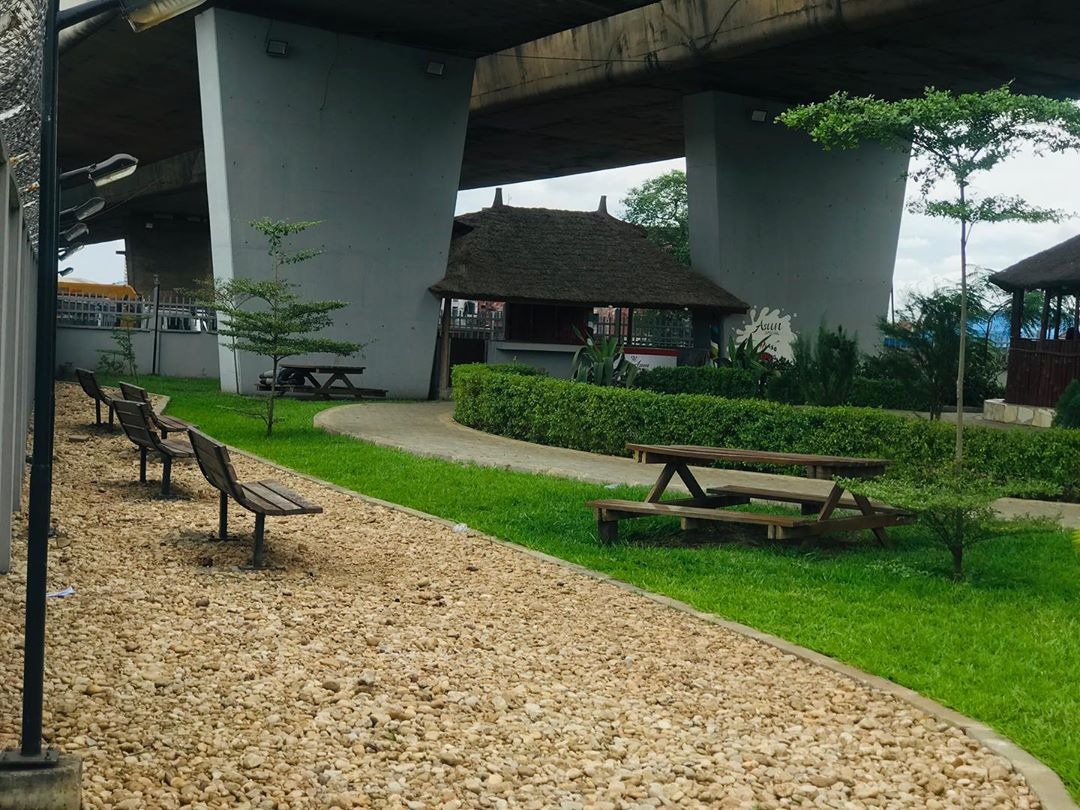
Lagos is geographically vast, and moving across the city comes with heavy costs in both transport fares and travel time. A person living in Ebute Metta or Oshodi who wants to take a one-hour morning walk before starting their Saturday cannot spend two hours sitting in transport just to reach Ndubuisi Kanu Park in Alausa. Reaching the park becomes a major excursion rather than a simple daily routine.
Operating rules and schedules create an even bigger barrier. LASPARK’s official park regulations set public opening hours between 9:00 AM and 6:00 PM, alongside an entry fee of ₦1,000 for individual visitors at managed facilities.
Those rules work fine for family picnics on a Sunday afternoon. They completely exclude individuals who need to work out as early as 6:00 AM or later than 6:00 PM. The roadside, on the other hand, is free and somewhat democratised because it sits right outside the neighbourhood, connected directly to the streets where people live and has no opening hours, gatekeepers or entrance ticket.
The Commercialisation of Civic Open Space
In a functional city, public open space is preserved as a basic civic right. Across Lagos, public land has been systematically monetised over decades of aggressive real estate development.
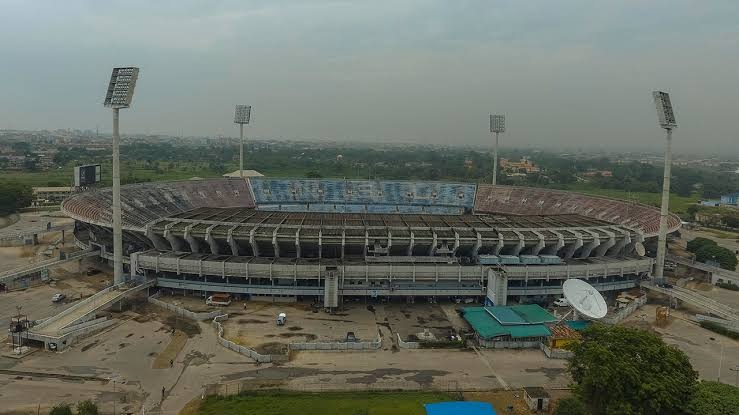
The National Stadium complex in Surulere was originally designed to be the primary sporting and recreational heart of the city. Instead, it has spent years dealing with locked gates, dilapidated tracks and private commercial leases. The open grounds around the stadium are regularly rented out for religious crusades, trade fairs, political rallies and private event marquees. An average citizen looking to use the running track frequently finds the gates locked or blocked by private event setups.
Every other open plot of land across the city faces the same pressure. Neighbourhood green patches, old school playing fields and road setback zones end up leased off for commercial plazas, petrol stations or private residential blocks.
When a city treats every square metre of land as real estate to be sold or built on, it strips away the basic physical space residents need to move. The population is left with no option but to adapt to the outer margins of the transport network.
The Art of Adaptation
Much of life in Nigeria involves finding ways around limitations. When traffic locks up an entire axis for hours, drivers map out informal alternative shortcuts through narrow inner streets. When public transport fares spike due to fuel shortages, commuters alter their daily schedules, walk longer distances or switch between different bus categories depending on the weather and crowd levels.
The exact same survival instinct governs how Nigerians interact with public space. If the city fails to build convenient, open parks where residents can walk, people do not simply stay indoors and abandon their physical health. They work out wherever space opens up. If a smooth stretch of road appears near their community, they notice it immediately. If a highway shoulder becomes relatively quiet on a Saturday morning before heavy commercial traffic picks up, that shoulder becomes usable ground.
This roadside exercise culture is not a conscious political protest or a demand for highways to be turned into permanent parks. It is a direct, practical response to the physical environment. Residents look at the infrastructure that actually exists around them, weigh their limited options and make use of whatever flat surface is available. When the city provides no designated room for human movement, its people improvise with whatever they can find, the same instinct that has driven private operators to build entire businesses around the gaps the state leaves behind.
This infrastructure deficit creates a predictable pattern whenever government authorities finish a major road rehabilitation project. When state or federal authorities resurface a major highway corridor, motorists celebrate faster commutes. Local runners see something completely different: miles of flat asphalt and clean concrete stretching without a single broken drain in sight.
When the Third Mainland Bridge underwent structural repairs and resurfacing, the cleared shoulders immediately drew a fresh wave of morning runners. The same thing happened along the expanded stretches of Airport Road in Ikeja, and it is happening again along the newly paved sections of the Lagos Coastal Road. Smooth pavement acts like a magnet for anyone who spends the rest of the week tripping over broken pavement inside their local community.
Lagos has already seen how far this improvisation can go when public space vanishes entirely. During the early weeks of the COVID-19 lockdown in 2020, large crowds gathered along the Gbagada-Oshodi Expressway. Hundreds of residents took over an entire lane of the newly reconstructed highway, converting it into a massive open-air workout space complete with group fitness leaders.
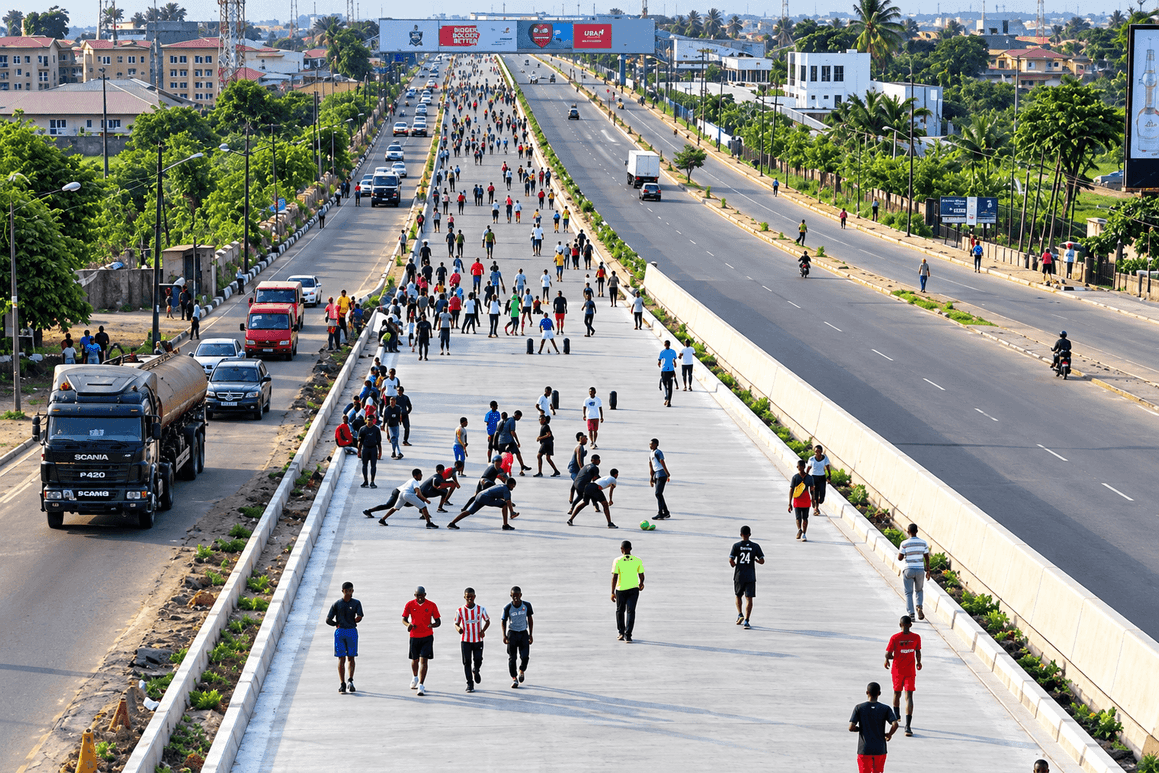
The state government responded the following day by sending police officers to disperse the exercise crowds. While the enforcement of health lockdown orders was necessary at the time, the underlying pattern predated the pandemic and continues today. Local residents had been using that stretch of road long before it made national news, and they returned to similar road margins the moment restrictions were lifted.
It is a subversion of public planning. The government builds a transport corridor to move cars, and the public reclaims the edges for exercise because no dedicated space exists nearby.
No matter how smooth or wide a road margin is, it cannot replace a functional public park. A real park offers grass, shade trees, good air circulation and surfaces designed to absorb physical impact rather than punish joints. It physically separates human beings from motor vehicles so that a moment of distraction leads to a simple stumble rather than a fatal collision. It provides seating, public water points and enough space for children to move safely.
None of those features exists on the Third Mainland Bridge, along Airport Road, beside major arterial streets or on the buffers of the Coastal Road. Exercising on major road margins carries heavy environmental and physical costs that many runners ignore. Air quality is the most severe hidden hazard. During heavy cardiovascular exercise, your breathing rate spikes, pulling air much deeper into your lungs. Early morning is precisely when long-distance trailers and heavy diesel trucks flood these main corridors.
Exercising inches away from active traffic lanes forces deep inhalations of unburnt fuel, fine particulate dust and toxic soot from ageing diesel engines. The activity intended to build cardiovascular health ends up pumping concentrated industrial exhaust straight into the respiratory system.
The physical hazards are equally significant. Road margins are not immune to traffic accidents. Speeding vehicles can lose control, commercial buses pull onto pedestrian buffers illegally to drop off passengers, and reckless motorcycle riders routinely jump onto raised walkways to bypass traffic jams. Positioning yourself on a narrow concrete buffer next to high-speed traffic every weekend is an extreme compromise that no citizen should have to make just to take a walk.
Reclaiming Room on the Blueprint
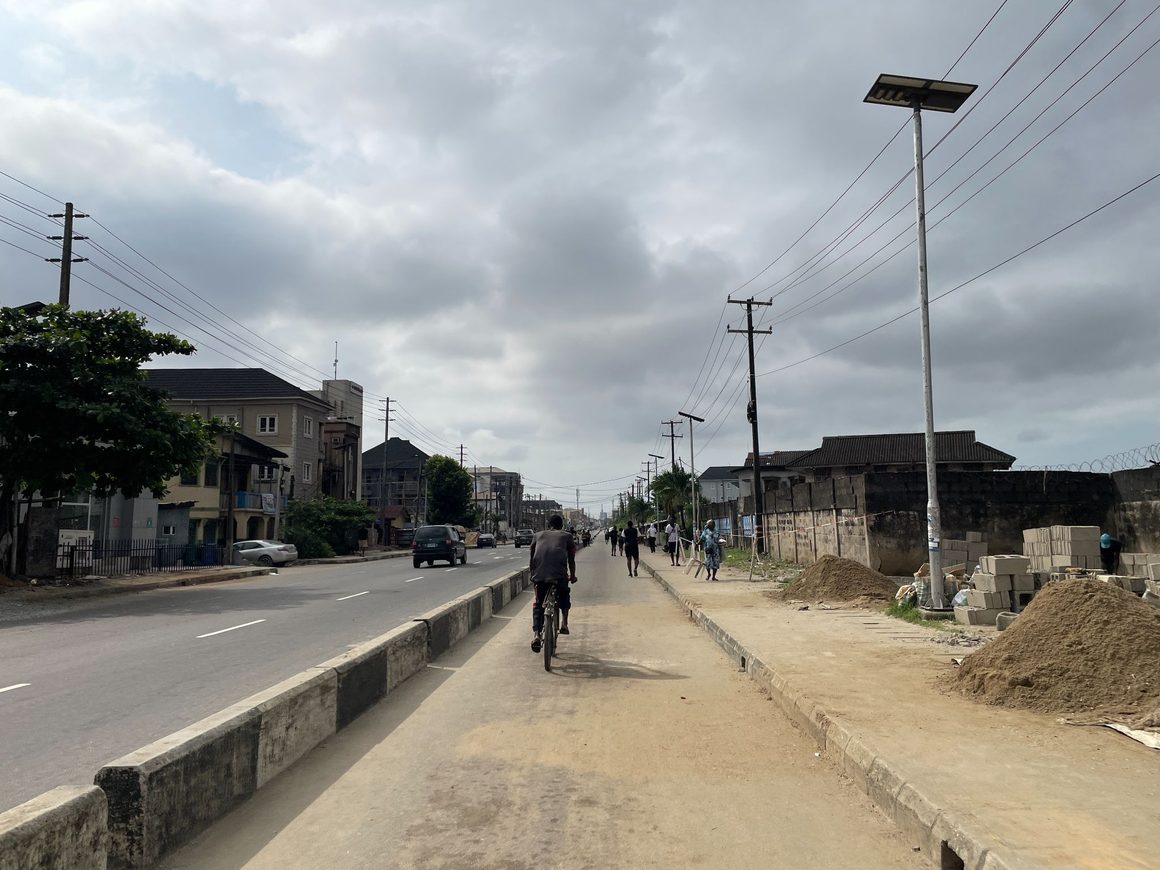
The sight of Lagosians using bridge shoulders, road margins and service walkways as weekend fitness grounds is not a lifestyle trend to romanticise. It is direct evidence of a fundamental urban planning failure, one that has been measured and documented since at least 2002, when a university study calculated roughly 81,000 people for every hectare of planned open space in metropolitan Lagos, against an international average of 600 people per hectare.
For decades, urban development across Lagos has prioritised vehicular movement over human beings. State budgets pour billions of Naira into expanding expressways, building flyovers and laying down asphalt for cars, while pedestrian networks, cycle lanes and accessible neighbourhood parks are written off as unnecessary luxuries. When city planners fail to include the human body in their blueprints, citizens are forced to improvise. People will find a place to move, even if it means turning a highway buffer into a makeshift gym.
If Lagos intends to function as a livable megacity, its infrastructure strategy requires a basic shift. Neighbourhoods across both the Mainland and the Island need dedicated pedestrian tracks, protected cycle paths and open public parks that citizens can access safely without inhaling diesel soot or dodging commercial traffic.
Until urban planning makes actual room for people, thousands of Lagosians will keep stepping out onto the concrete edges of the city’s busiest roads every weekend. They have found somewhere to work out for now and it just happens to be the highway margin.