
A flat battery is one of the most common reasons cars stall on Nigerian roads. Whether you are stuck in early morning traffic on the Third Mainland Bridge or trying to leave the office in Abuja after a long day, turning the key and hearing nothing but a rapid clicking sound is a unique kind of frustration.
Many drivers assume that a quick jump-start from a passing danfo or a colleague is a permanent fix. It is not. Understanding how to charge a car battery properly and knowing the difference between a temporary jump and a full recharge is the difference between reaching your destination and being stranded again an hour later.
Why Nigerian Roads Kill Batteries Faster
If your car manual says your battery should last three to five years, you should lower your expectations. In Nigeria, a standard lead-acid battery typically lasts 18 to 24 months.
Heat is the primary killer. While cold climates make engines hard to crank, extreme heat destroys the battery’s internal chemistry. Under-bonnet temperatures in Lagos or Kano traffic can easily exceed 50°C. This intense heat speeds up the evaporation of the battery’s electrolyte, accelerates plate corrosion and makes overcharging far more likely.
Beyond the climate, our daily driving habits contribute to early battery death. Short trips in heavy traffic mean the vehicle’s alternator never gets enough time or RPM to fully recharge the battery after the massive energy draw of starting the engine. Combine this with the dusty, humid coastal air that corrodes terminals and the rough roads that literally vibrate internal plates to pieces, and you have a hostile environment for any electrical system.
Finally, aftermarket electronics drain power. Poorly wired dashcams, heavy sound systems and custom LED light bars add parasitic drains that slowly kill batteries overnight.
Is It the Battery or the Alternator?
Before you attempt to charge a battery, you must confirm it is actually the source of your problem. If your car starts after a jump but dies again after a short drive, the battery is likely not the primary culprit. You are dealing with a failing alternator.
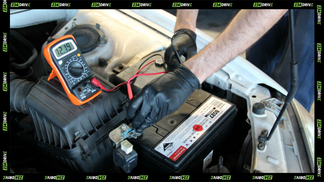
The easiest way to check is with a digital multimeter set to DC volts.
Testing the resting voltage:
Turn the engine off and let the car sit for at least an hour to remove any surface charge. Place the red probe on the positive terminal and the black probe on the negative terminal.
- 12.6 to 12.8 V: Healthy and fully charged.
- 12.4 to 12.5 V: Low. You need to charge it soon.
- 12.2 V: Discharged. Charge it immediately before judging its health.
- 12.0 V or below: Deeply discharged. A slow charge might recover it, but permanent damage is likely.
Testing the alternator:
With the engine running, a healthy charging system should read between 13.7 and 14.7 V. If it drops significantly below 13.5 V, your alternator is failing to keep up with the car’s demands. If it spikes above 15.0 V, the regulator is overcharging and boiling your battery acid.
Safety First: Do Not Skip This
Lead-acid batteries release hydrogen and oxygen gases while charging. Hydrogen is highly explosive at just a 4% concentration in the air. A single spark from a jumper cable clamp is the most common cause of battery explosions, which send corrosive acid and plastic shrapnel in every direction.
- Work in a ventilated space: Never charge a battery in a closed, unventilated garage.
- Protect your eyes and hands: Always wear safety goggles and gloves. Acid burns are severe.
- Kill the power: Turn the car fully off. Remove the keys and ensure all interior lights, AC units and stereos are switched off.
- Inspect the casing: Never charge a battery that is swollen, cracked, leaking or smells strongly of rotten eggs (hydrogen sulphide). If it looks deformed, replace it.
- Keep flames away: Cigarettes, lighters and even mobile phones should be kept away from a gassing battery.
Method A: The Dedicated Smart Charger (The Correct Way)
This is the only method that actually restores your battery to full health. You will need a 12V automatic smart charger, which is widely available on platforms like Jumia or in auto markets like Ladipo.
A smart charger pushes a controlled, multi-stage current (usually between 2 and 10 amps) that safely restores the battery without boiling it. A 60Ah battery on a 6A charger will typically take 4 to 12 hours to reach full capacity from a flat state.
Step-by-step charging process:
- Park in a safe, open space and switch off the engine.
- Clean the battery terminals with a wire brush and a paste made of baking soda and water to remove any white or green corrosion. Dry thoroughly.
- Disconnect the car’s battery cables to protect the vehicle’s ECU and electronics from power surges. Always remove the negative (black) cable first, then the positive (red) cable.
- Ensure your smart charger is unplugged from the wall.
- Connect the charger’s red clamp to the battery’s positive (+) post.
- Connect the charger’s black clamp to the battery’s negative (-) post.
- Plug the charger into the mains and switch it on. Select the 12V setting and the correct battery chemistry (Flooded, AGM or Gel) if your charger requires it.
- Let the charger run. Most modern units will automatically switch to a safe ‘float’ mode once the battery is full.
- When finished, switch off and unplug the charger from the wall first.
- Remove the black clamp, then the red clamp.
- Reconnect your car’s cables—positive first, then negative.
Method B: Jump-Starting (The Emergency Fix)
Jump-starting is an emergency procedure designed to get the engine running so the alternator can take over. It does not fully recharge a dead battery.
The order in which you connect the cables is critical to prevent sparks near the hydrogen gas emitted by the dead battery. Cheap, thin aluminium cables from roadside hawkers will often melt on larger SUV engines, so invest in heavy-duty copper cables.
The safe connection order:
- Park the good car close to the dead car, ensuring the vehicles do not touch. Put both cars in park or neutral and engage the handbrakes.
- Clamp one red end to the positive (+) post of the dead battery.
- Clamp the other red end to the positive (+) post of the good battery.
- Clamp one black end to the negative (-) post of the good battery.
- Clamp the final black end to an unpainted metal surface on the dead car’s engine block or chassis—as far away from the dead battery as possible. Never connect it directly to the dead battery’s negative post.
- Start the good car and let it idle for three to five minutes.
- Attempt to start the dead car. If it does not crank, wait a few more minutes. Do not crank endlessly.
- Once started, disconnect the cables in the exact reverse order.
- Drive the recovered car for at least 30 minutes to let the alternator put some surface charge back into the battery, then plan for a full overnight charge at home.
Method C: Charging From a Generator
Given the unreliability of the grid, many Nigerians rely on generators to charge their vehicle batteries. This works perfectly fine—if you do it right.
The safest method is to plug your 12V smart charger directly into the generator’s standard AC wall socket, just as you would inside the house. This allows the smart charger to regulate the voltage and current safely.
Do not use the small 12V DC terminals found on the front panel of many portable generators to do a full charge. These outlets are poorly regulated, push a raw current that fluctuates wildly and can easily boil your battery if left unattended. They are strictly for short emergency trickles.
2026 Price Guide and Replacement Costs
If your battery drops below 10.5 V or requires a jump-start every three days, it is time for a replacement. Prices fluctuate with foreign exchange and import duties, but as of mid-to-late 2026, here is what you should expect to spend.
- Standard Budget 75Ah: ₦40,000 to ₦70,000. These are often unbranded flooded batteries that require regular distilled water top-ups.
- Mid-Range Maintenance-Free (75Ah): ₦70,000 to ₦130,000. Brands like Diamond, Arnold and Everstart dominate this bracket for common sedans.
- Premium Korean Brands (Solite, Hankook): ₦90,000 to ₦135,000+.
- SUV Batteries (100Ah): ₦100,000 to ₦150,000+.
- AGM (For Start-Stop Vehicles): ₦150,000 to ₦350,000.
We strongly advise against buying used or ‘tokunbo’ batteries. Given the harsh Nigerian climate, a used battery is a liability that will likely fail you in the middle of an intersection within a few months.
If you are buying equipment, a reliable 12V 6A smart charger currently costs between ₦12,000 and ₦18,000. Heavy-duty jumper cables will set you back roughly ₦15,000 to ₦26,000. Look for chargers that advertise reverse-polarity protection.
The Maintenance Checklist
You can significantly extend the life of your battery by treating it as a component that needs maintenance rather than a black box you ignore until it breaks.
Clean your terminals monthly. Dust and engine heat combine to create severe corrosion that chokes the flow of electricity. A quick scrub with baking soda, followed by a light coat of petroleum jelly, prevents this.
Ensure the battery is clamped down tightly. Vibration from potholes will break the lead plates inside an unsecured battery. If your car sits unused for most of the week, start it and take it for a 20-minute drive at least twice a week to keep the charge topped up. Finally, if you use a traditional flooded battery, check the fluid levels during the dry season and top them up strictly with distilled water—never use tap water or extra battery acid.
Disclaimer: This guide applies to standard 12V lead-acid starter batteries found in most internal combustion engine vehicles. High-voltage battery packs in hybrid and electric vehicles are entirely different systems and should never be charged using these DIY methods. Always consult your vehicle’s owner manual, especially for modern cars equipped with Intelligent Battery Sensors (IBS).