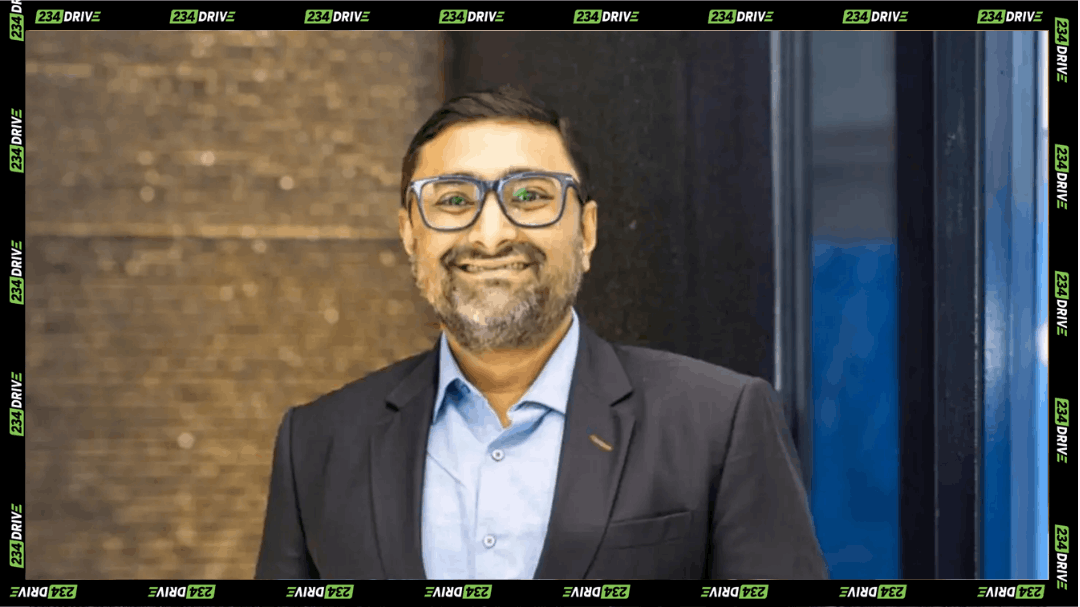

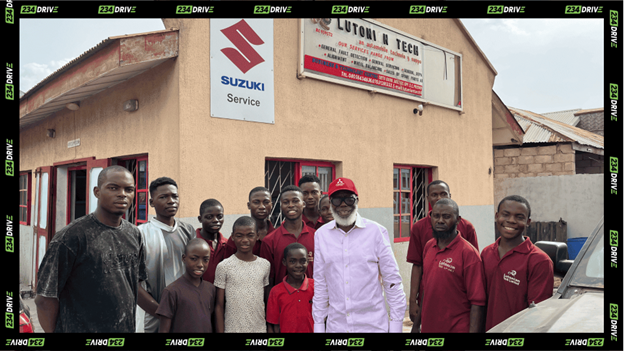
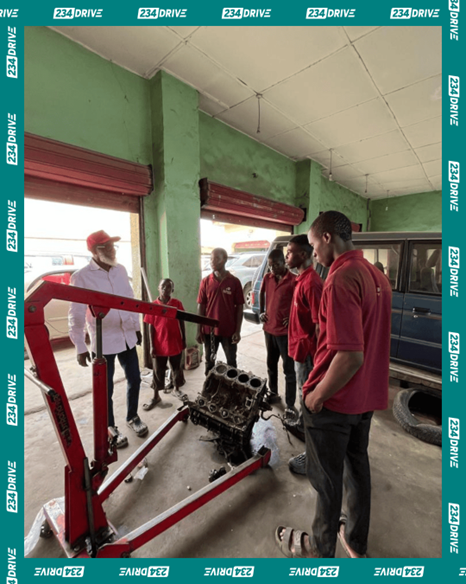
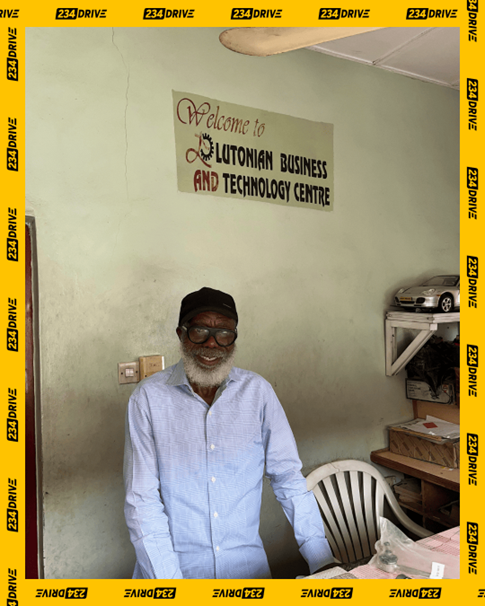
I first met Abdulrauf Abdulsalam on an excursion to his mechanic facility in January 2024. Interestingly, I was late on that particular morning and nearly missed the bus, but thank God I didn’t. Barely two minutes in his workshop, Lutonian Tech, I spotted a Formula 1-standard car jack and it immediately dawned on me that this was no ordinary Nigerian mechanic. The sheer intrigue from that day stayed with me for well over a year, until I finally got to interview him and hear his story in detail.
Early Life & the Ghana-Nigeria Migration
Born in 1954 in Ghana to Yoruba parents from Ogbomoso, Abdulrauf Abdulsalam spent his formative years in the former Gold Coast. He would have lived there his whole life if not for a 1969 quit order that saw the Ghanaian government expel thousands of Yoruba migrants, amongst others. Consequently, 15-year-old Abdulsalam relocated to Nigeria with his family.
Back home, his parents had to start from scratch. The urgency of the order meant that they were unable to sell their house and other properties before leaving Ghana, and worse still, finding a job in Nigeria proved difficult. Unfortunately, this meant they were no longer able to send Abdulsalam and his siblings to school.
Abdulsalam bitterly narrated to me:
‘I tell fathers to do whatever they can for their children when they can. Because back when we were in Ghana, my dad sent us to private schools and would pay our fees during the holidays, before the school term/session even began. He would get us two sets of uniforms every year. He provided all that we needed before the quit order changed it all.’
From Classroom to Workshop
Since formal schooling was no longer an option, Abdulsalam’s father asked his children what alternatives they were interested in. For Abdulsalam, this was a no-brainer, considering he had developed an affinity for cars since he was a kid. He told his father he was going to train as an automobile mechanic, so he took him to a mechanic workshop at Apake area in Ogbomosho where Abdulsalam’s foray into the automotive world began.
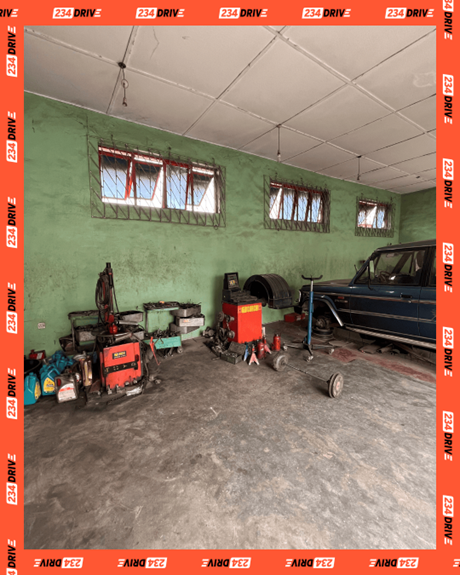
When he started learning how to fix cars, cars like the Morris Marina were commonly used as taxis. But within a year of learning, he began to notice more modern cars coming into the shop. He also noted differences like the wiring between the older Morris Marina and the new ones coming in. It then dawned on him that if he should remain at that mechanic workshop, he would not be able to cope in the future with more modern cars.
He went home to his father and requested to go to a technical college, settling on Government Technical College, Oyo. His father could not really afford his fees, but he helped out nonetheless, while Abdulsalam took menial jobs at a sawmill packing logs of wood and washing plates at a buka, to supplement what his father gave him. After four years at the Technical College, he completed his degree and became independent.
The Big Leap
At Orita Naira Ogbomosho, formerly called Orita Gbese, Abdulsalam rented a place and began working as a self-employed auto mechanic. Things were going great, but he felt an intense urge to take a big leap forward. This was when he decided to leave Nigeria to work in Saudi Arabia. Saudi Arabia was a prime choice since at the time (the 1980s), it was one of the easiest places to travel to, especially for Umrah or Hajj. However, Abdulsalam obtained a dependent visa which enabled him to travel alongside his wife, Aisha Kayode, a physiotherapist who had gotten a job in Saudi Arabia prior to their leaving Nigeria. With a dependent visa, he was able to acquire a work permit that enabled him to work in the country.
The morning after he got to Saudi Arabia, he went out in search of a job in this land that was completely strange to him. He simply hailed a taxi and asked to be taken to the mechanic village in the city, so the taxi driver took him to a place called Hayy al-Jamā‘ah in Jeddah. On getting there, he noticed the big Pirelli workshop—the famous Italian tyre manufacturer also has a mechanical division which deals in car repairs and maintenance.
A Turning Point in his Career
He walked in and approached the receptionist to ask for the workshop manager. The manager surfaced and asked what he wanted and he told him that he was an automobile mechanic and wanted to work for them. Shocked at his audacity, the manager invited him to his office where he asked him some automobile-related questions like what the firing orders of a four- and six- cylinder car were, and the location of the rotor in a car, all of which he answered correctly. The manager wanted to keep asking questions, but Abdulsalam requested for a practical test rather than a theoretical one. In his words, ‘Point me to one of the cars with a mechanical issue in the garage, so that I can try to fix it.’
The shop manager then tampered with a Nissan Patrol vehicle and asked Abdulsalam to make it work. The first thing he did was try to start the car but it did not come on. Then he remembered the manager had asked him about the location of a car rotor earlier, so he figured that they must’ve tampered with it. He looked around in the car and found the rotor in the glove compartment, fixed it in and tried to put on the car, but the firing order was out of place, so he rearranged it to fit the firing order of a V6 engine and voila! The car came on. That was how he got his first job. He would then enrol for an International Correspondent School (ICS) Diploma. Reflecting on his time at Pirelli, he told me,
‘I usually encourage my students who come for SIWES or IT to take their training seriously because this job can take them anywhere as cars are basically the same home and abroad’
The Move to Luton, UK
After working in the Middle Eastern country for a while, Abdulsalam landed a job at a Saudi Prince’s workshop. His income increased and he was more than comfortable, but then he realised that there was a certain level of Western education his children could not enjoy in Saudi Arabia. Consequently, he and his wife decided to relocate to either the UK or US. Their choices at the time were Luton in the UK or Florida in the US. Luton and Florida were singled out because Abdulsalam’s wife had been offered jobs in both cities. However, there was a stronger pull towards Luton as his wife and kids had spent some time there for the holidays and the town also had a prominent Muslim population. The final push came when Hurricane Andrew hit Florida in 1982, just a few days before their decision was due. Abdulsalam took this as a sign from Allah and picked Luton over Florida.
In Luton, he took the advice of his boss to further his education, knowing a diploma from Saudi Arabia could only take him so far. So, he got an OND first and eventually got an HND degree as well from Barnfield College all while working part-time. He worked in Luton until his retirement in 2020, before returning yet again to Nigeria of his own volition.
Returning to Nigeria: The Reverse-Japa Move
In recent years, Nigeria has experienced significant brain drain. A lot of people are leaving the country in search of greener pastures and yet, we have the few like Abdulsalam who have returned. Burning with curiosity, I asked him why he returned to Nigeria instead of simply enjoying his pension in Luton. He explained that during his time in Saudi Arabia and the UK, he regularly visited Nigeria for at least two-week periods as he believed that there was no place like home.
On his regular trips back to Nigeria, he realised that many Nigerian schools teach automobile engineering and only focus on the theoretical aspect of it. In comparison, during his training abroad for his OND and HND, they spent three days in the classroom and two days in the workshop. So, when he retired from Luton, he decided that he would return to Nigeria to train the country’s future mechanics. This decision was fuelled by Abdulsalami’s earnest desire to pass down his wealth of experience to the next generation.
A Master of All Vehicles and not a ‘Fitter’
Despite his age, 71-year-old Abdulsalam is still very much active in the day-to-day affairs of his brainchild, Lutonian Tech. In fact, he often performs various mechanical tasks. Interestingly, Abdulsalam believes all combustion engines are the same, a realisation that he came to while he was in the UK. The company he initially worked at worked exclusively on Hondas and he used to question why given the similarity with other cars.
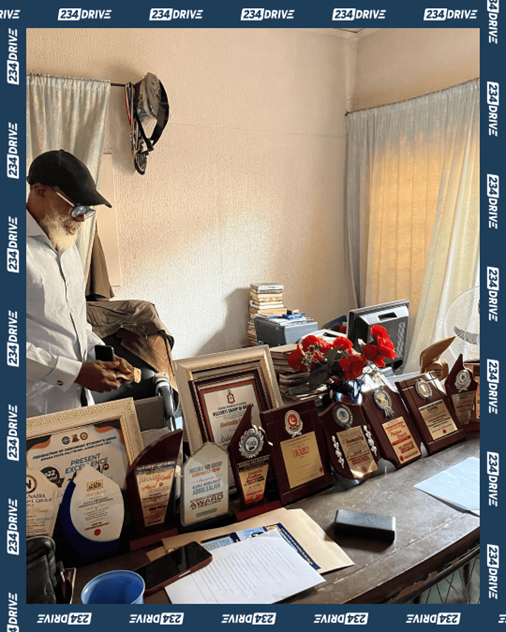
He explained to me that the new diagnostic kits cover A-Z of all cars; you just input the brand and do what you need to. Unlike people who only fix one car brand—whom he dubs ‘fitters’, he simply familiarises himself with different car manuals and he is good to go. He believes the internet makes things even better as one can download some of these manuals online and work with them in a systematic approach.
The Cross -Continental Auto Mechanic
Having worked decades as a mechanic in three different continents, Abdulsalam is very conversant with the nuances in work culture across board. He explained to me that in Nigeria, ‘anything goes’; someone could steal something from your workshop and go next-door to work without repercussions. But abroad, you need to get a referral from your previous work place to get a new job. This reduces misbehaviour and fraudulent tendencies of workers.
He also added that spare parts come with a warranty abroad. Whereas in Nigeria, if you buy something and it doesn’t work, it’s on you because the customer will return wanting a refund, thinking you deliberately gave them a fake part. However, in his company, Lutonian Tech, they give a warranty for a limited time period. If they replace a part and it gets damaged within a certain time frame, they replace it for free. He also helps out other mechanics by hosting a radio show every Monday for half an hour, enlightening other mechanics on how to do things and car owners on how not to get cheated.
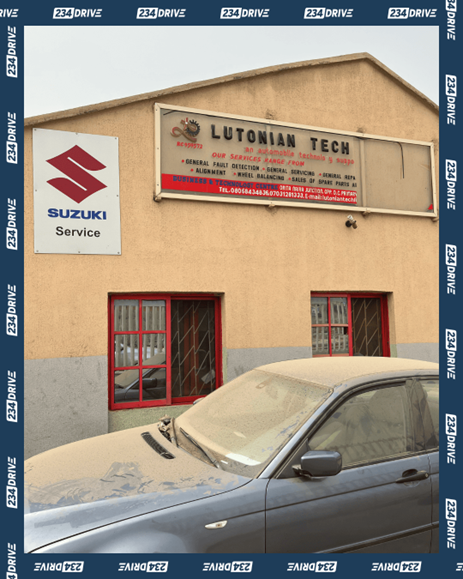
Another difference, according to Abdulsalam, is that if someone were to come and meet him for a repair abroad, he could give them a quote of the average repair cost right there and then. If there would be a change in price of any part, his part suppliers would inform him. But in Nigeria, prices change by the second because of inflation and the unstable economy. So he has to inquire prices in real time so he doesn’t run at a loss.
A Toss of the Coin
On the flip side, a unique advantage to working in Nigeria is having helping hands. By this, he means that people can come to learn the ropes and inadvertently work for him. Despite this, he compensates them for whatever they do, but at the end of the day he can’t have that abroad. It is either he employs someone as a worker or they learn the job in a school.
Now with Lutonian Tech in Nigeria, Abdulsalam leverages the valuable expertise he gained abroad to set him ahead of his competitors. Luton’s mechanics make use of scanners to identify what is wrong with a car and attack it straight on, rather than doing ‘guess work’. They also take continuing professional development seriously. Abdulsalam himself recently attended a course on mechanical diagnostic machines offered by CFAO to stay up-to-date in the dynamic auto business. This particular course enabled him to become a certified service provider for Suzuki and Mitsubishi in Ogbomosho and environs.
Abdulsalam’s principle for running a mechanic workshop effectively in Nigeria is simple: clear out as many cars as quickly as possible. For example, two cars come in, one needs an engine-overhaul and the other needs just a brake pad change. He simply does the brake pad change as quickly as possible to let that car go before tackling the more challenging one. Sometimes, there is a need to work overtime to complete some jobs.
Wise Words from a Sage
Additionally, he always encourages his staff to keep the environment clean. He said to me, ‘if you were to give a customer a discount of half the price on a repair and he or she stepped out of the shop with an oil stain on their shirt, they would not be happy.’ Hence, he encourages his workers to keep everywhere neat and tidy, clean oil stains as soon as possible and avoid scratches on cars. He personally goes around to ensure all these rules are enforced.
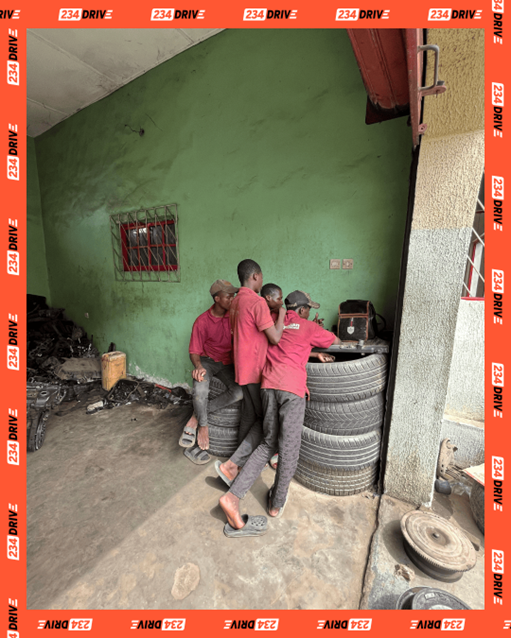
He also shared:
‘As it pertains to customers, many don’t actually know what you are doing on their cars. But you as a person offering the service should still explain in the simplest way possible, so that they understand what is going on. The internet also helps because you can easily tell them to read about it online. This fosters trust. In cases of dispute, I don’t let the workers directly talk to customers especially if they come agitated. I simply direct them to my office and try to calm down the situation.’
Reflecting on one of his joys of working at Lutonian Tech, he shared, ‘Sometimes, repairs that could not be done elsewhere are brought and we handle it at Lutonian Tech.’ He hopes to see more mechanic workshops become just like his: being well-organised and delivering top-notch services.
A Lifetime Under the Hood
When I asked Abdulsalam what his dream car to work on was, he casually said that he had already worked on them back in Abu Dhabi. He has worked on Ferraris and even Bugattis as a younger mechanic. He recounted a particular instance when he took a particular Ferrari he had fixed to a secluded area and started revving it to the max, just for the thrill of it.
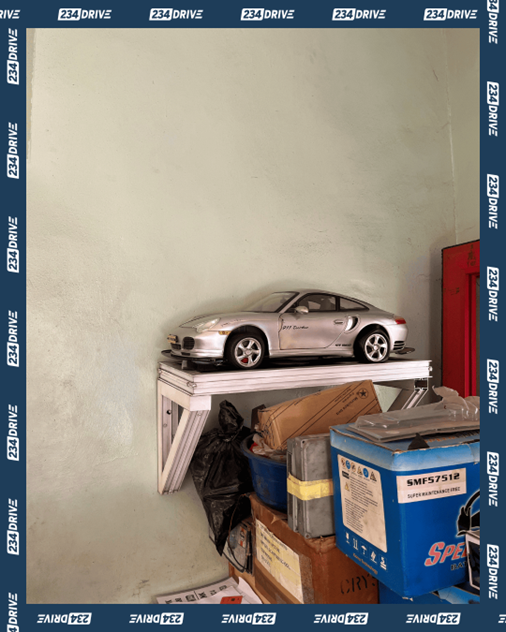
I noticed a lot of Porsche car replicas around his office space, so I asked if that was his favourite car, but to my surprise he said no. He revealed that his favourite car is an old Mitsubishi Pajero SUV, which he currently owns. He bought it from Germany in 2009 and has travelled over 300,000 miles with it. However, he has told his children to buy him either a Bentley or Rolls Royce before he dies.
All things considered, Abdulrauf Abdulsalam has lived an interesting, adventurous and fulfilling life as a mechanic. His parting words in our interview were, ‘do what you love and do it well.’
Vini, Vidi, Vici!