
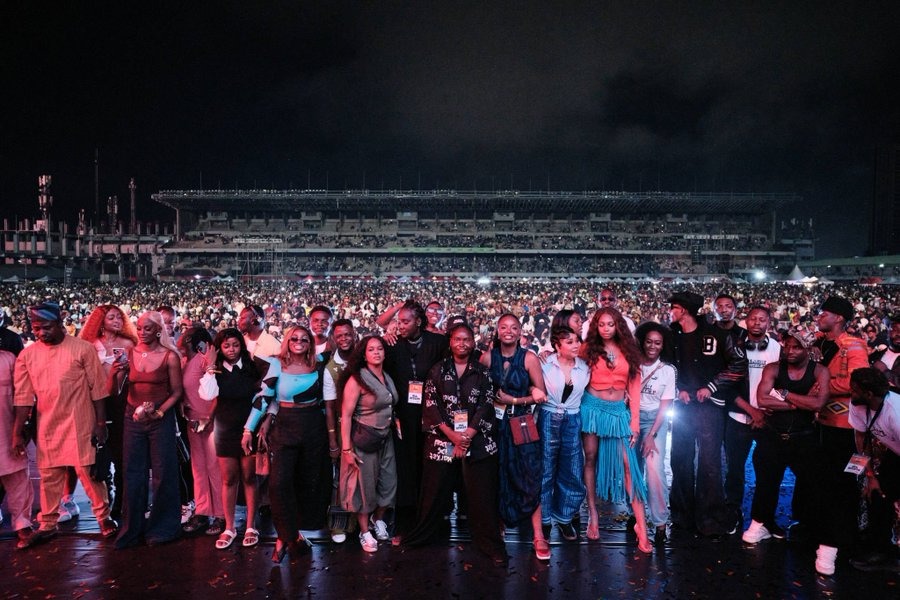
On Saturday night, 26 September, 2026, at Tafawa Balewa Square (TBS), history was made. Over 51,000 people gathered under the Lagos sky to watch Black Market, officially breaking the Guinness World Record for the largest attendance at a film screening in a single location.
To witness this as a Nigerian and a passionate supporter of our film industry is a deeply proud moment. Seeing a homegrown production fill a venue of that magnitude fills the heart with immense pride. It is a triumph for the entire cast and crew, for producer Nora Awolowo, and especially for director Fatimah Binta Gimsay, who pulled off a global milestone on her very first feature film. Hosting over 50,000 to 60,000 people at a single event is a monumental undertaking that even seasoned global event corporations struggle to pull off.
Nonetheless, we must also look honestly at what happens when the credits roll and the 50,000+ people step out into the night.
The View from the Roadside
As the celebrations inside TBS wound down, a different narrative began unfolding on the surrounding streets. The complaints that surfaced online in the hours that followed were not from people trying to bring the movie down. On the contrary, almost every attendee praised the film, the food and the atmosphere. Their frustration stemmed from the struggle of getting back home safely.
For many attendees, the exit logistics proved overwhelming. Several guests noted that promised arrangements, including dedicated BRT shuttle access, did not materialise as expected. X user @AyomideIrish congratulated the team while pointing out, ‘You promised BRT, nothing… but Black market movie was good btw.’ Similarly, @Phemmilala posted, ‘They promised that there would be buses available after the movie, here we are stranded no bus.’ Another user shared that they waited nearly an hour without seeing a single bus heading towards Yaba.
Rideshare services offered little relief. Although promotional discounts were active on paper, execution on the ground proved chaotic. User @thayour_10 noted that while the Bolt discount worked, ‘drivers were demanding that you add extra for them or you cancel the ride.’ This forced many attendees to switch to alternative apps such as InDrive, often at heavy surge prices. @Girllikevanessa said they enjoyed the movie but spent hours trying to secure a ride home.
With no immediate vehicles in sight, large crowds of attendees had to trek from TBS towards Obalende bus stop late at night. User @TalkWithAyanfe described standing at Obalende past midnight and trying to figure out where to sleep before finally reaching Ikeja at 2:00 AM. These accounts suggest that the event’s transportation challenges did not end when the screening did because for many attendees, the journey home became the night’s most difficult experience.
A Labour of Love and the Reality of Scale
It is essential to hold these two truths in the same hand: the event was a resounding cinematic success, and the transport setup fell short.
Moving tens of thousands of people out of Lagos Island simultaneously tests the limits of any urban road network. As attendee @Alpha_Yom thoughtfully observed on X, ‘Crowd management can be better but hosting 60,000 people at once no be joke o. I salute the effort’. Another attendee, @emperor8yo, captured the quintessential Lagos spirit by tweeting that despite ‘fighting for my life in Lagos traffic’ until 11:32 PM, it was still a ‘10/10 experience, would stress myself again’.
The organisers gave Lagos a night to remember. But the takeaway for future events—not just for this team, but for the entire entertainment industry—is that transportation cannot be treated as an afterthought or left entirely to individual improvisation.
Making Mobility Integral to the Production
When an event gathers tens of thousands of people under one roof, getting them home safely is just as vital as the performance on screen. Transport cannot be treated as an afterthought or left entirely to individual improvisation.
There’s a small irony worth sitting with here. Black Market’s own partner list included the mobility startup Shuttlers alongside MTN, Puma and Oraimo, which suggests organised transit was part of the plan on paper. Whatever arrangement existed didn’t scale to the size of the crowd it actually needed to move, which is really the whole argument for building mobility into the production budget rather than treating it as a sponsorship slot.
Moving forward, mega-events in Nigeria must integrate mobility directly into the core event strategy. Event organisers can build robust transport frameworks by securing formal fleet agreements with state transit authorities like BRT to hold pre-paid shuttles on standby for post-event dispersal. Establishing physical, security-patrolled e-hailing pick-up hubs away from primary traffic bottlenecks would prevent driver gouging and ride cancellations. Furthermore, designing phased exit schedules that clear venue sections in waves will allow surrounding road networks to absorb crowd movements naturally.
Black Market proved that Nollywood possesses the incredible power to pull massive crowds and command global respect. By ensuring that transit planning grows alongside our creative ambitions, Nigerian organisers can guarantee that every historic night ends as smoothly as it begins.