
What defines the operation of an Internal Combustion Engine (ICE)? If you ask a Francophone engineer—as I discovered in a classroom in Belgium, they’ll tell you it’s the Beau de Rochas Cycle. But to perhaps the rest of the world, it’s the Otto Cycle. Both names refer to the four-stroke cycle—intake, compression, power and exhaust—that ICEs use to turn air and fuel into a propellant for vehicles. But while Frenchman Alphonse Beau de Rochas patented the cycle in 1862, it was not until 1876 that German engineer Nikolaus Otto invented and patented an engine that actually ran on this cycle.
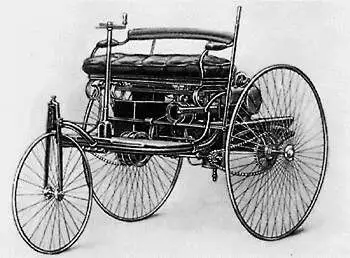
The world’s first automobile invented by Carl Benz. Source: EDN Network
Otto and Beau de Rochas essentially laid the groundwork for another German engineer, Carl Benz, to build the first automobile to run on an ICE in Mannheim, Germany in 1885—yes, the same Benz of ‘Mercedes-Benz’. On 3 July, 1886 (6 months after it had been patented), Benz drove his landmark two-seater vehicle around Mannheim, powered by a single-cylinder engine that provided 0.75 hp of pure mechanical power and enabled a top speed of 16 km/h.
The modest automobile, called the Benz-Patent-Motorwagen, still caught some scepticism about its viability. Until Benz’s wife Bertha and their two sons embarked on an unprecedented long-distance journey from Mannheim to Pforzheim with an improved version of the engine one fateful day in August 1888. The 180-km round trip was enough to convince the world that this vehicle was practical—a word that’s often synonymous with ‘German’.
The Benz-Patent-Motorwagen was the foundational automobile that would spark Germany’s—and the world’s—automotive revolution. And now, 140 years later, the European Union’s 2035 ban on new ICE vehicles in favour of electric vehicles (EVs) is forcing the country that built the car as we know it to kill it, a harrowing threat to its own history. An existential reckoning that simply cannot be taken with levity.
Germans and Their Cars, a True Love Affair
To understand why this hits Germany so hard, you have to appreciate the cultural weight that cars carry there. Germans don’t just drive cars. They have a relationship with them.
Think about how France presents itself to the world. Wine. Pastries. Fashion. Philosophy. Cinema. The TGV (Train à Grand Vitesse or high-speed train) is impressive, but no one is having an existential crisis over it. Italy has Ferrari and Lamborghini, yes—and those brands fought Brussels tooth and nail over the 2035 deadline—but Italy also has la dolce vita, the art, the food, the leather. Cars are part of Italy’s cultural export, but they’re not the whole sentence.
Germany is a different case entirely. You could argue that the two things Germany has exported most successfully to the global imagination are beer and cars, and one of those is regulated to a fraction of its former influence. Cars are not a side character in the German story. They are the protagonist.
Like most elements of European history, Adolf Hitler’s legacy is complicated. While the German dictator wreaked unimaginable havoc on millions of lives, one aspect of his legacy that does not leave a heartwrenching mark was his development of the German auto industry. Most notably, he commissioned the Volkswagen (meaning ‘the people’s car’) from Ferdinand Porsche in the 1930s, a vehicle designed to be affordable for the average German family. Additionally, he exploited the emotive power of cars for his own gain, building the country’s extensive motorways (including the autobahn) in the 1930s.
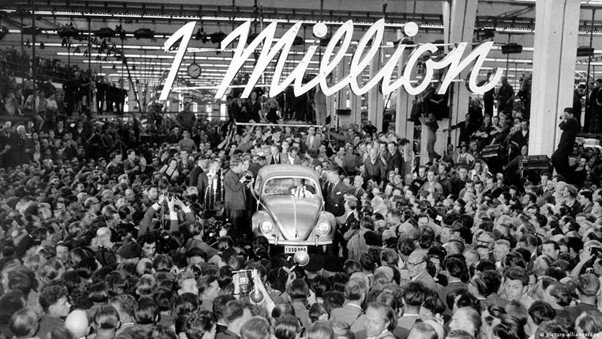
The one millionth Beetle produced at the VW plant in Wolfsburg in 1955. Source: picture-alliance/dpa
Post World War II, the VW Beetle became a symbol of West Germany’s miraculous economic resurgence, showing the world that Germany was back to building things again. Beyond being industrial powerhouses, automakers like Volkswagen, Mercedes-Benz, Audi and Porsche have served as cultural icons that shape how the world sees German innovation.
But even on a more personal level, cars mean a lot to Germans. Today, roughly 70% of Germany’s autobahn network has no speed limit. The policy has survived decades of political challenge, accident statistics and environmental lobbying. The term ‘Freie Fahrt für freie Bürger’ (unrestricted driving for free citizens), which has been used in the country since the 1970s, succinctly explains the reason for this survival. To Germans, the unrestricted autobahn represents freedom more than anything.
A 2025 report by the Deutsche Automobil Treuhand (DAT) found that 79% of German car owners (from a survey of 4,664 persons) experienced joy simply by looking at their car. And over 86% of the respondents described driving as ‘fun’—not transportation, not utility, fun. Meanwhile, 63% were unhappy about and very sceptical of the desired technological shift to electric mobility. To them, BEVs still had to prove themselves.
This scepticism is very German. Four out of five Germans research cars extensively before buying—online deep-dives, technical reviews, lifecycle analyses. And the more they researched electric vehicles, the less certain they became. Ironically, it was the government’s own generous subsidies of up to €9,000 for EV purchases in 2019 that sparked such intense public investigation of the technology that it ended up fuelling the backlash.
The EV Race is Bringing Germany to its Knees
Beyond the cultural and psychological weight, there is a very practical industrial problem. Forming the biggest sector of Europe’s largest economy, Germany’s automotive industry currently employs about 800,000 people directly. That number doesn’t even account for the ripple economy of parts suppliers, mechanics, dealerships, and the thousands of small Mittelstand companies whose entire existence is centred around making ICE components.
Consequently, German publication Handelsbatt reported in 2020 that the shift to EVs would cost 410,000 jobs in Germany by 2030. 4 years to go and the country has already lost over 200,000 industrial jobs since 2019, most of which are in the automotive sector. From automakers like Mercedes Benz and Audi to supporting manufacturers like Bosch and ZF Friedrichshafen, the job cut dominoes continue to fall, driven by low demand, mounting costs associated with EV production and the final nail in the coffin: fierce Chinese competition.
This is why, in late 2025, Chancellor Friedrich Merz sat down and wrote a letter to European Commission President Ursula von der Leyen earnestly urging her to reconsider. He asked for explicit exemptions to the 2035 ban for plug-in hybrids, range-extender EVs and highly efficient conventional engines, framing it as ‘technology neutrality.’ Anyone paying attention read it as what it actually was: a country under pressure, trying to buy time.
The move from ICE to EV is not like switching from analogue to digital recording, where the underlying skill set largely transfers. A combustion engine is beautifully complicated, requiring multitudes of parts to suction, compress, combust and produce power. We’re talking about everything from pistons and crankshafts to exhaust systems and cooling circuits, all of which Germany has mastered. But battery-powered cars are much simpler. Over 40% of the car’s value lies in the battery and there are far fewer supporting parts to these batteries. This simplicity is nothing short of catastrophic for an economy built around ICE complexity.

Germany is finding it hard to get behind the EU’s mandated EV transition
And Germany is only catching up to where the value has moved: the battery. Europe is building gigafactories, including Tesla’s Giga Berlin, but the raw materials, the chemical engineering, and the intellectual property that underpin battery technology remain concentrated in Asia— particularly Japan, China, and South Korea. China’s BYD and Nio have been capturing growing European market share with EVs that are cheaper and increasingly competitive.
The technological alternative that Germany has invested real hope in—hydrogen fuel cell technology—remains frustratingly out of reach for mass-market passenger vehicles. Hydrogen combustion offers something battery EVs cannot: refuelling times comparable to petrol and the energy density that batteries currently cannot match. But the infrastructure barely exists, the production cost of green (100% clean) hydrogen remains high and the efficiency losses across the production-to-wheel chain make it difficult to justify at scale for passenger cars in the near term. It may yet find its lane in heavy transport and long-haul logistics. But for the family driving a Golf down the autobahn on a Sunday? Not quite yet.
Sweet in the Middle?
Germany’s coalition government arrived at its hybrid-friendly position not simply through industrial lobbying, but through something more awkward: genuine ideological conflict. The CDU/CSU German political party has traditionally been pro-industry and rival party SPD has always had deep ties to organised labour. Even the Greens, historically the party most committed to electrification, found themselves reluctantly accepting some compromise because the alternative (staggering mass unemployment) is not a price any government survives.
Merz’s letter to von der Leyen was, in this sense, not just industrial policy. It was domestic politics. A government looking at Wolfsburg, at Stuttgart, at Ingolstadt— cities whose economies are inseparable from car production—and calculating what it can afford to let happen.

German car brands and where they’re based
The European Commission’s apparent willingness to negotiate represents a significant shift. When Germany first secured a narrow e-fuels exemption in 2023, it faced fierce resistance. Now, with multiple manufacturers struggling to meet interim CO₂ targets, Brussels sounds like it is prepared to offer ‘flexibility.’ France and Spain oppose any weakening of the 2035 target while Italy and Eastern European states want reviews. The negotiations that follow will tell us a great deal about what the EU’s green ambitions are actually worth when they collide with economic reality.
Meanwhile, a February 2026 report from the German Institute for Economic Research (DIW) confirmed that Germany’s energy transition is not moving fast enough to reach its own renewables targets. Solar installations by the end of 2025 stood at about half of the 2030 target. Onshore wind had reached around 60% of what is required. Electrification of transport and heating remained the most significant laggards. Even Germany’s own grid is not yet ready for the EV transition Germany is being asked to lead.
Quieting Germany
What makes all of this more poignant is that the objection is not entirely irrational nostalgia. There is something real being lost. The internal combustion engine is, by any honest account, a remarkable human achievement. It converts controlled explosions into motion. It roars and breathes and vibrates. It requires skill to understand and care and attention to maintain. Former Lamborghini engineer Maurizio Reggiani said it plainly: ‘What we sell is emotion, and part of that emotion comes from the sound of the engine.’ In Germany, this is not a niche luxury sentiment, but a mass psychology.
An electric vehicle is quiet. It accelerates smoothly, which is its own pleasure, but it does not growl. It does not smell of oil and fuel. It does not require the kind of tactile, intuitive knowledge that German mechanics and enthusiasts have accumulated across generations. The intimacy is gone.
Germany will adapt. It always has. The question is what gets lost in the adaptation, and whether a country that built its modern identity in part around the beauty of the machine can find the same sense of meaning in an industry rebuilt around technology that feels rather…soul-less.
The answer, probably, is that Germany will do what it has always done: engineer its way through. Porsche is investing in Croatian EV performance company Rimac. BMW’s i4 and Porsche’s Taycan are proof that German brands can make EVs that carry some of that old emotional charge. Volkswagen’s ID series has found a market. The Taycan may not roar like a 911, but it is unmistakably, insistently a Porsche.
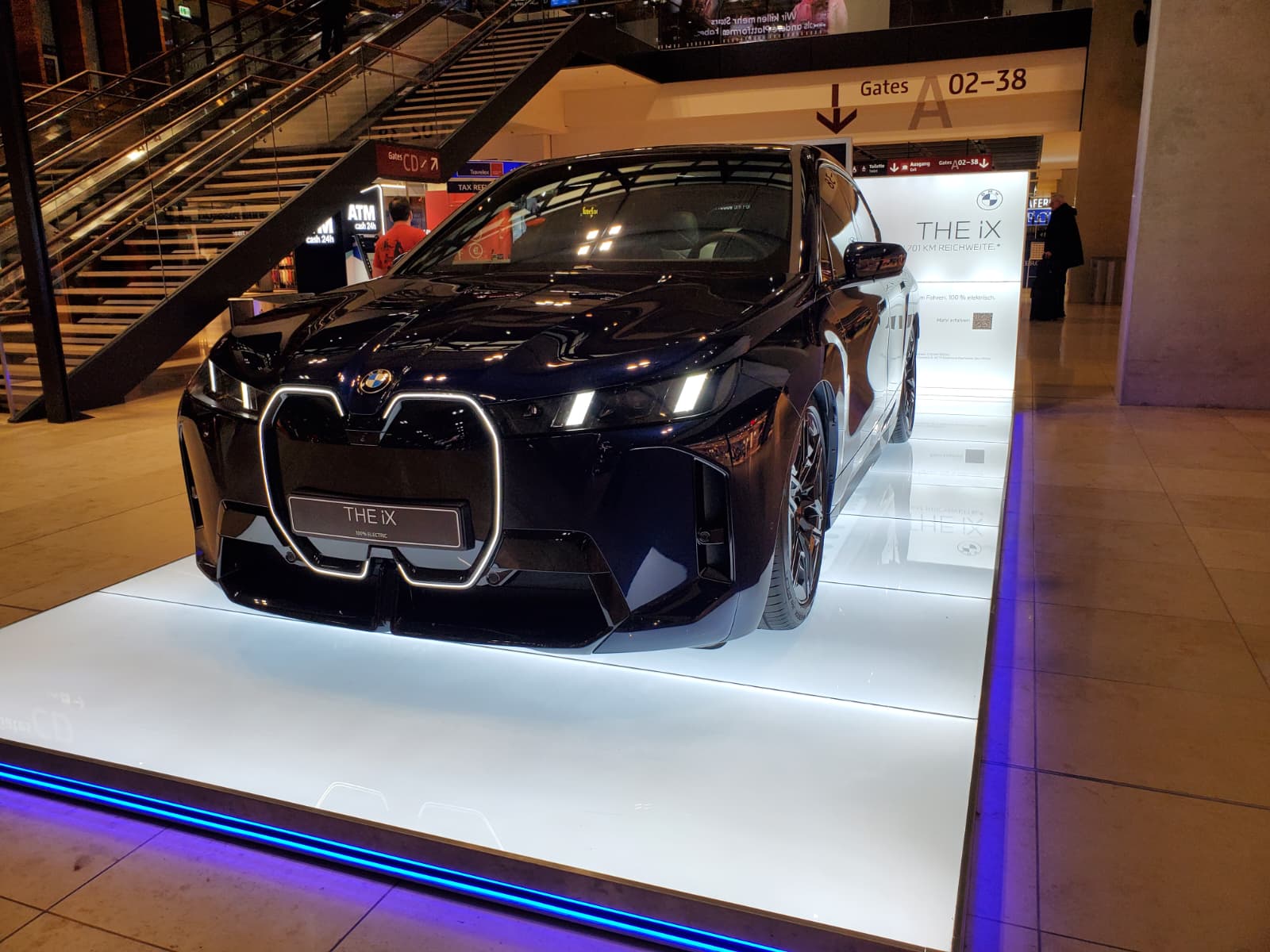
The BMW iX electric car on display at the Brandenburg International Airport in Berlin
But the industry is doing this under duress, against a timeline set by politicians, not by the market or by consumer demand. Germany did not become the world’s greatest car-making nation because Brussels told it to. It became that because a man in Mannheim couldn’t stop tinkering, and an entire culture decided that the result was worth building a civilisation around.
All this is not to say that Germany does not acknowledge the reality of global warming. They do, and they see that there is an equally real need to save the planet by reducing CO2 emissions, but the pertinent question for them is, at what cost?