
The automotive finish is the first line of defence for any vehicle, yet it is often the most neglected. In the high-intensity driving environments of 2026, where modern clear coats have become thinner to meet weight and environmental standards, the traditional ‘Saturday morning car wash’ can inadvertently become a session of abrasive damage. For the Nigerian car owner, whose vehicle is frequently subjected to the dual pressures of intense UV radiation and corrosive road dust, understanding a proper car wash sequence is no longer a luxury—it is a financial necessity. A single improper wash can introduce swirl marks that devalue a vehicle by millions of Naira, turning a pristine asset into a faded relic.
This analysis moves beyond the surface-level advice of typical car blogs to examine the technical requirements of automotive preservation. We explore why timing, chemistry and sequence are the three pillars of a professional-grade finish. By shifting the focus from the ‘wash’ to the ‘preparation’, owners can significantly extend the life of their paintwork and protective coatings. Whether you are maintaining a daily-driven workhorse or a high-end exotic, these five principles represent the authoritative standard for automotive care in a climate that is increasingly hostile to poorly maintained surfaces.
1. The Thermal Trap: Timing and Environmental Control
The first rule of automotive preservation is that the temperature of the vehicle’s surface dictates the success of the wash. Washing a car in direct sunlight or when the body panels are hot from a recent drive is a primary cause of ‘mineral etching’. When water and soap are applied to a hot surface, the liquid evaporates almost instantly, leaving behind concentrated deposits of calcium, magnesium and silica. These minerals do not simply sit on the surface; the heat causes them to bond with the clear coat, creating permanent water spots that often require professional machine polishing to remove.
To maintain the integrity of the finish, washing should ideally occur in the early morning or late evening, and always in a shaded area to avoid direct sunlight. A cool surface allows the cleaning agents to dwell on the paintwork, providing the necessary lubrication to lift dirt without it re-attaching. In a tropical environment like Nigeria’s, where surface temperatures can exceed 60 degrees Celsius at midday, ignoring this thermal rule is the fastest way to degrade paint longevity and dull the reflective depth of the clear coat.
2. Chemical Warfare: The Danger of Household Cleaners
The use of household detergents—such as dish soap, laundry liquids or general-purpose cleaners—is an existential threat to automotive paint. These products are engineered to strip grease and organic matter, which makes them highly alkaline. While effective for kitchenware, these harsh degreasers immediately strip away protective waxes, polymer sealants and even the hydrophobic top layers of ceramic coatings. Once this protection is gone, the paint is left ‘naked’ against UV rays, acid rain and bird droppings, leading to rapid oxidation and clear-coat failure.
Professional automotive shampoos are pH-balanced, typically sitting between a neutral 7 and 8 on the scale. These specialised formulas are designed with high lubricity, creating a slippery barrier that allows the wash mitt to glide over the surface. By using dedicated car-wash products, owners ensure that they are only removing the dirt, not the protection. Consumer data indicates that vehicles washed consistently with pH-neutral shampoos maintain their resale value significantly better than those treated with corrosive household chemicals.
3. The Two-Bucket Protocol: Preventing Micro-Abrasion
Contamination is the primary cause of ‘swirl marks’—the fine, circular scratches visible under bright light. These are almost always ‘wash-induced’, caused by dirt particles trapped in a sponge or mitt being dragged across the paint. The two-bucket method is the professional standard for preventing this: one bucket contains the soapy solution, while the second contains plain water for rinsing the mitt. By rinsing the mitt after every panel, the grit is deposited into the rinse bucket rather than being reintroduced to the clean soapy water.
Further protection is provided by ‘grit guards’—plastic grates at the bottom of the buckets that trap debris so it cannot be picked up again by the mitt. Furthermore, the choice of tool is critical; traditional sponges and old bath towels are too dense and flat, meaning dirt is pressed against the paint. Modern microfibre chenille or twisted-loop mitts are engineered to lift and trap particles within their fibres, safely away from the delicate clear coat.
4. The Pre-Rinse Mandate: Removing Abrasive Load
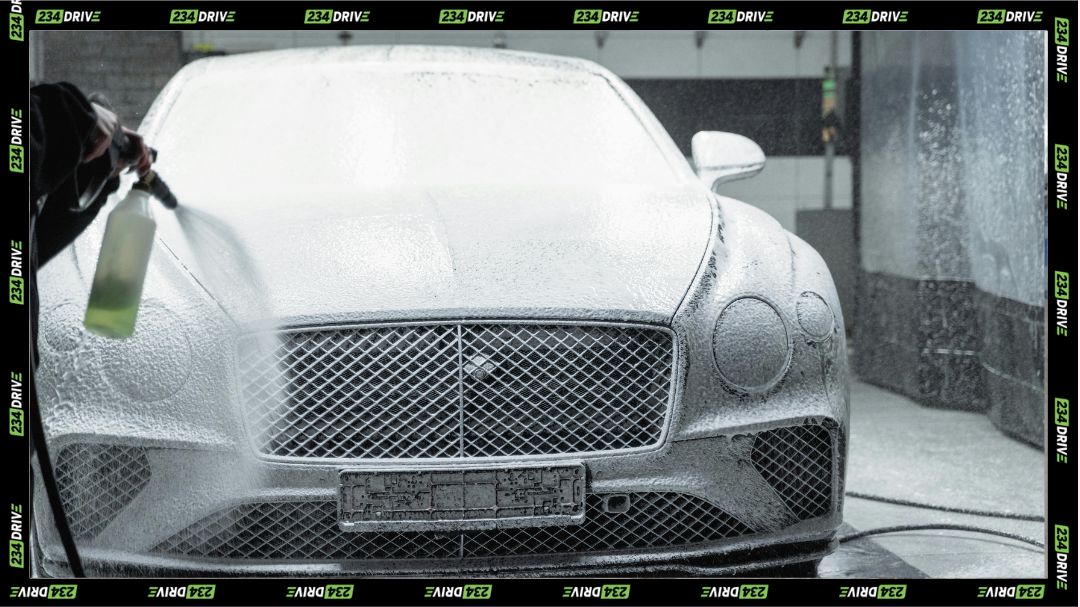
Skipping the pre-rinse is perhaps the most common mistake in amateur car care. Up to 80% of the abrasive particles on a vehicle—including dust, pollen, and road salt—can be removed through a thorough rinse before any physical contact occurs. Rubbing a mitt against a dry, dusty car is effectively the same as using fine-grit sandpaper. A high-pressure rinse (or the use of a ‘snow foam’ cannon) softens and flushes away the bulk of these contaminants, ensuring that the manual wash phase is as gentle as possible.
In the Nigerian context, where road film and dust can be particularly stubborn, a pre-rinse is essential for dislodging grit from crevices and wheel arches. Detailers refer to skipping the pre-rinse as one of the top five mistakes in the cleaning process; it is the single most effective step in preventing the micro-scratches that eventually lead to a dull, hazy finish. Working from the top down ensures that dirty runoff does not re-contaminate sections that have already been rinsed.
5. Frequency and Lifecycle Management
The final consideration is the frequency of the wash, which must be balanced against the driving environment and the type of protection applied to the vehicle. While a daily driver in a dusty city like Kano may require a gentle wash every week, a garage-kept vehicle in a coastal area like Lagos might only need a bi-weekly session. Over-washing with poor technique causes just as much damage as under-washing, but allowing bird droppings or tree sap to sit for more than 48 hours can lead to permanent chemical etching.
Owners must also recognise the specific needs of their vehicle’s protective layer. Ceramic-coated cars, for instance, are highly resistant to chemical attack but still require a maintenance wash to clear the ‘clogging’ of the coating’s pores. Understanding how to avoid common mistakes regarding washing frequency ensures the vehicle remains in peak condition regardless of the season, protecting the clear coat from premature degradation.
Dust, Heat, and Infrastructure
In Nigeria, the ‘wash’ is often viewed as a low-skill task, frequently delegated to informal ‘car wash’ stands where the use of well water (high in iron and minerals) and abrasive rags is common. The local climate—characterised by extreme heat and the Harmattan season’s fine silica dust—makes these informal methods particularly dangerous. The heat accelerates chemical reactions, while the dust acts as a constant abrasive. For a vehicle to survive the Nigerian road network without looking ‘aged’ prematurely, the owner must treat the wash as a technical procedure rather than a chore.
Availability of high-quality maintenance products is also a consideration. While imported brands like Chemical Guys or Meguiar’s are increasingly available in urban centres like Lagos and Abuja, the temptation to use cheaper local alternatives remains high. However, when one considers the cost of a full respray—which can run into millions for a professional finish—the investment in a pH-neutral shampoo and a few microfibre mitts is a negligible expense that offers immense long-term protection.
Competitive Comparison and Durability
When comparing professional-grade maintenance to the convenience of automated ‘tunnel’ washes, the differences in durability are stark. Automated washes frequently use abrasive brushes that have cleaned hundreds of vehicles before yours, accumulating a heavy load of grit that acts like a scouring pad. While an automated wash might cost significantly less and take only minutes, the ‘hidden cost’ is the rapid degradation of the paint’s clear coat and the destruction of resale value.
In terms of maintenance costs, a high-quality maintenance routine (including the two-bucket method and pH-balanced products) actually proves more cost-effective over a three-year ownership cycle. By preventing the need for frequent paint correction or ‘buffing’, the owner saves on professional detailing fees. Furthermore, a well-maintained finish is more durable against the elements; a smooth, waxed or coated surface sheds water and dirt more effectively, meaning the car stays cleaner for longer and requires less effort during each subsequent wash.
Conclusion
The 2026 standard for automotive care is defined by precision and prevention. By adhering to the five rules of pre-wash preparation—timing, chemistry, protocol, rinsing and frequency—the Nigerian car owner can protect their investment against one of the most challenging environments on the continent. These steps are not merely about aesthetics; they are about the preservation of the authoritative record of your mobility.
How do you approach your car-care routine? Are you a proponent of the DIY two-bucket method, or do you have a trusted professional who follows these high standards? Share your experiences and your favourite maintenance tips in the comments below.