
The ritual of plugging in an electric vehicle—dragging a heavy, often weather-worn cable across a garage floor—is about to become an optional relic for the luxury segment. Porsche has officially launched its Porsche Wireless Charging (PWC) system, an 11 kW inductive solution that makes its production debut with the all-new 2026 Cayenne Electric (internal code E4). This marks the first time a major manufacturer has offered a high-power, ‘one-box’ inductive charging system as a series-production option, signaling a significant shift in how we conceptualise home energy replenishment.
While the Cayenne Electric is set to arrive in UK showrooms in June 2026, the wireless charging hardware is scheduled for release in the second half of the year. For the 234Drive reader, this isn’t just a gimmick for the affluent; it is a preview of the ‘invisible infrastructure’ that will eventually define the premium EV ownership experience.
The Mechanics of Inductive Luxury
The PWC system operates on the principle of magnetic induction, transferring energy across a 12–18 cm air gap between a ground-mounted pad and a receiver plate integrated into the vehicle’s underbody. To ensure maximum efficiency, the Cayenne Electric utilises its adaptive air suspension to automatically lower the vehicle once it is positioned over the pad, minimising the distance the magnetic field must travel.
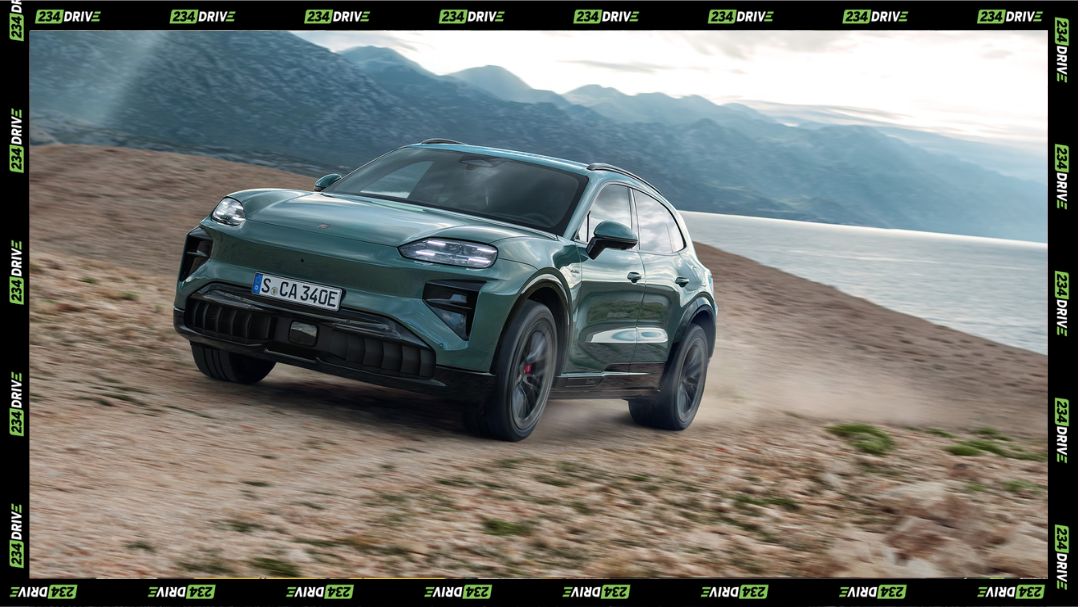
Technical performance is remarkably close to traditional wired AC charging. Porsche claims a grid-to-battery efficiency of over 90%, peaking at 92% under optimal conditions. In practical terms, an 11 kW wireless transfer will fully charge the Cayenne’s massive 113 kWh gross battery in roughly 10 to 11 hours—matching the speed of a standard 11 kW wired wallbox. This transformative solution ensures that owners lose no time by choosing convenience over cables.
The hardware comprises three distinct components. First is the vehicle-side ‘preparation’ required during the initial build. Second is the physical receiver plate mounted behind the front axle. The third, and most visible, is the 50 kg ground pad. This floor plate is a robust, weatherproof ‘one-box’ design, meaning it houses all necessary electronics and connects directly to a standard mains supply, eliminating the need for a separate wall-mounted control unit.
A Seamless User Experience
Porsche has engineered the system to be as frictionless as the driving experience itself. Drivers are guided into position via the Porsche Communication Management (PCM) system, which uses ultra-wideband technology to overlay a target on the 3D Surround View display. Once the vehicle is aligned—with a generous tolerance of up to 10 cm—the driver simply engages the parking brake and the charging process begins automatically.
Safety is governed by sophisticated sensors capable of detecting both foreign objects (such as metallic items) and living objects. If a pet or person enters the magnetic field, the system pauses instantly to prevent any risk of overheating or interference. Furthermore, the magnetic field is tightly contained within the area beneath the vehicle, ensuring electromagnetic emissions remain well below international safety limits.
The Cost of Convenience
As expected with pioneering Porsche technology, the barrier to entry is significant. Total system costs for UK customers are estimated at approximately £6,750. This includes roughly £4,750 for the ground pad and £1,700 for the vehicle-side hardware, with the remainder covering preparation and installation.
When contrasted with the cost of a high-end wired wallbox (typically £800–£1,200), the premium is clear. However, analysis suggests that the upfront hardware cost is the primary financial hurdle rather than electricity losses. For the target demographic of the Cayenne Electric, the investment is not about recouping costs through energy savings; it is an investment in time and the removal of a daily physical chore.
Why It Matters for the Global Market
Porsche’s internal data reveals that roughly 75% of EV charging happens at home. By eliminating the ‘hassle factor’ of cables, Porsche is addressing one of the final psychological barriers to EV adoption in the luxury tier. While the technology is currently exclusive to the Cayenne Electric, it establishes a technological milestone that rivals like BMW, Mercedes-Benz, and even Lucid will be forced to answer.
From an industry perspective, this launch validates inductive charging as a viable, high-power alternative to the status quo. It moves the conversation away from ‘how fast can you charge on a road trip’ to ‘how little do you have to think about charging at home.’ As Porsche scales this technology across the Macan and Taycan lines, we expect to see a ripple effect that eventually drives down hardware costs, potentially bringing wireless charging to more accessible segments of the market by the end of the decade.