
Stand beside any major arterial road in an African city today and you witness the absolute triumph of the modern automobile. From the ubiquitous Toyota sedans navigating Nairobi’s expressways to the heavy-duty logistics trucks keeping Lagos moving, the internal combustion engine is the undisputed king of our mobility ecosystem. We understand how these vehicles shape our current economic reality but tracing their exact origin requires stripping away centuries of refinement to ask a very basic question: which country actually built the first one?
The answer depends entirely on your parameters. If you are looking for the first self-propelled vehicle, you must look to France. However, if you are asking about the first practical, integrated internal-combustion automobile that birthed the modern industry, the global consensus is absolute; Germany is widely credited with making the first true car.
It was engineered by Carl Benz, a mechanical engineer operating in Mannheim within the German Empire. Between 1885 and 1886, Benz did not simply attach a motor to a horse carriage. He designed an entirely new, integrated system that became the undisputed blueprint for the global automotive industry.
The German Standard
To understand why Carl Benz takes the crown, we have to look at what exactly he built. In 1885, Benz completed the prototype of a vehicle powered by a gas engine. It ran under its own power that same year. On 29 January 1886, he applied for Imperial Patent DRP 37435. Historians, engineers and industry analysts universally regard this specific document as the birth certificate of the modern automobile.
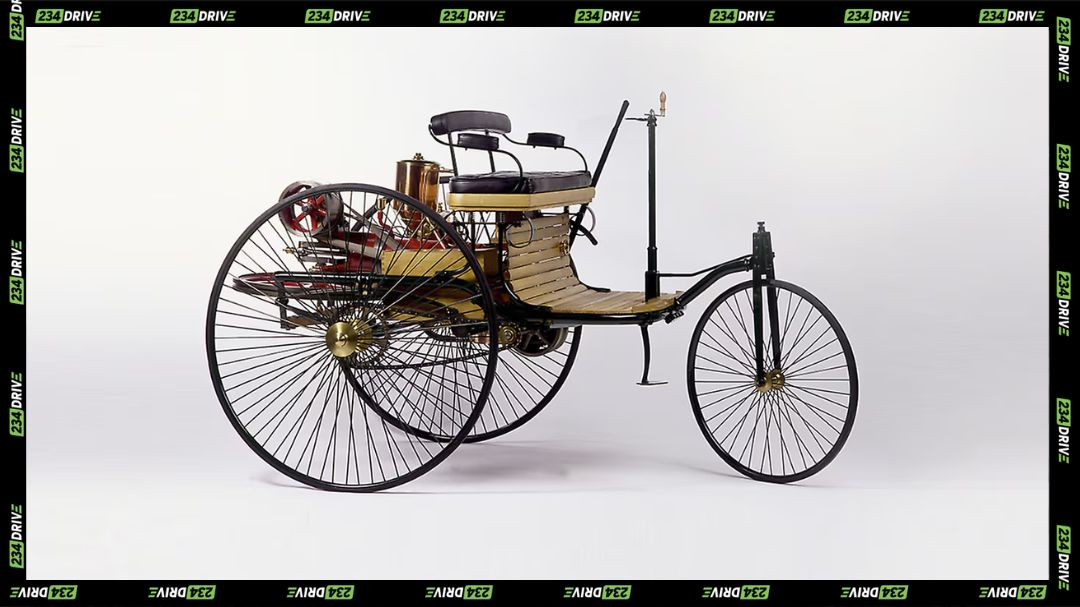
The vehicle that emerged from this patent in January 1886 was a three-wheeled machine. It featured two large rear wheels and one smaller front wheel for steering. Crucially, it was built on a purpose-designed tubular steel chassis. This is the defining factor that separates Benz from his predecessors. Earlier inventors had simply bolted crude engines onto existing wooden carriages. Benz understood that the propulsion system and the chassis had to be engineered as a single, unified entity.
His design featured a rear-mounted, single-cylinder four-stroke internal combustion engine. It utilised electric ignition via a spark plug, water cooling and a differential. It ran on ligroin, a petroleum spirit widely available at the time. By modern standards, the specifications of this early machine are incredibly modest. The engine displaced roughly 954 cubic centimetres and produced a mere 0.75 horsepower at 400 revolutions per minute.
Top speed hovered between 10 and 16 kilometres per hour. There was no steering wheel, only a simple tiller. There were no pedals and the open padded bench offered zero protection from the elements. Yet, it worked. It was reliable enough to be reproduced and sold commercially.
The Ultimate Road Test
While Carl Benz possessed the engineering brilliance to build the Benz Patent-Motorwagen, it was his wife and primary financial backer, Bertha Benz, who proved its commercial viability. In August 1888, frustrated by her husband’s reluctance to market his invention aggressively, Bertha took matters into her own hands.
Without his knowledge, she loaded her two teenage sons into a Model 3 Patent-Motorwagen and embarked on a 106-kilometre journey from Mannheim to her hometown of Pforzheim. This was the world’s first long-distance automobile trip.
The journey was a masterclass in on-the-fly mechanical improvisation. When the fuel line clogged, Bertha cleared it with her hatpin. When an ignition wire short-circuited, she insulated it with her garter. She purchased ligroin from a local pharmacy in Wiesloch, effectively creating the world’s first filling station. When the wooden brakes began to fail on steep descents, she instructed a village cobbler to nail leather strips to the blocks, inadvertently inventing brake linings.
This publicity stunt was a massive success. It generated intense public interest, validated the machine’s reliability and provided Carl Benz with crucial field data that led to the addition of a lower gear for climbing hills. Bertha’s journey proved that the automobile was not just an engineering novelty, but also a practical mobility solution.
The French Precursor
While Germany claims the first practical car, France holds the title for the first self-propelled vehicle. Decades before Benz’s internal combustion engine, the French military was experimenting with steam power.
Between 1769 and 1770, French inventor Nicolas-Joseph Cugnot built a working mechanical land vehicle designed to haul heavy artillery. It was a massive, three-wheeled steam dray. While it successfully moved under its own power, it was highly impractical. The heavy boiler was mounted over the front wheel, making it incredibly difficult to steer. It required frequent stops to rebuild steam pressure and managed a top speed of just over three kilometres per hour.
It was a brilliant experimental machine but it was an evolutionary dead end. Steam power ultimately proved too heavy, too dangerous and too inefficient for personal transport on everyday roads. The modern industry did not evolve from Cugnot’s steam dray. It evolved from liquid petroleum and internal combustion.
Defining the Modern Automobile
History is rarely a clean narrative of solitary geniuses. The invention of the car was a highly evolutionary process involving dozens of engineers working concurrently across Europe. This is why the precise definition of a car matters so much when awarding historical credit.
In Austria, Siegfried Marcus mounted a crude petrol engine on a handcart around 1870. However, his early designs lacked proper steering, brakes or a practical clutch. He did not commercialise his invention and modern historians largely view his work as a non-practical precursor.
Meanwhile, back in Germany, Gottlieb Daimler and Wilhelm Maybach were working independently of Carl Benz just a few towns away. In 1885, they built a motorised bicycle precursor. By 1886, they successfully motorised a carriage with a high-speed petrol engine, creating the first four-wheeled internal-combustion automobile. Their company would eventually merge with Benz’s operation to form the automotive powerhouse we now know as Mercedes-Benz.
What separates Carl Benz from these contemporaries is the complete integration of his design and his success in bringing it to market. Benz & Cie produced a small series of roughly 25 units between 1887 and 1893. They were the first company to actively sell a reproducible automobile to the public.
The Global Shift
Germany lit the spark but the fire quickly spread. By the early 1890s, French companies like Peugeot were building cars using licensed Daimler engines. In 1893, the Duryea brothers built the first successful gasoline cars in America.
The industry rapidly shifted from bespoke European engineering to American mass production. In 1901, the Oldsmobile Curved Dash became the first mass-produced car. By 1908, Henry Ford introduced the Model T and the assembly line, forever changing the economics of mobility and making the automobile accessible to the masses.
When we look back at the expansive history of the automobile, the timeline is dotted with brilliant failures, steam-powered oddities and parallel discoveries. Yet, the lineage of almost every vehicle currently operating on African roads traces back to a single workshop in Mannheim.
Germany built the first car because Carl Benz did not just build a machine. He built a complete, practical system that fundamentally permanently altered how the human race moves.